
Disease in the History of Modern Latin America
From Malaria to AIDS
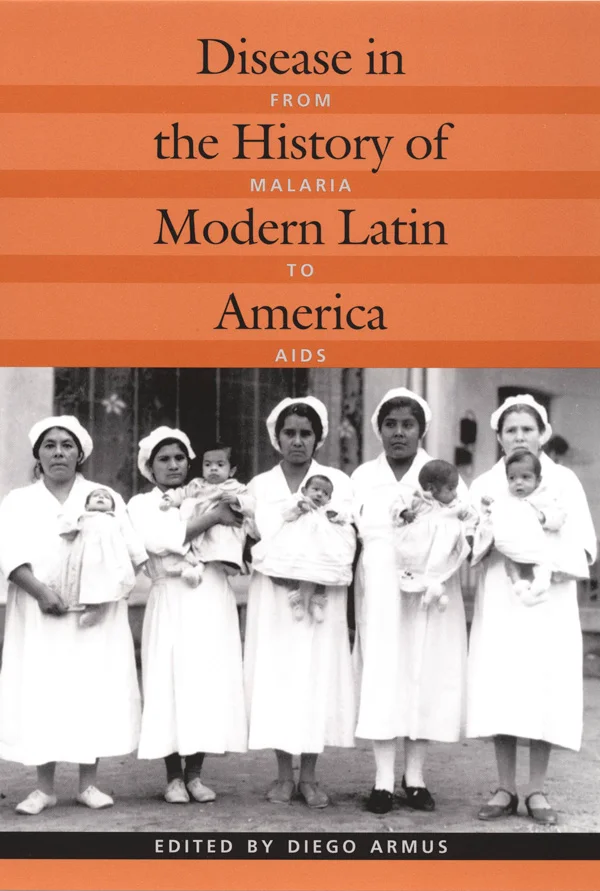
Book
Pages: 336
Illustrations: 29 illus.
Published: March 2003
Editor: Diego Armus
Contributors: Nancy Lews Stepan, Marilia Coutinho, Diana Obregon, Anne-Emanuelle Birn, Katherine Elaine Bliss, Ann S. Blum, Ann Zulawski, Marcos Cueto Caballero, and Patrick Larvie
Subjects
Latin American Studies, History > Latin American History, Medicine and Health > Medical Humanities
Latin American Studies, History > Latin American History, Medicine and Health > Medical Humanities
Praise
Buy
Availability: In stock
Price: $34.95
This title will be released on March 26, 2003
Buy the e-book:
Information
Author/Editor Bios
Back to TopDiego Armus is Assistant Professor of Latin American History at Swarthmore College.
Table Of Contents
Back to Top
Preface vii
Disease in the Historiography of Modern Latin America / Diego Armus 1
“The Only Serious Terror in These Regions”: Malaria Control in the Brazilian Amazon / Nancy Leys Stepan 25
An Imaginary Plague in Turn-of-the-Century Buenos Aires: Hysteria, Discipline, and Languages of the Body / Gabriella Nouzeilles 51
Tropical Medicine in Brazil: The Case of Chagas’ Disease / Marilia Coutinho 76
Tango, Gender, and Tuberculosis in Buenos Aires, 1900–1940 / Diego Armus 101
The State, Physicians. and Leprosy in Modern Colombia / Diana Obregón 130
Revolution, the Scatological Way: The Rockefeller Foundation’s Hookworm Campaign in 1920s Mexico / Anne-Emanuelle Birn 158
Between Risk and Confession: State and Popular Perspectives of Syphilis Infection in Revolutionary Mexico / Katherine Elaine Bliss 183
Dying of Sadness: Hospitalism and Child Welfare in Mexico City, 1920-1940 / Ann S. Blum 209
Mental Illness and Democracy in Bolivia: The Manicomio Pacheco, 1935–1950 / Ann Zulawski 237
Stigma and Blame during an Epidemic: Cholera in Peru, 1991 / Marcus Cueto 268
Nation, Science, and Sex: AIDS and the New Brazilian Sexuality / Patrick Larvie 290
Contributors 315
Index 317
Disease in the Historiography of Modern Latin America / Diego Armus 1
“The Only Serious Terror in These Regions”: Malaria Control in the Brazilian Amazon / Nancy Leys Stepan 25
An Imaginary Plague in Turn-of-the-Century Buenos Aires: Hysteria, Discipline, and Languages of the Body / Gabriella Nouzeilles 51
Tropical Medicine in Brazil: The Case of Chagas’ Disease / Marilia Coutinho 76
Tango, Gender, and Tuberculosis in Buenos Aires, 1900–1940 / Diego Armus 101
The State, Physicians. and Leprosy in Modern Colombia / Diana Obregón 130
Revolution, the Scatological Way: The Rockefeller Foundation’s Hookworm Campaign in 1920s Mexico / Anne-Emanuelle Birn 158
Between Risk and Confession: State and Popular Perspectives of Syphilis Infection in Revolutionary Mexico / Katherine Elaine Bliss 183
Dying of Sadness: Hospitalism and Child Welfare in Mexico City, 1920-1940 / Ann S. Blum 209
Mental Illness and Democracy in Bolivia: The Manicomio Pacheco, 1935–1950 / Ann Zulawski 237
Stigma and Blame during an Epidemic: Cholera in Peru, 1991 / Marcus Cueto 268
Nation, Science, and Sex: AIDS and the New Brazilian Sexuality / Patrick Larvie 290
Contributors 315
Index 317
Rights
Back to TopSales/Territorial Rights: World
Rights and licensingAdditional Information
Back to Top
Paper ISBN:
978-0-8223-3069-1 /
Hardcover ISBN:
978-0-8223-3057-8 /
eISBN:
978-0-8223-8434-2 /
DOI:
https://doi.org/10.1215/9780822384342
Publicity material