
Home / Books / Forensic Media

Forensic Media

Reconstructing Accidents in Accelerated Modernity
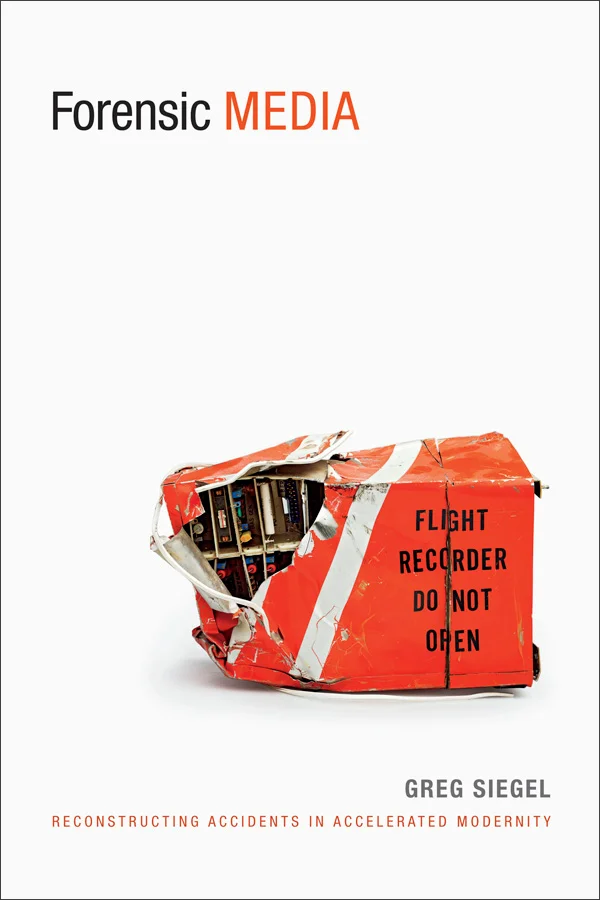
Forensic Media cover image

Sign, Storage, Transmission

More about this series

Book

Pages: 272

Illustrations: 57 illustrations

Published: November 2014

Author: Greg Siegel

In Forensic Media, Greg Siegel considers how photographic, electronic, and digital media have been used to record and reconstruct accidents, particularly high-speed crashes and catastrophes. Focusing in turn on the birth of the field of forensic engineering, Charles Babbage's invention of a "self-registering apparatus" for railroad trains, flight-data and cockpit voice recorders ("black boxes"), the science of automobile crash-testing, and various accident-reconstruction techniques and technologies, Siegel shows how "forensic media" work to transmute disruptive chance occurrences into reassuring narratives of causal succession. Through historical and philosophical analyses, he demonstrates that forensic media are as much technologies of cultural imagination as they are instruments of scientific inscription, as imbued with ideological fantasies as they are compelled by institutional rationales. By rethinking the historical links and cultural relays between accidents and forensics, Siegel sheds new light on the corresponding connections between media, technology, and modernity.

Praise

"An original historical analysis of the intersection of accidents and media, this book resonates with the present climate of terror and risk, bringing a significant historical dimension to our understanding of the contemporary moment. Forensic Media demonstrates how thoroughly the technological accident drives and is driven by parallel developments in modern recording media. By raising crucial questions about the role of the mediated accident in modern debates on causality, evidence, knowledge, and narrative, it makes significant contributions to media archeology and the history of science."
- Karen Beckman, editor of Animating Film Theory

"Forensic Media is an innovative work that contributes substantially to the growing body of research in surveillance studies, risk studies, and design studies as they converge in the history of technology and media studies disciplines. Greg Siegel is an elegant and engaging writer, and this book will satisfy technology historians and film and media studies scholars alike." - Lisa Cartwright, author of Moral Spectatorship: Technologies of Voice and Affect in Postwar Representations of the Child

"Siegel’s thoroughly researched and beautifully written book is essential reading for anyone concerned with how media help us construct and imagine both what has happened in the past and what might happen in the future." - Jaimie Baron, Television & New Media

Buy

Availability: Loading...

Price: Loading...

Request a desk or exam copy

Information

Author/Editor Bios

Back to Top
Greg Siegel is Associate Professor of Film and Media Studies at the University of California, Santa Barbara.

Table Of Contents

Back to Top
Acknowledgments ix
Introduction. Accidents and Forensics 1
1. Engineering Detectives 31
2. Tracings 65
3. Black Boxes 89
4. Tests and Split Seconds 143
Epilogue. Retrospective Prophecies 195
Notes 215
Bibliography 237
Index 251

Rights

Back to Top

Sales/Territorial Rights: World

Rights and licensing

Additional Information

Back to Top
Related Links Paper ISBN: 978-0-8223-5753-7 / Hardcover ISBN: 978-0-8223-5739-1 / eISBN: 978-0-8223-7623-1 / DOI: https://doi.org/10.1215/9780822376231

Publicity material