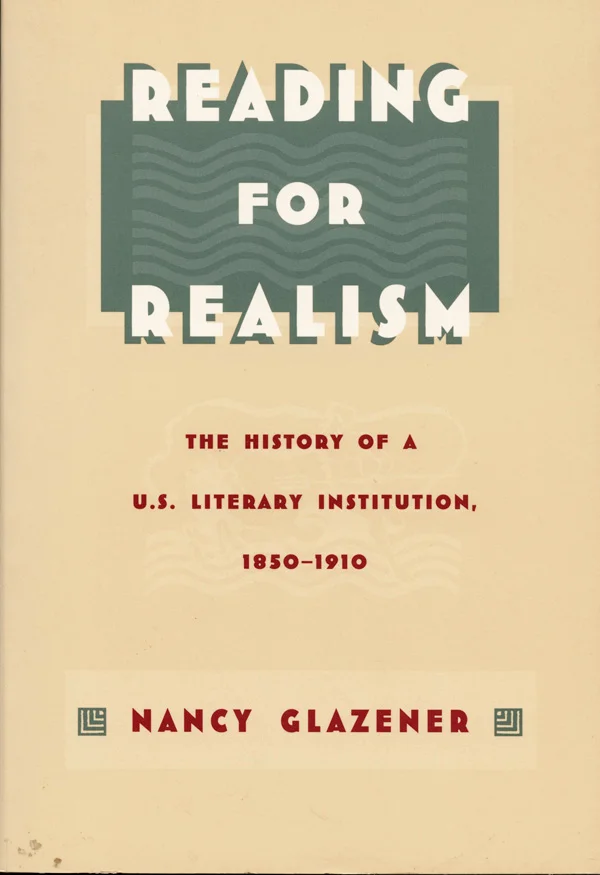
“Reading for Realism is a formidable work. To find a book of comparable range and importance in the field, one must go back thirty years to Jay Martin’s Harvests of Change (1967). That Glazener, like Martin, combines extraordinary erudition with keen analytical powers gives this relatively brief volume a specific intellectual gravity seldom found in books twice its size. That is, scholars will likely be consulting Reading for Realism for years to come; it is certain to be cited and thus accorded the authority it deserves.” - John W. Crowley, Nineteenth-Century Literature
“Reading for Realism is an exemplary form of contemporary cultural studies.” - Lynn Wardley , American Quarterly
“Few scholars produce truly interdisciplinary work as successfully as Nancy Glazener has in this remarkable study. Integrating historical detective work on the American publishing scene of the late nineteenth and early twentieth centuries with careful interpretations of literary works and movements, she constructs and illuminating, complex picture that cannot be achieved without such an American studies approach. . . . Scholars of American studies who seek a model for groundbreaking, interdisciplinary research can do no better than read Reading for Realism.” - David Goldstein-Shirley, American Studies
“There is a growing body of scholarly work investigating journal publication in nineteenth-century America, and Nancy Glazener continues and extends this critical trend in her study of the influence of ‘the Atlantic group". . . . Glazener works hard to excavate the sites of literary authority and to make plain the role of the Atlantic group in their construction; there is much to be learned from her work.” - Janet Beer, Journal of American Studies
“This book will be extremely valuable to students of both literary realism and historical reading practices because of its extensive documentation and insightful analysis of how the Atlantic group influenced the critical attitude toward realism and the ways in which one reads literature.” - , Choice
“This comprehensive, exquisitely argued book introduces an innovative method for studying late-nineteenth-century realism and literary classification more generally. . . . This fascinating discussion is an apt culmination to a literary history that dares to explore the inconsistencies within the genre. Glazener begins by asking how, and in what ways, literary classification became socially useful in the second half of the nineteenth century. The array of answers she develops ensures this book a prominent place in the field.” - Philip Joseph, American Literature
“Reading for Realism is one of the very best books I’ve seen on American literary history, cultural history, and literary theory. It is a welcome and important contribution to the ongoing socio-historical reinvestigation of American literary canons and cultural paradigms. Impressive, well-conceived, and elegantly written, it provides both informative scholarship and stimulating criticism.” - Evan Carton, University of Texas, Austin
“In anatomizing how white, male, upper-class New Englanders succeeded in dominating literary production to naturalize taste for a Realism that proscribed categorical consideration of race, class, and gender, Glazener recovers a crucial chapter of literary history.” - Kathryne Lindberg, Wayne State University