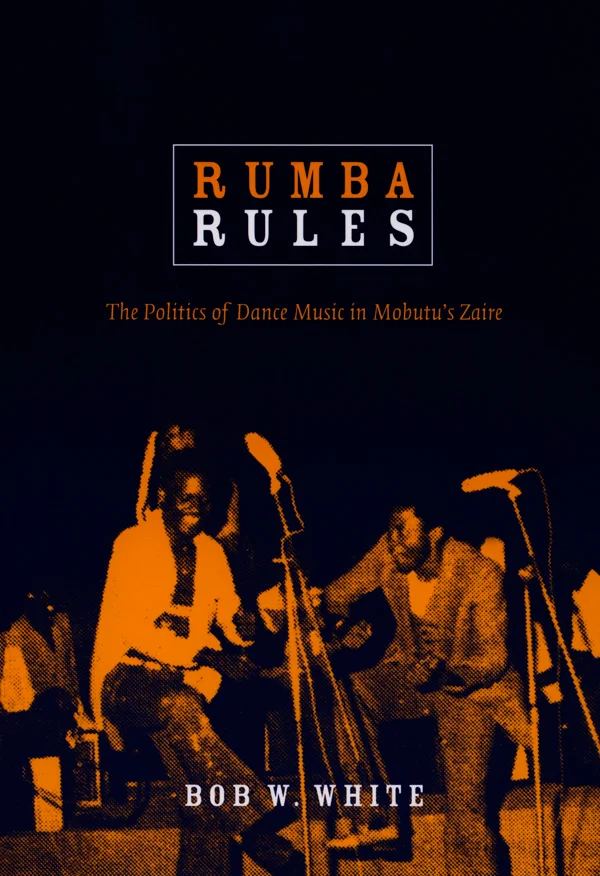
“[R]umba Rules is a text that will be central to the Anthropology of African popular music and contemporary music culture in Kinshasa. . . . This was a book worth reading.” - Mwenda Ntarangwi, Anthropological Quarterly
“[W]hite’s command of the literature and his endearing narrative lends his book a convincing air of authority as it contributes greatly to our understanding of the mutual “contamination” between music and politics.” - Ch. Didier Gondola, African Arts
“Rumba Rules adds to a growing literature on the culture and politics of post-colonial African nations. . . . [An] illuminating study. . . .” - Joe O’Connell, Popular Music
“[White’s] intense focus on a particular epoch in Congolese history in no way detracts from the relevance of his topic to broader implications within Africanist scholarship and within the larger fields of ethnomusicology, cultural studies, and political science. Rather, such a tight focus provides the reader with both a sense of actual events and the ability to extrapolate from those events, based on the theoretical framework which the author provides.” - Aaron L. Rosenberg, African Studies Review
“Although White’s book is about music (the music industry, the activities and lifestyle of musicians, and the audience), the study’s most important contribution is in the realm of politics. . . . Bob White has produced a powerfully insightful study of the dynamic relationship between charismatic leaders and their dependents.” - John Yoder, International Journal of African Historical Studies
“Despite Congolese rumba’s status as the continent’s premiere music, it has been woefully understudied, as White points out. But Rumba Rules does much more than fill a gap in the literature. It builds on and advances the study of popular cultural practices on the African continent. . .” - Marissa J. Moorman, Journal of African History
“If you’re at all doubtful about whether music can illuminate politics, this book is a good place to start. White writes engagingly, with plenty of personal anecdotes and almost no jargon. . . . He confines his theorizing to a few brisk, cogent pages per chapter and omits the name-dropping, leaden quotes that exhaust so many ethnographies. Yet he manages to trace multiple ways in which politics and music intersect, and to deepen our understanding of both the music and the politics.” - Julian Gerstin, PoLAR
“Other books have provided a greater insight into the functioning of musical patronage under Mobutu, but the strength of [Rumba Rules] is that it captures the voice of the musicians themselves.” - Paul Nugent, Annual Bulletin of Historical Literature
“What an enchanting ethnographic study! This book deserves to be widely read. . . . My comments on this book are based on my understanding of its significance in terms of the contribution it makes to debates within the field of cultural anthropology, in particular the anthropology of performance, the anthropological study of music, political anthropology and the anthropology of popular culture. . . . It was indeed a joy to read. Right now I am going to go out to buy a Congolese music CD to dance to!” - Rosita Henry, The Australian Journal of Anthropology
“Rumba Rules is a really exciting book, definitely worthy of the ‘groundbreaking’ and ‘sorely needed’ labels it is bound to attract. It is full of the basics and the nuances; deeply informative about a place, a scene, a local history, and lived realities; and deeply accountable to debates and discussions about how popular culture encodes a feeling of and for modernity.” - Steven Feld, Distinguished Professor of Anthropology and Music, University of New Mexico
“Rumba Rules ties dance music to dictatorship, band leaders to politicians, in ways that are sensitive to the struggles of Congolese musicians and their fans in Kinshasa. Bob W. White neither diminishes the artistry and entertainment value of musical performances nor over-determines their role in political culture. This is a book that finely theorizes the relationship between aesthetics and political culture through vivid and often amusing storytelling.” - Louise Meintjes, author of Sound of Africa! Making Music Zulu in a South African Studio
“What began with an extraordinary feat of immersion into Kinshasa’s music scene toward the end of Mobutu’s regime has been honed and crafted into a study of Congolese popular culture and politics that is bound to become a classic. A feat of ethnography and a much-needed ray of hope in these messy and tragic times.” - Johannes Fabian, author of Memory against Culture: Arguments and Reminders
“Rumba Rules: The Politics of Dance Music in Mobutu’s Zaire by Bob W. White should be a welcome addition to the library of any fan of Congolese music. This book has descriptive passages that give a delicious insight into the everyday workings of a modern Kinshasa orchestre. Furthermore there is some fascinating information and research that helps explain how Congolese music sits within the national culture and everyday social life of the Congolese people. The book can be justifiably described as an essential read for anyone wishing to gain an extended appreciation of the Congo, its politics and its quirky obsession with music.” - Martin Sinnock, Beat
“[A] pioneering study of its subject.” - Ted Smith, Montreal Review of Books
"An important source of information about one of the most celebrated genres of dance music in Africa. Highly recommended.” - Kazadi wa Mukuna, Choice