
Home / Books / Territories of the Soul

Territories of the Soul

Queered Belonging in the Black Diaspora
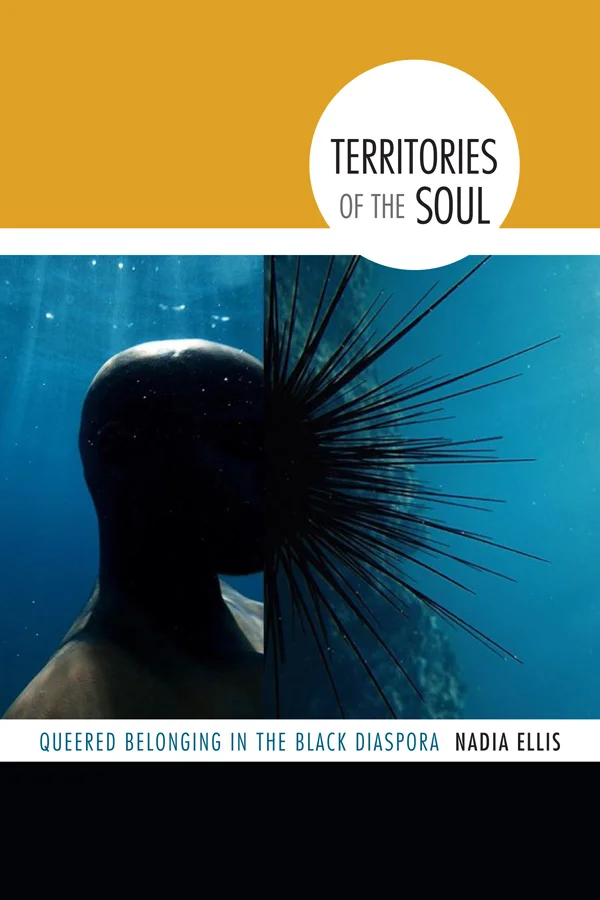
Territories of the Soul cover image

Book

Pages: 256

Illustrations: 5 illustrations

Published: September 2015

Author: Nadia Ellis

Nadia Ellis attends to African diasporic belonging as it comes into being through black expressive culture. Living in the diaspora, Ellis asserts, means existing between claims to land and imaginative flights unmoored from the earth—that is, to live within the territories of the soul. Drawing on the work of Jose Muñoz, Ellis connects queerness' utopian potential with diasporic aesthetics. Occupying the territory of the soul, being neither here nor there, creates in diasporic subjects feelings of loss, desire, and a sensation of a pull from elsewhere. Ellis locates these phenomena in the works of C.L.R. James, the testy encounter between George Lamming and James Baldwin at the 1956 Congress of Negro Artists and Writers in Paris, the elusiveness of the queer diasporic subject in Andrew Salkey's novel Escape to an Autumn Pavement, and the trope of spirit possession in Nathaniel Mackey's writing and Burning Spear's reggae. Ellis' use of queer and affect theory shows how geographies claim diasporic subjects in ways that nationalist or masculinist tropes can never fully capture. Diaspora, Ellis concludes, is best understood as a mode of feeling and belonging, one fundamentally shaped by the experience of loss.

Praise

"Fearlessly following the roving movements of black desire, Nadia Ellis reformulates the classic diasporic tension between 'roots' and 'routes.' In gorgeous prose, she skillfully employs the insights of queer and affect studies to produce original readings of belonging and migration in Black Atlantic literature, music, and art. This is a timely and needed intervention."
- Tavia Nyong'o, author of The Amalgamation Waltz: Race, Performance, and the Ruses of Memory

"Territories of the Soul is a work of such profligate complexity and counter-intuitive imagination that it defies stable definition. It aims, above all, to figure a queer aesthetic of diasporic sensibility that exceeds any simple dialectic of belonging and displacement, sameness and difference. Through its uncanny juxtapositions it challenges us to think against our normative assumptions of the limits and satisfactions of black identification. Nadia Ellis has written a sensuously queer manifesto of diasporic loss and utopia." - David Scott, author of Omens of Adversity: Tragedy, Time, Memory, Justice

"Territories of the Soul offers a powerful reconceptualization of the African diaspora. . . . Ellis presents an important new way of seeing and writing diaspora, one that challenges queer theory and diaspora studies to explore the structural similarities of black diaspora and queer identity." - Leah Rosenberg, African American Review

"Territories of the Soul provides a compelling and interrogative look into black life and black culture and the idea of transcendence through the concept of the imagination and land spatiality in a queered diaspora." - Palimpsest Editorial Collective, Palimpsest

Buy

Availability: In stock

Price: $34.95

Request a desk or exam copy Spring 2026 Web Sale

Information

Author/Editor Bios

Back to Top
Nadia Ellis is Assistant Professor of English at the University of California, Berkeley.

Table Of Contents

Back to Top
Acknowledgments  ix

Introduction. The Queer Elsewhere of Black Diaspora  1

1. The Attachments of C. L. R. James  18

2. The Fraternal Agonies of Baldwin and Lamming  62

3. Andrew Salkey and the Queer Diasporic  95

4. Burning Spear and Nathaniel Mackey at Large  147

Epilogue. Dancehall's Urban Possessions  177

Notes  192

Bibliography  221

Index  233

Rights

Back to Top

Sales/Territorial Rights: World

Rights and licensing

Awards

Back to Top

Honorable Mention, 2015 William Sanders Scarborough Prize, presented by the Modern Language Association

Additional Information

Back to Top
Paper ISBN: 978-0-8223-5928-9 / Hardcover ISBN: 978-0-8223-5915-9 / eISBN: 978-0-8223-7510-4 / DOI: https://doi.org/10.1215/9780822375104

Publicity material