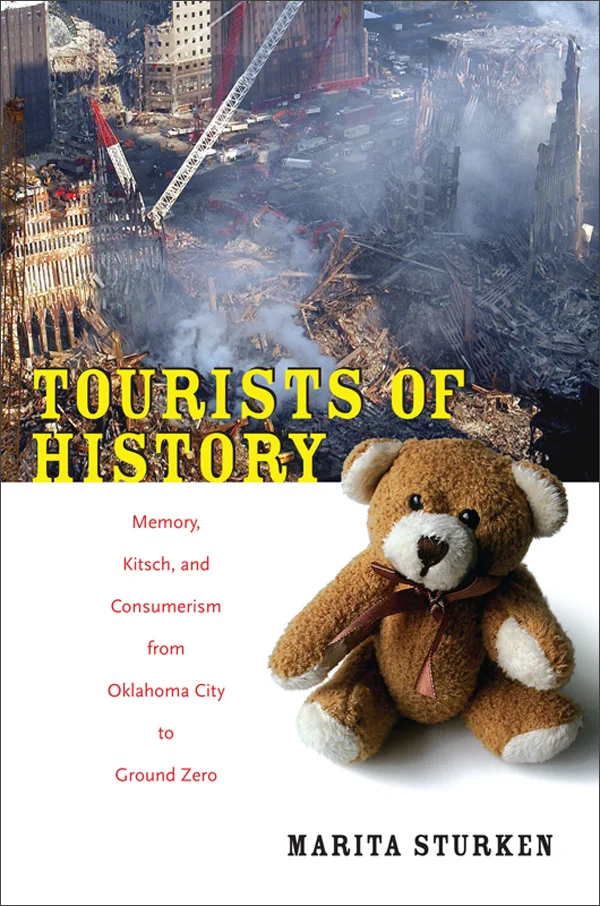
• Tourists of History: Memory, Kitsch, and Consumerism from Oklahoma City to Ground Zero

    Author(s):
    Pages: 360
    Illustrations: 119 illustrations
    Sales/Territorial Rights: World
  • Cloth: $104.95 - In Stock
    978-0-8223-4103-1
  • Paperback: $27.95 - In Stock
    978-0-8223-4122-2
  • Quantity
  • Add To Bag
  • Acknowledgments ix

    Introduction 1

    1. Consuming Fear and Selling Comfort 35

    2. Citizens and Survivors: Cultural Memory and Oklahoma City 93

    3. The Spectacle of Death and the Spectacle of Grief: The Execution of Timothy McVeigh 139

    4. Tourism and “Sacred Ground”: The Space of Ground Zero 165

    5. Architectures of Grief and the Aesthetics of Absence 219

    Conclusion 287

    Notes 295

    Bibliography 319

    Index 333
  • Tourists of History provides insight into memorialization of American history. In particular, Sturken sheds light on the public’s immediate reaction to the two events and how that response influenced subsequent developments, such as the establishment of memorials at both the Oklahoma City bombing site and Ground Zero.”

    “[T]here is some insightful work here—chapter five, ‘Architectures of Grief and the Aesthetics of Absence’ (extending on her contribution to the Understanding September 11 volume), is an especially careful and intriguing analysis, and many of the narratives and relations Sturken critiques and analyzes throughout her book are indeed unhealthy ones. . . .”

    “[T]his book presents an excellent and extensive analysis of the myriad of responses to two of the major national traumas of our time and place. The book will be of interest to those whose research, scholarship, and teachings touch on the many aspects of contemporary American culture.”

    “At a time in US history which is increasingly defined by an obsession with memorialisation, Sturken’s book is a much-needed contribution to the relatively few studies that explore the multifaceted intersection of cultural memory with tourism and marketing on the one hand and kitsch, paranoia and surveillance on the other. . . . Her work is impressive in its theoretical and analytical depth, rich empirical details and astute observations. Most importantly, it is a political project that urges us all to rethink the ways in which terrorism can be understood as a consequence of human conflicts. . .”

    “Drawing the threads between Oklahoma City and Ground Zero and their deeper ties to U.S. history and culture, Sturken illuminates the dangers in being tourists of history.”

    “In Tourists of History, Marita Sturken provides a rich reading of other kitsch artifacts, arguing powerfully for how seemingly mundane acts of consumption articulate to certain politics, and deny the possibility of others. . . . Sturken provides a number of interesting and powerful contributions to a variety of scholarly conversations on memory, trauma, tourism, and public culture. Her clear articulation of the politics of seemingly mundane objects speaks to her ability as a critic, and makes Tourists of History both informative and entertaining.”

    “Marita Sturken’s Tourists of History is essential reading for cultural studies scholars interested in the aesthetic and rhetorical dimensions of public memory. . . . [The book is] particularly well suited to elucidate the surfaces and excavate the depths of what might otherwise be discarded in the proverbial dustbin of history.”

    “People with interests in material culture, cultural memory, the pedagogy of memory, architecture, monuments, tourism and kitsch will find this an engaging and delightful read.”

    “Readers will be fascinated by the social and political commentary buried in Sturken's appraisal of kitsch. A thought-provoking work; highly recommended.”

    “Sturken is at her best making connections among the varied strands of American popular culture and mass media. . . . Sturken's analysis of contemporary consumer culture is stimulating. . . .”

    “Sturken shows how the complex interrelationship of fear and safety ultimately defines contemporary American culture and provides momentum for an episteme in which a terrorist threat is always imminent. Her book is original and powerfully insightful, and comes strongly recommended to readers of cultural studies and public history.”

    “Sturken’s account will unsettle readers and keep people thinking long after they have finished her book.”

    “Sturken’s insight, and her ability to make the theories she uses to ground that insight accessible to readers, makes Tourists of History a useful source for anyone interested in the consequences of certain kinds of consumerism and contemporary culture.”

    “While she argues for the importance of remembering the tragic loss of lives in Oklahoma City, Washington, Shanksville, and New York City, Sturken urges attention be paid to a dangerous confluence of memory, tourism, consumerism, paranoia, security, and kitsch that promulgates fear in order to sell safety, offers prepackaged emotion at the expense of critical thought, contains alternative politics not always seen until after the fact, and facilitates public acquiescence in the federal government's repressive measures at home and its aggressive political and military policies abroad.”

    Reviews

  • Tourists of History provides insight into memorialization of American history. In particular, Sturken sheds light on the public’s immediate reaction to the two events and how that response influenced subsequent developments, such as the establishment of memorials at both the Oklahoma City bombing site and Ground Zero.”

    “[T]here is some insightful work here—chapter five, ‘Architectures of Grief and the Aesthetics of Absence’ (extending on her contribution to the Understanding September 11 volume), is an especially careful and intriguing analysis, and many of the narratives and relations Sturken critiques and analyzes throughout her book are indeed unhealthy ones. . . .”

    “[T]his book presents an excellent and extensive analysis of the myriad of responses to two of the major national traumas of our time and place. The book will be of interest to those whose research, scholarship, and teachings touch on the many aspects of contemporary American culture.”

    “At a time in US history which is increasingly defined by an obsession with memorialisation, Sturken’s book is a much-needed contribution to the relatively few studies that explore the multifaceted intersection of cultural memory with tourism and marketing on the one hand and kitsch, paranoia and surveillance on the other. . . . Her work is impressive in its theoretical and analytical depth, rich empirical details and astute observations. Most importantly, it is a political project that urges us all to rethink the ways in which terrorism can be understood as a consequence of human conflicts. . .”

    “Drawing the threads between Oklahoma City and Ground Zero and their deeper ties to U.S. history and culture, Sturken illuminates the dangers in being tourists of history.”

    “In Tourists of History, Marita Sturken provides a rich reading of other kitsch artifacts, arguing powerfully for how seemingly mundane acts of consumption articulate to certain politics, and deny the possibility of others. . . . Sturken provides a number of interesting and powerful contributions to a variety of scholarly conversations on memory, trauma, tourism, and public culture. Her clear articulation of the politics of seemingly mundane objects speaks to her ability as a critic, and makes Tourists of History both informative and entertaining.”

    “Marita Sturken’s Tourists of History is essential reading for cultural studies scholars interested in the aesthetic and rhetorical dimensions of public memory. . . . [The book is] particularly well suited to elucidate the surfaces and excavate the depths of what might otherwise be discarded in the proverbial dustbin of history.”

    “People with interests in material culture, cultural memory, the pedagogy of memory, architecture, monuments, tourism and kitsch will find this an engaging and delightful read.”

    “Readers will be fascinated by the social and political commentary buried in Sturken's appraisal of kitsch. A thought-provoking work; highly recommended.”

    “Sturken is at her best making connections among the varied strands of American popular culture and mass media. . . . Sturken's analysis of contemporary consumer culture is stimulating. . . .”

    “Sturken shows how the complex interrelationship of fear and safety ultimately defines contemporary American culture and provides momentum for an episteme in which a terrorist threat is always imminent. Her book is original and powerfully insightful, and comes strongly recommended to readers of cultural studies and public history.”

    “Sturken’s account will unsettle readers and keep people thinking long after they have finished her book.”

    “Sturken’s insight, and her ability to make the theories she uses to ground that insight accessible to readers, makes Tourists of History a useful source for anyone interested in the consequences of certain kinds of consumerism and contemporary culture.”

    “While she argues for the importance of remembering the tragic loss of lives in Oklahoma City, Washington, Shanksville, and New York City, Sturken urges attention be paid to a dangerous confluence of memory, tourism, consumerism, paranoia, security, and kitsch that promulgates fear in order to sell safety, offers prepackaged emotion at the expense of critical thought, contains alternative politics not always seen until after the fact, and facilitates public acquiescence in the federal government's repressive measures at home and its aggressive political and military policies abroad.”

  • Tourists of History is a fearless guide through the paranoid landscape of contemporary American culture. Marita Sturken brilliantly maps the ways consumerism and tourism offer avenues of comfort in a threatening world at the same time that they become politically disabling. From the responses to the Oklahoma City bombing to the memorials to the Twin Towers, Sturken shows how the American way of mourning and remembering the dead shores up a conviction in a timeless sense of national innocence. This exceptionally timely book reaches deep into the past and will continue to resonate in the future.” — Amy Kaplan, author of, The Anarchy of Empire in the Making of U.S. Culture

    Tourists of History is a great read: well written, accessible on numerous levels, and driven by a persuasive argument that links tourism, consumerism, and Americans’ understandings of themselves and their history.” — Erika Doss, author of, Spirit Poles and Flying Pigs: Public Art and Cultural Democracy in American Communities

  • Permission to Photocopy (coursepacks)

    If you are requesting permission to photocopy material for classroom use, please contact the Copyright Clearance Center at copyright.com;

    If the Copyright Clearance Center cannot grant permission, you may request permission from our Copyrights & Permissions Manager (use Contact Information listed below).

    Permission to Reprint

    If you are requesting permission to reprint DUP material (journal or book selection) in another book or in any other format, contact our Copyrights & Permissions Manager (use Contact Information listed below).

    Images/Art

    Many images/art used in material copyrighted by Duke University Press are controlled, not by the Press, but by the owner of the image. Please check the credit line adjacent to the illustration, as well as the front and back matter of the book for a list of credits. You must obtain permission directly from the owner of the image. Occasionally, Duke University Press controls the rights to maps or other drawings. Please direct permission requests for these images to permissions@dukeupress.edu.
    For book covers to accompany reviews, please contact the publicity department.

    Subsidiary Rights/Foreign Translations

    If you're interested in a Duke University Press book for subsidiary rights/translations, please contact permissions@dukeupress.edu. Include the book title/author, rights sought, and estimated print run.

    Disability Requests

    Instructions for requesting an electronic text on behalf of a student with disabilities are available here.

    Rights & Permissions Contact Information

    Email: permissions@dukeupress.edu
    Email contact for coursepacks: asstpermissions@dukeupress.edu
    Fax: 919-688-4574
    Mail:
    Duke University Press
    Rights and Permissions
    905 W. Main Street
    Suite 18B
    Durham, NC 27701

    For all requests please include:
    1. Author's name. If book has an editor that is different from the article author, include editor's name also.
    2. Title of the journal article or book chapter and title of journal or title of book
    3. Page numbers (if excerpting, provide specifics)
    For coursepacks, please also note: The number of copies requested, the school and professor requesting
    For reprints and subsidiary rights, please also note: Your volume title, publication date, publisher, print run, page count, rights sought
  • Description

    In Tourists of History, the cultural critic Marita Sturken argues that over the past two decades, Americans have responded to national trauma through consumerism, kitsch sentiment, and tourist practices in ways that reveal a tenacious investment in the idea of America’s innocence. Sturken investigates the consumerism that followed from the September 11th attacks; the contentious, ongoing debates about memorials and celebrity-architect designed buildings at Ground Zero; and two outcomes of the bombing of the Alfred P. Murrah Federal Building in Oklahoma City: the Oklahoma City National Memorial and the execution of Timothy McVeigh.

    Sturken contends that a consumer culture of comfort objects such as World Trade Center snow globes, FDNY teddy bears, and Oklahoma City Memorial t-shirts and branded water, as well as reenactments of traumatic events in memorial and architectural designs, enables a national tendency to see U.S. culture as distant from both history and world politics. A kitsch comfort culture contributes to a “tourist” relationship to history: Americans can feel good about visiting and buying souvenirs at sites of national mourning without having to engage with the economic, social, and political causes of the violent events. While arguing for the importance of remembering tragic losses of life, Sturken is urging attention to a dangerous confluence—of memory, tourism, consumerism, paranoia, security, and kitsch—that promulgates fear to sell safety, offers prepackaged emotion at the expense of critical thought, contains alternative politics, and facilitates public acquiescence in the federal government’s repressive measures at home and its aggressive political and military policies abroad.

    About The Author(s)

    Marita Sturken is a professor of culture and communication at New York University. She is the author of Tangled Memories: The Vietnam War, the AIDS Epidemic, and the Politics of Remembering and a coauthor of Practices of Looking: An Introduction to Visual Culture.

Explore More
Share

Create a reading list or add to an existing list. Sign-in or register now to continue.


Contact Us

  • Duke University Press
  • 905 W. Main St. Ste 18-B
  • Durham, NC 27701
  • U.S. phone (toll-free): 888-651-0122
  • International: 1-919-688-5134
  • orders@dukeupress.edu