
Home / Books / A Fictional Commons

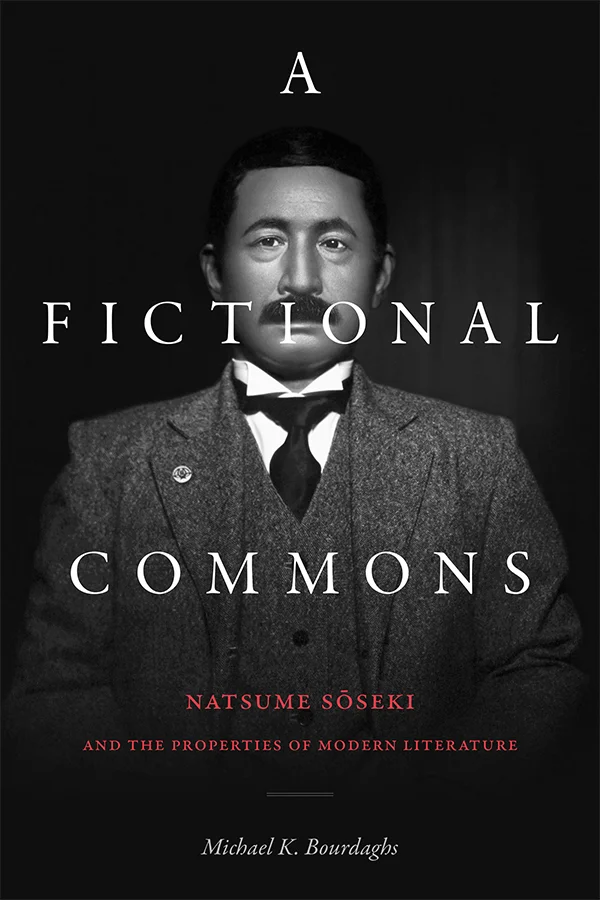
A Fictional Commons

Natsume Soseki and the Properties of Modern Literature
Book

Pages: 240

Illustrations: 2 illustrations

Published: September 2021

Modernity arrived in Japan, as elsewhere, through new forms of ownership. In A Fictional Commons, Michael K. Bourdaghs explores how the literary and theoretical works of Natsume Sōseki (1867–1916), widely celebrated as Japan's greatest modern novelist, exploited the contradictions and ambiguities that haunted this new system. Many of his works feature narratives about inheritance, thievery, and the struggle to obtain or preserve material wealth while also imagining alternative ways of owning and sharing. For Sōseki, literature was a means for thinking through—and beyond—private property. Bourdaghs puts Sōseki into dialogue with thinkers from his own era (including William James and Mizuno Rentarō, author of Japan’s first copyright law) and discusses how his work anticipates such theorists as Karatani Kōjin and Franco Moretti. As Bourdaghs shows, Sōseki both appropriated and rejected concepts of ownership and subjectivity in ways that theorized literature as a critical response to the emergence of global capitalism.

Praise

“Michael K. Bourdaghs's A Fictional Commons provides a strikingly new approach to thinking about the fiction and theories of Natsume Soseki as well as for thinking how literature as a practice gestures to something beyond the modern regime of private property. Literature, Bourdaghs demonstrates, is one of the sites where we imagine the return in a higher dimension of the commons, the gift, and primitive communism.” - Karatani Kojin, author of Isonomia and the Origins of Philosophy

“Both erudite and innovative, A Fictional Commons brilliantly demonstrates how Natsume Soseki, through his fiction and criticism, explored literature as a domain for imagining the alternatives to modern private property regime and the related conceptualization of modern personhood. It is a major contribution to Soseki studies and modern Japanese literary studies. It also joins broader debates over the value of literature in the twenty-first century—how literature may inspire creative modes of sharing that traverse national, regional, and other boundaries dividing our troubled present.” - Tomiko Yoda, Takashima Professor of Japanese Humanities, Harvard University

"As more and more people question the extremes of capitalism, Bourdaghs’ study of Soseki adds a fascinating lens for further examining other works of literature. . . . In A Fictional Commons, Bourdaghs reveals Soseki’s sharp mind, ever wrestling with the most important sociological issue of his time. Through this book, Bourdagh also reminds us that the role of literature is to rethink what is possible — and thereby literally rewrite the world." - Kris Kosaka, Japan Times

“[Bourdaghs] makes extensive use of Japanese and Western sources, both primary and secondary, drawing seamlessly on work in multiple languages. [A Fictional Commons] is extensively referenced and comes with an exhaustive list of bibliographic studies . . . which will be of immense help to both students and scholars interested in Soseki, and in Meiji- and Taisho-era Japanese literature more broadly.” - Gouranga Charan Pradhan, Japan Review

“Bourdaghs’s exploration of the question of property for Soseki is broad, trenchant, and productive, and it drew connections for me that I would not have otherwise imagined.” - Edward Mack, Journal of Japanese Studies

"This book is a gift from a Soseki-philiac to a reading commons brought to life by a singular novelist. Let A Fictional Commons not be an epitaph for the tried-and-true-but-threatened art of intense literary engagement with complex texts set within their entangling contexts." - Alan Tansman, Harvard Journal of Asiatic Studies

Buy

Availability: Loading...

Price: Loading...

Request a desk or exam copy

Information

Author/Editor Bios

Back to Top
Michael K. Bourdaghs is Robert S. Ingersoll Professor of East Asian Languages and Civilizations at the University of Chicago, coeditor of Sound Alignments: Popular Music in Asia's Cold Wars, also published by Duke University Press, and author of Sayonara Amerika, Sayonara Nippon: A Geopolitical Prehistory of J-Pop.

Table Of Contents

Back to Top
Note on Usage  ix
Acknowledgments  xi
Introduction. Owning up to Sōseki  1
1. Fables of Property: Nameless Cats, Trickster Badgers, Stray Sheep  13
2. House under a Shadow: Disowning the Psychology of Possessive Individualism in The Gate  51
3. Property and Sociological Knowledge: Sōseki and the Gift of Narrative  91
4. The Tragedy of the Market:Younger Brothers, Women, and Colonial Subjects in Kokoro  121
Conclusion. Who Owns Sōseki? Or, How Not to Belong in World Literature  147
Notes  177
Bibliography  205
Index  219

Rights

Back to Top

Sales/Territorial Rights: World

Rights and licensing

Awards

Back to Top

Honorable Mention, 2023 John Whitney Hall Prize, presented by the Association for Asian Studies

Additional Information

Back to Top
Related Links Paper ISBN: 978-1-4780-1462-1 / Hardcover ISBN: 978-1-4780-1369-3 / eISBN: 978-1-4780-2192-6 / DOI: https://doi.org/10.1215/9781478021926