
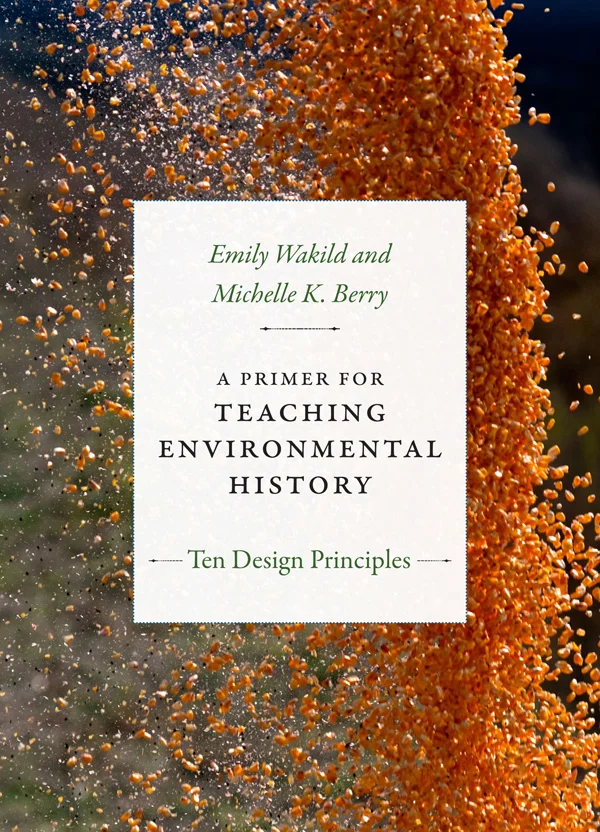
A Primer for Teaching Environmental History
Ten Design Principles
Buy
Availability: Loading...
Price: Loading...
This title will be released on May 11, 2018
Buy the e-book:
Information
Author/Editor Bios
Back to TopEmily Wakild is Professor of History at Boise State University and the author of Revolutionary Parks: Conservation, Social Justice, and Mexico's National Parks, 1910–1940.
Michelle K. Berry is Lecturer in the Departments of History and Gender and Women's Studies at the University of Arizona.
Michelle K. Berry is Lecturer in the Departments of History and Gender and Women's Studies at the University of Arizona.
Table Of Contents
Back to TopPreface: How to Make Use of This Book ix
Acknowledgments xiii
Introduction 1
Part I. Approaches
1. The Fruit: Into Their Lunch Bags to Teach Relevance and Globalization with Food 13
2. The Seed: Using Learning Objectives to Build a Course 27
3. The Hatchet: Wielding Critique to Reconsider Periodization and Place 39
4. The Llama: Recruiting Animals to Blend Nature and Culture 53
Part II. Pathways
5. The Fields: Science and Going Outside 71
6. The Land: Sense of Place, Recognition of Spirit 85
7. The Power: Energy and Water Regimes 99
Part III. Applications
8. The People: Environmental Justice, Slow Violence, and Project-Based Learning 115
9. The Tools: Using Technology to Enhance Environmental History 131
10. The Test: Assessment Methods, Rubrics, and Writing 141
Epilogue 151
Notes 153
Bibliography 163
Index 177
Acknowledgments xiii
Introduction 1
Part I. Approaches
1. The Fruit: Into Their Lunch Bags to Teach Relevance and Globalization with Food 13
2. The Seed: Using Learning Objectives to Build a Course 27
3. The Hatchet: Wielding Critique to Reconsider Periodization and Place 39
4. The Llama: Recruiting Animals to Blend Nature and Culture 53
Part II. Pathways
5. The Fields: Science and Going Outside 71
6. The Land: Sense of Place, Recognition of Spirit 85
7. The Power: Energy and Water Regimes 99
Part III. Applications
8. The People: Environmental Justice, Slow Violence, and Project-Based Learning 115
9. The Tools: Using Technology to Enhance Environmental History 131
10. The Test: Assessment Methods, Rubrics, and Writing 141
Epilogue 151
Notes 153
Bibliography 163
Index 177
Rights
Back to TopSales/Territorial Rights: World
Rights and licensingAdditional Information
Back to Top
Related Links
Paper ISBN:
978-0-8223-7148-9 /
Hardcover ISBN:
978-0-8223-7137-3 /
eISBN:
978-0-8223-7159-5 /
DOI:
https://doi.org/10.1215/9780822371595
Publicity material