
Home / Books / A Social Laboratory for Modern France

A Social Laboratory for Modern France

The Musée Social and the Rise of the Welfare State
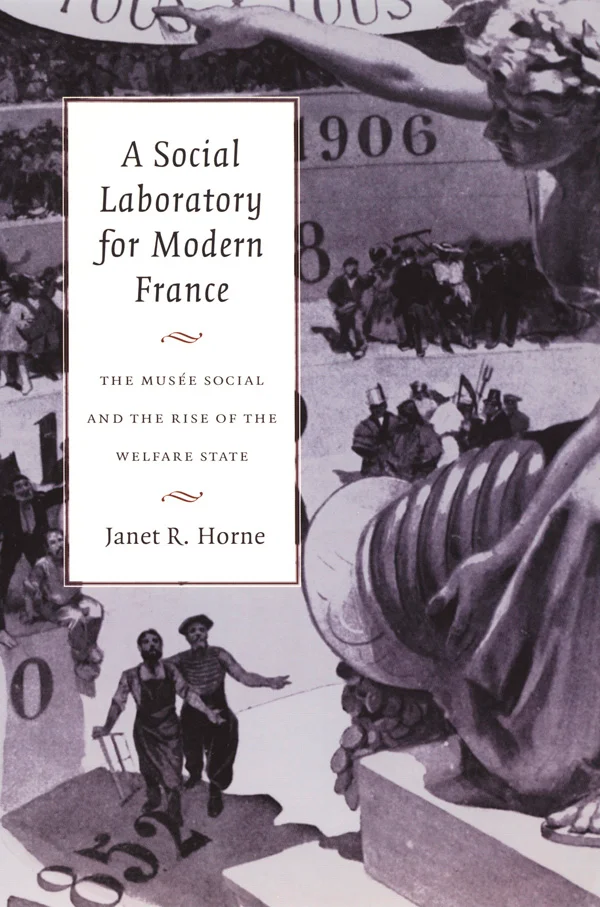
A Social Laboratory for Modern France cover image

Book

Pages: 344

Illustrations: 15 b&w photos, 2 tables

Published: January 2002

Author: Janet R. Horne

As a nineteenth-century think tank that sought answers to France’s pressing “social question,” the Musée Social reached across political lines to forge a reformist alliance founded on an optimistic faith in social science. In A Social Laboratory for Modern France Janet R. Horne presents the story of this institution, offering a nuanced explanation of how, despite centuries of deep ideological division, the French came to agree on the basic premises of their welfare state.
Horne explains how Musée founders believed—and convinced others to believe—that the Third Republic would carry out the social mission of the French Revolution and create a new social contract for modern France, one based on the rights of citizenship and that assumed collective responsibility for the victims of social change. Challenging the persistent notion of the Third Republic as the stagnant backwater of European social reform, Horne instead depicts the intellectually sophisticated and progressive political culture of a generation that laid the groundwork for the rise of a hybrid welfare system, characterized by a partnership between private agencies and government. With a focus on the cultural origins of turn-of-the-century thought—including religion, republicanism, liberalism, solidarism, and early sociology—A Social Laboratory for Modern France demonstrates how French reformers grappled with social problems that are still of the utmost relevance today and how they initiated a process that gave the welfare state the task of achieving social cohesion within an industrializing republic.

Praise

“Janet Horne’s book provides not only an excellent history of the Musée Social but also an important new perspective on the activities of turn-of-the-twentieth-century reform networks. It demonstrates that the Musée Social constituted a unique French institution, free from Jacobin, centralizing pressures,where experts, intellectuals, and administrators could interact among themselves. Her work reveals the misunderstood but essential role played by independent reformers in the modernization of France.” - Pierre Rosanvallon, directeur d'études à l'Ecole des hautes études en sciences sociales

“This book is far more than the history of a single institution. It is also a thoughtful examination of political ideology and social discourse in the nineteenth and early twentieth centuries, and an important and convincing argument about the origins of social policy in the Third Republic.” - Don Reid, University of North Carolina at Chapel Hill

Buy

Availability: Loading...

Price: Loading...

Request a desk or exam copy Spring 2026 Web Sale

Information

Author/Editor Bios

Back to Top

Janet R. Horne is Associate Professor of French at the University of Virginia.

Table Of Contents

Back to Top
Acknowledgments

Introduction

Part One. Rhetoric of Reform


1. The Modern Sphinx: Debating the Social Question in Nineteenth-

Century France


2. Inventing a Social Museum


Part Two. Networking for Reform


3. A Genealogy of Republican Reform


4. A Laboratory for Social Reform


Part Three. Implementing Reform


5. Voluntary Associations and the Republican Ideal


6. The Modernity of Hygiene: Interventions in the City


Conclusion

Notes

Bibliography

Index

Rights

Back to Top

Sales/Territorial Rights: World

Rights and licensing

Additional Information

Back to Top
Paper ISBN: 978-0-8223-2792-9 / Hardcover ISBN: 978-0-8223-2782-0 / eISBN: 978-0-8223-8324-6 / DOI: https://doi.org/10.1215/9780822383246

Publicity material