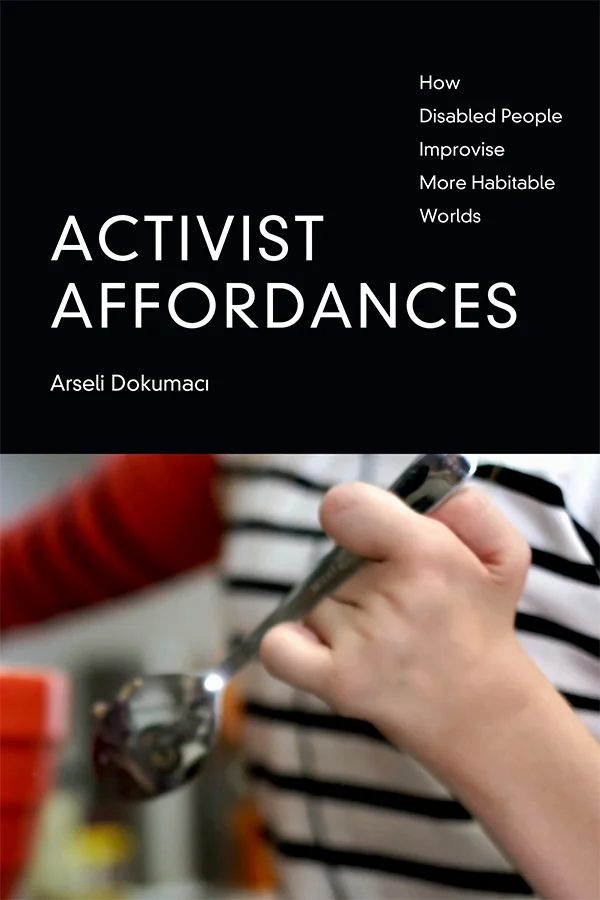
“In this exciting work Arseli Dokumaci offers compelling ethnographic interviews, journal entries, and her own experiences of difficulties with rheumatoid arthritis. Her accounts of the lives of her interlocutors are rich and evocative and form the basis for her idea of activist affordances: the everyday hacks that allow disabled people to manage the simplest of daily activities as they face a diminishing world of possible action and imaginaries. Addressing what it means to live with bodily challenges, Activist Affordances is critical disability studies at its intersectional best.” - Faye Ginsburg, David B. Kriser Professor of Anthropology, New York University
“Arseli Dokumaci reveals how people living with illnesses and disabilities navigate an inaccessible and ableist world by identifying the creativity, innovation, and resilience that goes into such navigation. Refusing the still-too-common notion that knowledge about disability is the province of medical experts rather than disabled people themselves, she brilliantly theorizes the accumulation of skills, negotiations, and hacks that disabled people discover to make their way in this world. And in this way, Dokumaci persuasively argues, they help concretize more accessible and just worlds.” - Alison Kafer, author of Feminist, Queer, Crip
"This book strikes a balance between academic rigor (i.e., theory) and practical relevance (i.e., practice). Readers will appreciate that many of the hacks discussed also come with pictures to help readers visualize the affordances. The book draws on a range of disciplines, including disability studies, anthropology, and design, to provide a comprehensive understanding of the complexities of disability activism. Recommended. Advanced undergraduates through faculty; professionals."
- G. Colosi, Choice
"Activist Affordances attunes readers to individual, everyday acts that could teach us how to create more habitable futures. Such a perspective opens new spaces for scholarly and political debates on activism, disability, and the preservation of the planet."
- Kostadin Karavasilev,
LSE Review of Books
“[A] generative, thought provoking text … it will be exciting to follow how readers ‘make up, make real, and make do with’ this book’s innovative contributions.”
- Christine Sargent,
American Ethnologist
"Arseli Dokumaci has written a powerfully useful book. . . . Dokumaci’s scholarship is relevant not just to anthropology but to many other fields, including performance studies, occupational therapy, movement science, rehabilitation research, disability studies, and sustainability studies. I expect this work to make a lasting and even translational impact, providing us with needed strategies to understand and navigate troubling times." - Pamela Block, Journal of Anthropological Research
"Dokumaci identifies a liminal space between advocating for greater supports for disabled and chronically ill people and pinpointing moments of performance where disabled people have created their own accessibility out of whatever has been made available within the physical environment." - Efrat Gold, Theatre Research in Canda
"Activist Affordances is a widely applicable piece of scholarly literature that offers strategies for survival in our increasingly precarious world." - Emalee Crews, Lateral
"Drama therapists can benefit from Activist Affordances as a tool to recognize and celebrate what practices their clients may already apply in enacting their basic care needs and thinks through strategies for how these practices can be creatively represented." - Rachel Boyd, Drama Therapy Review