
Affective Justice
The International Criminal Court and the Pan-Africanist Pushback
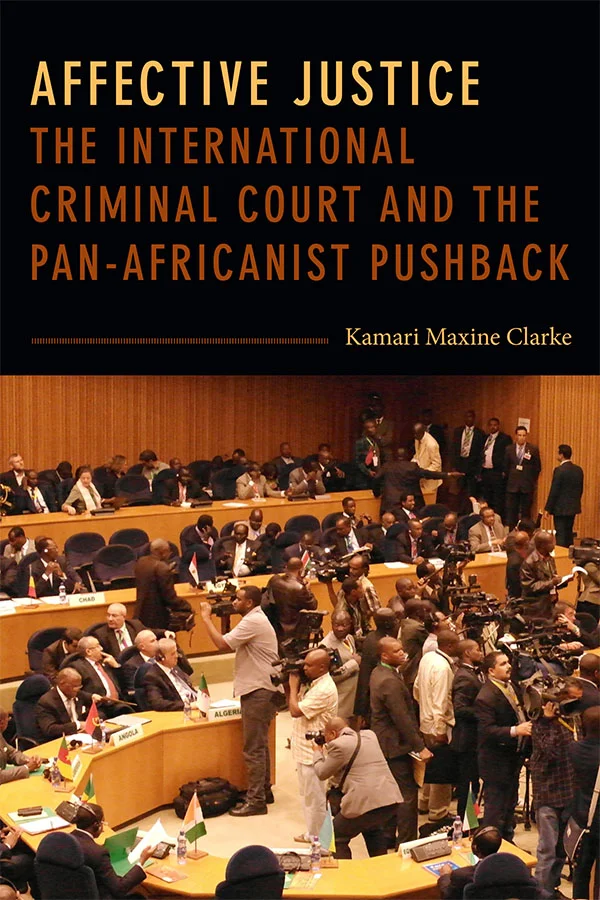
Book
Pages: 384
Illustrations: 7 illustrations
Published: November 2019
Author: Kamari Maxine Clarke
Praise
Buy
Availability: In stock
Price: $39.95
This title will be released on November 15, 2019
Buy the e-book:
Open Access
Funding information for the OA format is found at the bottom of the page.
Information
Author/Editor Bios
Back to Top
Kamari Maxine Clarke is Professor of Anthropology at the University of California, Los Angeles, and the author of Mapping Yorùbá Networks: Power and Agency in the Making of Transnational Communities, also published by Duke University Press, and Fictions of Justice: The International Criminal Court and the Challenge of Legal Pluralism in Sub-Saharan Africa.
Table Of Contents
Back to TopAcknowledgments ix
Preface. Assemblages of Interconnection xvii
Introduction. Formation, Dislocations, and Unravelings 1
Part I. Component Parks of the International Criminal Law Assemblage 47
1. Genealogies of Anti-impunity: Encapsulating Victims and Perpetrators 49
2. Founding Moments? Shaping Publics through Sentimental Narratives 91
3. Biomediation and the #BringBackOurGirls Campaign: Making Suffering Visible 116
4. From "Perpetrator" to Hero: Renarrating Culpability through Reattribution 140
Part II. Affects, Emotional Regimes, and the Reattribution of International Law 175
5. Reattribution through the Making of an African Criminal Court 177
6. Reattributing the Irrelevance of the Official Capacity Movement as an Affective Practice 217
Epilogue. Toward an Anthropology of International Justice 257
Notes 267
Bibliography 309
Index 337
Preface. Assemblages of Interconnection xvii
Introduction. Formation, Dislocations, and Unravelings 1
Part I. Component Parks of the International Criminal Law Assemblage 47
1. Genealogies of Anti-impunity: Encapsulating Victims and Perpetrators 49
2. Founding Moments? Shaping Publics through Sentimental Narratives 91
3. Biomediation and the #BringBackOurGirls Campaign: Making Suffering Visible 116
4. From "Perpetrator" to Hero: Renarrating Culpability through Reattribution 140
Part II. Affects, Emotional Regimes, and the Reattribution of International Law 175
5. Reattribution through the Making of an African Criminal Court 177
6. Reattributing the Irrelevance of the Official Capacity Movement as an Affective Practice 217
Epilogue. Toward an Anthropology of International Justice 257
Notes 267
Bibliography 309
Index 337
Rights
Back to TopSales/Territorial Rights: World
Rights and licensingAwards
Back to TopFinalist, 2020 Elliott P. Skinner Book Award, presented by the Association for Africanist Anthropology
Winner, Amaury Talbot Prize for African Anthropology, presented by the Royal Anthropological Institute (UK)
Additional Information
Back to Top
Related Links
- Kamari Clarke's Website
- Read an interview with Kamari Maxine Clarke on Black Agenda Report
- Read an interview with Kamari Maxine Clarke on PoLAR
Publicity material
Funding Information
Back to Top
This book is freely available in an open access edition thanks to TOME (Toward an Open Monograph Ecosystem)—a collaboration of the Association of American Universities, the Association of University Presses, and the Association of Research Libraries—and the generous support of Arcadia, a charitable fund of Lisbet Rausing and Peter Baldwin, and the UCLA Library. Learn more at the TOME website.