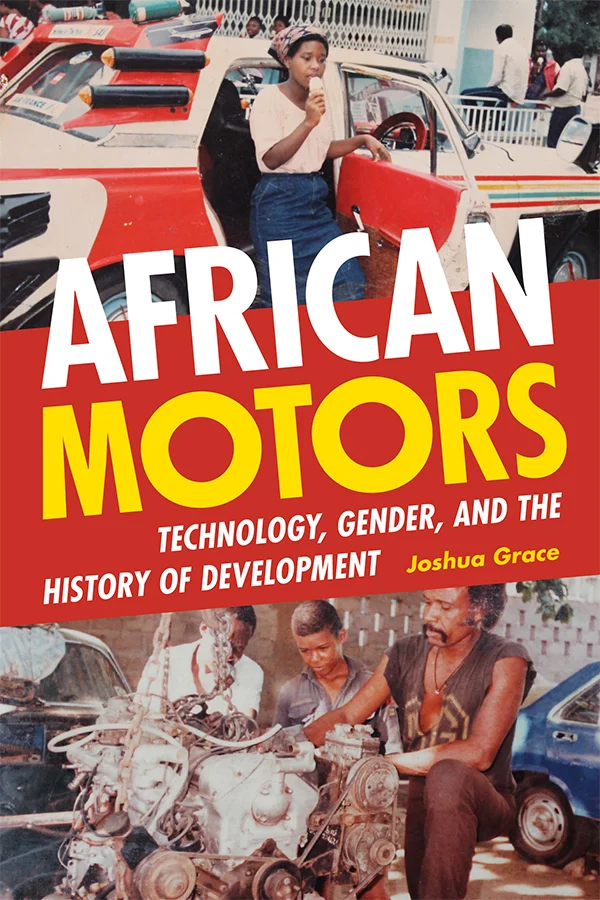
“African Motors is an exhilarating contribution to recent African-centric histories of development shedding new light on the significance of automobility—meaning the entire ‘machinic complex’ of driving, roads, garage work, urban transport, and oil trading. Joshua Grace emphasizes the creativity and agency involved in vernacular invention, maintenance, and repair as part of urban mobility and ‘technological citizenship’ in Tanzania. This book is a welcome addition to the growing field of postcolonial mobility studies, decolonial mobility history, and African studies of technology and innovation.” - Mimi Sheller, Professor of Sociology and Director of the Center for Mobilities Research and Policy, Drexel University
“In vivid prose, African Motors shows how motor vehicles became African technologies. Joshua Grace sets new standards for research and engagement, weaving tales of African technological expertise into an analysis whose import extends well beyond Tanzania. You will never see cars and drivers the same way again.” - Gabrielle Hecht, author of Being Nuclear: Africans and the Global Uranium Trade
“African Motors stands as an excellent contribution to both the history of science and African history fields. . . . AfricanMotors handily illustrates the effects that the automobile has had on both Tanzanian states and societies, as well as the technological agency Tanzanians have sought to work through the car in turn.” - Kyle Harmse, H-Sci-Med-Tech, H-Net Reviews
“Tanzania’s automobility takes center stage in this scholarly work by Grace. . . . The book's five main chapters cover mobility in the region and infrastructure from the 1860s to 1960, masculinity, gender relations, and notions of citizenship tied to technological objects. Recommended.”
- G. Emeagwali,
Choice
“African Motors is wide-ranging in its scope, taking the reader on a journey that provides needed insight into the layered and overlapping social and technological systems that have produced modern African systems of motor transport. . . . While set in Tanzania, this text provides insights that will doubtless resonate with scholars of other African and world regions.” - Jonathan T. Reynolds, International Journal of African Historical Studies
“Joshua Grace’s African Motors offers a fascinating, wide-ranging historical account of automobility in what is now Tanzania. . . . Grace is an intrepid researcher, not only plumbing novel archives but also conducting extensive oral histories and even getting his hands dirty at local garages. The result is a welcome emphasis on the way automobility coevolved with local concepts and logics.” - Michael Degani, Journal of African History
“Put simply, African Motors is a testament to how historians should practice their craft. … [It] constitutes a foundational study that should, in this reviewer’s opinion, remain a mainstay in methodological postgraduate history seminars for years to come.”
- Marcus Filippello,
Technology and Culture
"This is a highly informative and illuminating book, which will likely appeal to scholars—from a range of fields beyond history—with interest in mobilities, gender, transport systems, infrastructure, and technology. Although the book is focused on the Tanzanian context, the insights presented will likely have relevance for many other African countries." - Manja Hoppe Andreasen, AAG Review of Books
"In writing about the Tanzanian case, Grace denaturalizes the car and the multiple economies that surround it in order to think about the many ways that automobiles, technology, infrastructure, drivers, and passengers are entangled. Throughout the book, we see how the car was appropriated by colonial, post-independence, and socialist leaders in Tanzania. In this light, the text will interest not only African Studies scholars but also those readers eager to design more sustainable and equitable futures for our car-based societies of today." - Guillermo Stefano Rosa Gómez, Exertions
"This ambitious and sweeping account of automobility as a lens onto state formation, gender dynamics, and technological expertise was enabled by Grace’s methodological creativity. ... This methodological multiplicity exemplifies not just Africanist scholarship at its very best, but is more broadly instructive for historians and anthropologists of the state and STS scholars." - Emma Park, African Studies Review
"African Motors highlights familiar experiences and narratives that may resonate with scholars who have studied African societies. ... Grace’s approach provides Africanists with an entry point into discussions about African perspectives and experiences of development in the twentieth century." - Waseem-Ahmed Bin-Kasim, Journal of the History of Economic Thought
"African Motors marks a major contribution to the history of African automobility, technology and development that is both challenging for experts and accessible for undergraduate students." - Jennifer Hart, Canadian Journal of African Studies
"African Motors is undoubtedly a product of erudite scholarship. The writing is lucid, the narratives are nuanced, and the plot will be easy to follow by specialists, students and general readers alike. Beyond Tanzania, African Motors will remain an essential text for years to come for scholars of technology, gender, urban and rural studies, (auto-)mobility and Third World socialism."
- Adewumi Damilola Adebay, Africa