
Home / Books / Archival Irruptions

Archival Irruptions

Constructing Religion and Criminalizing Obeah in Eighteenth-Century Jamaica
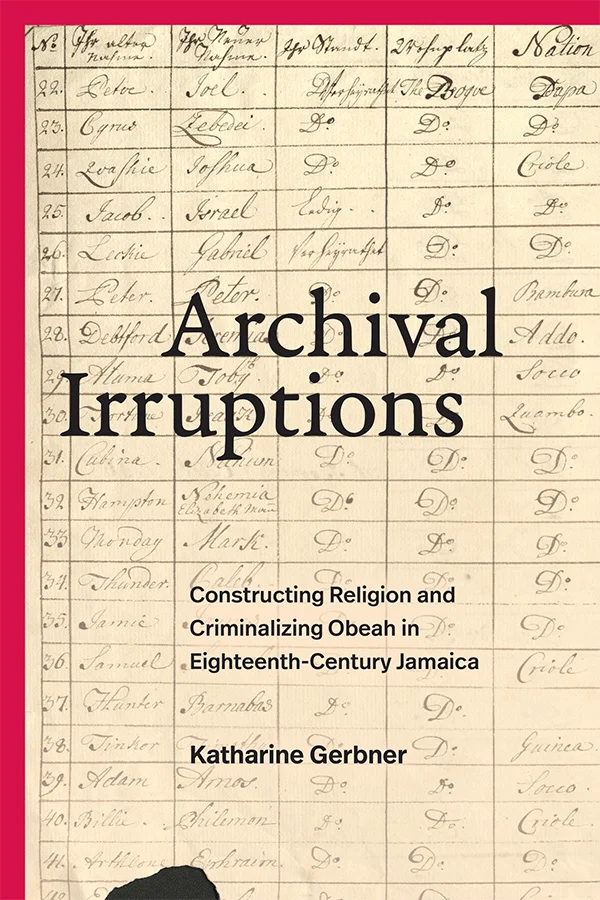
Cover of Archival Irruptions features an image of an old handwritten ledger or registry page with rows and columns filled with cursive names and annotations and what appears to be an ink smudge at the bottom.

Religious Cultures of African and African Diaspora People

More about this series

Read the Introduction

Book

Pages: 240

Illustrations: 20 illustrations

Published: October 2025

In 1760, following the largest slave revolt in the eighteenth-century British Empire, the Afro-Caribbean word Obeah first appeared in British colonial law. In Archival Irruptions, Katharine Gerbner traces how British authorities in Jamaica came to criminalize Obeah, a practice that was variously seen as a healing method, an Africana religion, a science, and a form of witchcraft. Gerbner shows that in the years directly preceding its criminalization, for enslaved Africans and Maroons, Obeah was a prophetic practice tied to healing and death rites. Drawing on Moravian missionary archives, Gerbner theorizes these descriptions of African religious beliefs, rituals, and concepts as “irruptions”: moments when Africana epistemologies break the narrative of a European-authored archival document. In these irruptions, we see European assertions of authority through the lens of Obeah. Moreover, we find that the modern category of religion is rooted in the histories of slavery, rebellion, and the criminalization of Black religious practices. Gerbner’s search for archival irruptions not only creates an opportunity to write an alternative narration about Obeah; it provides a new methodology for all those conducting archival research.

Praise

“This vital story captures the spirit of colonial Christianity. Reading through the selective observations and strategies of racial suppression employed to silence Africana religion, Katharine Gerbner’s engrossing narrative reveals how Black ways of knowing left indelible marks on the archive of Atlantic slavery. More than anything else I can remember, this book expands the way we must think about how authority, recognition, and disavowal shapes religious transformations.” - Vincent Brown, author of Tacky’s Revolt: The Story of an Atlantic Slave War

“In this groundbreaking book, Katharine Gerbner develops an account of the experiences, beliefs, thoughts, and decisions of enslaved Africans in mid-eighteenth-century Jamaica. Her definitive research provides a new starting point for theorizing Obeah historically and distilling its value to some of its original custodians of African descent. Archival Irruptions is a new model for how scholars can read colonial archives in order to update, complicate, and expand the historical narratives they construct about the past and make available to their readers.” - Dianne M. Stewart, author of Obeah, Orisa, and Religious Identity in Trinidad, Volume II, Orisa

"Archival Irruptions should not be viewed merely as a new study of an eighteenth-century Jamaican plantation based on fresh archival sources. Rather, it serves as a practical demonstration of a critical approach to colonial documents, addressing common risks while resolutely aiming to avoid the 'repetition of epistemic violence of our archives'." - Pedro Luengo, Ethnic and Racial Studies

Buy

Availability: In stock

Price: $27.95

Buy the e-book:

Open Access

Read the OA edition

Funding information for the OA format can be found at the bottom of the page.

Request a desk or exam copy

Information

Author/Editor Bios

Back to Top
Katharine Gerbner is Associate Professor of History and Director of Religious Studies at the University of Minnesota. She is the author of Christian Slavery: Conversion and Race in the Protestant Atlantic World.

Table Of Contents

Back to Top
Acknowledgments  ix
Introduction  1
Part I: Obeah
1. Africana Irruptions  17
2. Religio-Nations in the Archives  37
3. Maroons, Blood Oaths, and Gendered Irruptions  63
Part II: Heuchelei
4. Archival Silence, Sexual Violence  83
5. Policing Bodies, Saving Souls  101
6. Construction Religion, Defining Crime  121
Epilogue. Land and Archive  141
Appendix 1  147
Appendix 2  149
Notes  153
Bibliography  183
Index  211

Rights

Back to Top

Sales/Territorial Rights: World

Rights and licensing

Additional Information

Back to Top
Related Links Paper ISBN: 978-1-4780-3240-3 / Hardcover ISBN: 978-1-4780-2903-8 / eISBN: 978-1-4780-6125-0 / DOI: https://doi.org/10.1215/9781478061250

Funding Information

Back to Top
This book is freely available in an open access edition thanks to TOME (Toward an Open Monograph Ecosystem)—a collaboration of the Association of American Universities, the Association of University Presses, and the Association of Research Libraries—and the generous support of The University of Minnesota. Learn more at the TOME website.