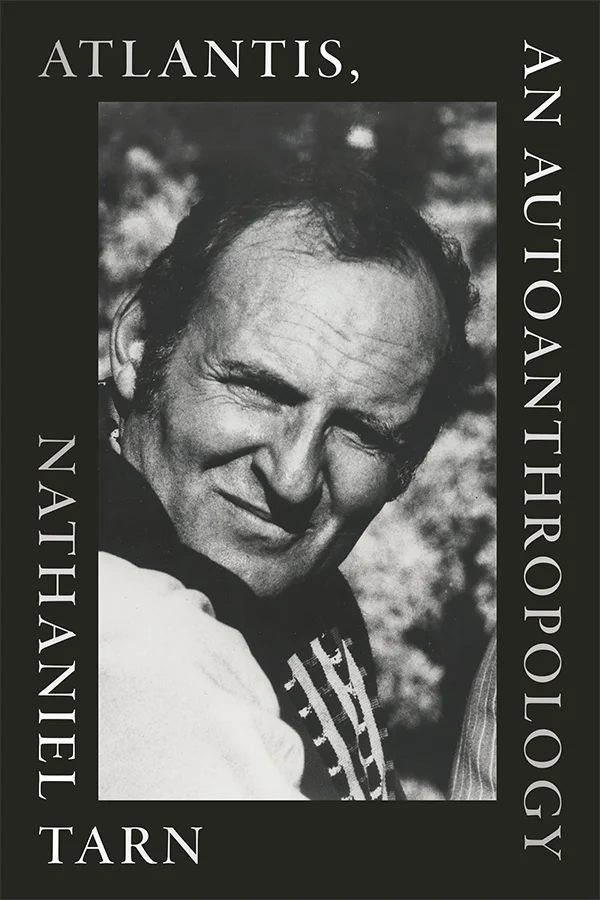
“Nathaniel Tarn doesn’t fit our whole world within his imagined autobiographical Atlantis, but he comes intoxicatingly close by way of a rigorous and expansive investigation of his lifelong quest to achieve a science of spirituality. ‘Completion,’ Tarn declares, ‘is not a word that should ever come near this book.’ Likewise, no reader interested in the myriad histories and personae of the self will wish for it either.” - Albert Mobilio
“What a great pleasure it is to read such a thoughtful, original, and necessary book, one that touches on so many aspects of culture, the life of the mind, the sources and resources of the creative imagination, all indelibly arrayed against a long life full of exotic travels and memorable human encounters. There is so much to savor in this fabulously inviting work of courageous generosity.” - Jed Rasula
"A work of brilliant originality, simultaneously a memoir, an ethnography, a sweeping masterpiece of travel literature, and above all, a poetic testimony of unflinching intelligence and grand passion." - Norman Finkelstein, Restless Messengers
"It’s singularly interesting experience to ingest this book, to be amid it, even to be overwhelmed by it. Atlantis, is a readable avalanche, a discontinuous (but still chronological) memoir, a Big Bricolage of notations, essayistic forays, diary squibs of living life, field notes and polemics, giving the reader charming and telling vignettes . . . these being anecdotes of rare drollery, along with polemics of incisive, and sometimes got-a-bee-in-bonnet challenges...." - Rachel Blau DuPlessis, Restless Messengers
"Atlantis is an account of defiant and passionate explorations—of geographies, languages, disciplines, and identities. Tarn is candid about the personal, professional, and economic costs of these choices—evident from what he shares and in what he explicitly declines to share." - Elizabeth T. Gray, Jr., Restless Messengers
"Atlantis is not just an anthropological take on auto-fiction or the documentation of a life’s experiences lived with passion for the great diversity of human cultures and the energies of the written word. It is a vision of profound environmental significance. In its negotiation of the whole and the part, its quest for totality, Atlantis, An Autoanthropology transits consistently out and home, charting routes that lead toward devotion to the great diversity and beauty of our home, the Earth—an act of eco-writing, the work of environmental ethics and pedagogy." - Joshua Hoeynck, Restless Messengers
"Atlantis is a book which accompanies its reader in mesmerizing fashion and provides brilliant revelation in clear form. The map Nathaniel Tarn is able to weave, by way of memory’s materials and silences, time’s encounters and losses, and the wisdom collected by an insatiable reader who has spent a lifetime desiring and dwelling within language and culture, is an extraordinary feat of will and of hope. Atlantis leaves its reader stunningly stranded between the world Tarn has witnessed, the world Tarn created as he witnessed, and the world of the prophetic, awaiting language yet beyond its realms."
- Rachel Kaufman, Restless Messengers
"[Atlantis] is truly sui generis, without comparison. As autobiography it resists the ploddingly chronological, though a furtive timeline prevails. . . . The pages turn with the kind of momentum depicted in old movies with leaves blowing off a desk calendar. It’s a resoundingly inviting experience: one reads with the quaintly misguided expectation that Dorothy on her way to Oz may show up at any moment. Its aura of wonder reflects a remarkably varied life—a life of contrasting careers, as anthropologist and as poet." - Jed Rasula, Restless Messengers
"Like Whitman in “Song of Myself,” Nathaniel Tarn contains multitudes: the Bunker Libraries of Fort Tarn outside of Santa Fe, where a lifetime’s reading and collecting are meticulously stored and arranged, are an image of his identity, as much as the shelves of books he has himself written. . . . Tarn stands at the threshold of two eras—the Gutenberg Age and the Age of the Internet—and casts his gaze back to the pre-literate and forward to some Atlantis of the future beyond his and our imaginings."
- Mark Scroggins, Restless Messengers
"Tarn brings to life a seven-decade career lived traveling and writing throughout the world. Impressive in his ability to conjure up meetings with publishers and conversations with friends that took place more than 50 years ago, Tarn builds on his experiences to create an ethnographic study of himself that reads like a biography that is an autobiography. Enthusiasts of anthropology, poetry, academic life, and self-writing will enjoy Tarn’s approach and the insider’s perspective he brings to a life spent translating, publishing, editing, teaching, and traveling. . . . Recommended. Graduate students through faculty." - S. Batcos, Choice
"At its heart, it is an exploration of poetry: what it is and how it comes about within the mind of the creator. There are insights into the visionary poetry of Wordsworth and Blake, the need for the poet not merely to give pleasure but crucially to become part of the very spin of the world in motion. It is also about the many different sides of Tarn. . . . Although, at times, the writing is introspective, his style is always engaging and often conversational with a good dose of humour." - Neil Leadbeater, North of Oxford
"Atlantis will no doubt be of interest both to anthropologists and scholars of poetry, and especially to those interested in the ‘parallel’ lives they sometimes lead. It will also appeal to those students of the history of both fields eager for a glimpse into the personalities behind art and knowledge, who are eager to see poetry (and anthropology for that matter) as intrinsic to everyday life. Eminently readable and erudite, Atlantis will no doubt be with us for many years to come." - Andrew Brandel, Ethnos
"The text reads smoothly and effortlessly. Tarn’s sensibility is distinctly mid-twentieth-century European, and the formal and thematic intricacies of the book read quite effortlessly and sensibly: he simply knows how to spin a yarn full of color and detail. The reader of course can’t help but notice, and marvel at, the complexity of the structure of the book, yet its author seems not to be impressed; he is simply intent on reporting what is to be reported with evident pleasure and élan." - Norman Fischer, American Book Review