
Home / Books / Blood Loss

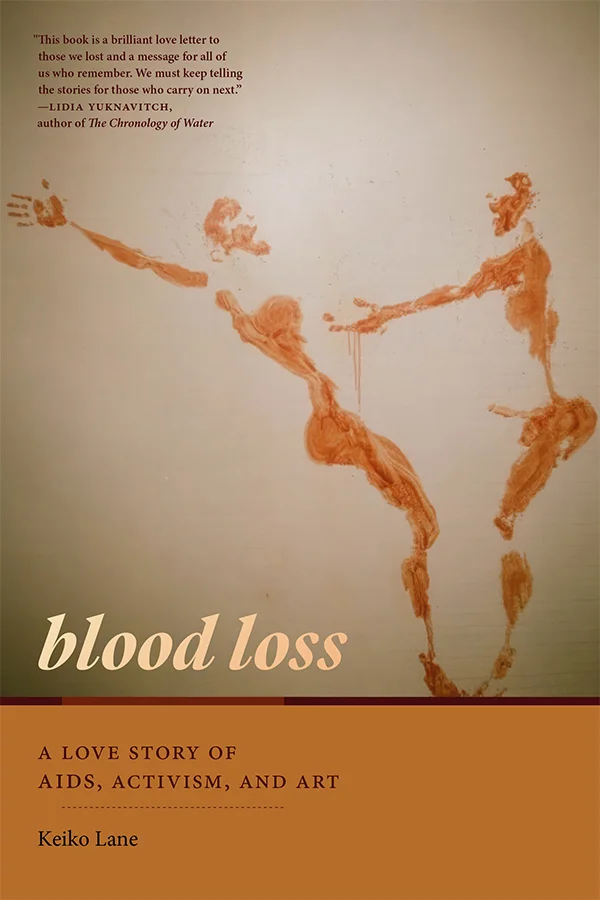
Blood Loss

A Love Story of AIDS, Activism, and Art
Book

Pages: 312

Published: September 2024

Author: Keiko Lane

In 1991, sixteen-year-old activist Keiko Lane joined the Los Angeles chapters of Queer Nation and ACT UP. Their members protested legislation aimed at dismantling rights for LGBTQ people, people living with HIV, and immigrants while fighting for needle-exchange programs, reproductive justice, safer-sex education, hospice funding, and the right to die with dignity. At the same time, the activists were a queer chosen family of friends and lovers who took care of one another in sickness and in health. Sometimes they helped each other die. By the time Lane turned twenty-two, most had died of AIDS. In her evocative memoir, Lane weaves together love stories and afterlives of queer resistance and survival against the landscape of the Rodney King Rebellion, the movement for queer rights, and the censorship of queer artists and sexualities. Lane interrogates the social construction of power against and in queer communities of color and the recovery of sexual agency in the midst and aftermath of violence. Luminous and powerfully moving, Blood Loss explores survival after those we love have died.

Praise

“Keiko Lane’s Blood Loss travels back through the heart of AIDS Activism with fierce love and a dazzling, devotional desire to bring the story back to life. What I found in these pages was history, memory, hope, fight, and a heart beating, not beaten. This book is a brilliant love letter to those we lost and a message for all of us who remember. We must keep telling the stories for those who carry on next.” - Lidia Yuknavitch, author of The Chronology of Water

“Keiko Lane is a powerful writer, and Blood Loss is especially notable for its perspective of a young Asian American queer woman AIDS activist. Lane describes a significant conflict in herself: between her duty to protest on behalf of others and her deeply ingrained cultural survival tactic of avoiding notice in order to avoid violence. Viscerally evocative on every page, Blood Loss is historically significant as a work of Asian American literature, women’s literature, and queer activist history.” - Alexander Chee, author of How to Write an Autobiographical Novel: Essays

"At its best, the book is a poetic yet often devastating account of the worst of the AIDS epidemic, as well as the profound intimacy Lane experienced during this period." - Kirkus Reviews

"Blood Loss’s contents gush off of the page with aching urgency, begging readers to remember one more person—urging us to hold onto people history has already forgotten. . . . Blood Loss feels like the blanket that Lane used to warm her dying friends. Just as importantly, it also serves as a proud banner in the never-ending battle for equality, tolerance, and respect." - Jose SolĂ­s, The Body

"A deeply poetic and moving memoir of a queer political immersion at an early age." - Tim Murphy, Poz

"This is a book about brave and desperate acts of care, the necessity and impossibility of memory, and how time refuses closure. It differs from other AIDS activist memoirs not just in terms of perspective, but through its vulnerability, its openness to the porousness of experience, its drive to articulate the inexpressible." - Mattilda Bernstein Sycamore, TruthOut

"Through the lens of her relationships—with those who lived and those who have passed—Lane shows that love, loss, and survival are inherently intertwined, particularly within queer anticolonial movements, and the importance of community in times of crisis." - Allison Armijo, The Rumpus

"Blood Loss is an engaging and accessible book that offers a fresh perspective on the history of HIV/AIDS activism and attests to the power of friendship in surviving an epidemic." - Nicholas Derda, Synapsis

"There have been many books and memoirs written about the AIDS crisis, but few are as well-written and moving as Keiko Lane’s Blood Loss. . . .  What Keiko Lane ultimately shows us, and with great skill, is that truth—the difficult, bloody, gritty truth—is beautiful, as Keats famously maintained, no matter what is being revealed. This is a memoir that deserves to be widely read." - H N Hirsch, Gay and Lesbian Review

"Written from multiple co-existent times—one that reports with heartfelt detail a raucous teenage life amid activist adults; another, more knowing, that has lived into middle age and has been shaped and scarred by death—Lane testifies to her friends' lives and losses while accounting for how survival has structured her desire , her ferocity, her pain, her art, and this book." - Alexandra Juhasz, Anarchist Review of Books

"Lane takes an auto-theoretical approach in the sharing of her lived experience; pieces from her archives, including the contents of several letters never mailed ('unsent fragments') and the addition of 'marginalia' in the form of short lists of statistics from year to year, show Lane experimenting with form; lyric language lends a meditative tone to the prose. Particularly evocative is the choice to print a number of pages in solid black with the names of the friends who passed away written like headstones at a gravesite."
  - Mary Fons, E3W Review of Books

"Lane’s book is a thought-piece on the nature of survival as much as it is one on loss. Her short chapters and fragments weave together vignettes of mutual care, especially among queer communities of color, that reflection on the bonds of friendship amidst the struggle for social power." - John S. Garrison, Electric Literature

Buy

Availability: Loading...

Price: Loading...

Request a desk or exam copy

Information

Author/Editor Bios

Back to Top
Keiko Lane is an independent scholar and practicing psychotherapist.

Table Of Contents

Back to Top
The Problem of the Story  1
The Beginning  8
An Archive of Impending Loss  52
What Love Is  91
After Leaving  144
Plague Poetics and the Construction of Countermemory  182
Then, After  225
The Rememberers  227
How Memory Works  274
Epilogue. Endnotes Ongoing—An Incomplete List  284
Acknowledgments  289
Notes  293
Bibliography  297
Credits  299

Rights

Back to Top

Sales/Territorial Rights: World

Rights and licensing