
Home / Books / Brown Saviors and Their Others

Brown Saviors and Their Others

Race, Caste, Labor, and the Global Politics of Help in India
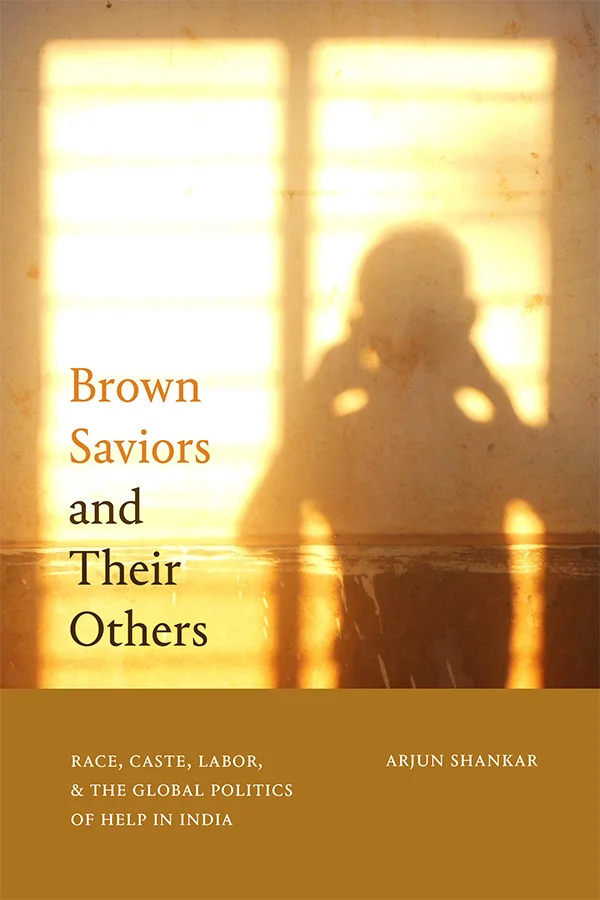
Book

Pages: 360

Illustrations: 11 illustrations

Published: August 2023

Author: Arjun Shankar

In Brown Saviors and Their Others Arjun Shankar draws from his ethnographic work with an educational NGO to investigate the practices of “brown saviors”—globally mobile, dominant-caste, liberal Indian and Indian diasporic technocrats who drive India’s help economy. Shankar argues that these brown saviors actually reproduce many of the racialized values and ideologies associated with who and how to help that have been passed down from the colonial period, while masking other operations of power behind the racial politics of global brownness. In India, these operations of power center largely on the transnational labor politics of caste. Ever attentive to moments of discomfort and complicity, Shankar develops a method of “nervous ethnography” to uncover the global racial hierarchies, graded caste stratifications, urban/rural distinctions, and digital panaceas that shape the politics of help in India. Through nervous critique, Shankar introduces a framework for the study of the global help economies that reckons with the ongoing legacies of racial and caste capitalism.

Praise

“In this ‘nervous’ and ‘sweaty’ ethnography of an education NGO in South India, Arjun Shankar offers an original, historically and theoretically robust analysis of the global helping economy, elaborating a complex system that unites racial capitalism, technocratic solutionism, neocolonialism and development ideologies under the figure of the ‘brown savior.’” - Adia Benton, Associate Professor of Anthropology and African Studies, Northwestern University

"A needed take on the growing neoliberalization of caste values and racialization of cultural capital in the globalized world. The color-cosmetic desires penetrate into markets of patronship and subjecthood. The analogy of the brown savior is damning the philosophy of the underclass in the colonial width. 'Brown saviors' is a befitting jargon of the neoliberal postcolonial world. Brown is colonized and therefore it is global. Its structural hangouts are cultural, and thus it thinks of itself as a savior to its people because it has become a savior in the global economy and corporate diversity. This powerful manuscript, packed with accessible ethnography, points out the obvious in the room with demanding rigor and engaging theory. A dutiful addition to the global castes." - Suraj Yengde, Harvard University

"Brown Saviors and their Others will appeal to scholars and students of development studies, postcolonial and decolonial studies, and of critical race studies. The nervous ethnography that characterizes it is sure to enrich ongoing debates about what it would mean for ethnography to truly break from its colonial and white supremacist past and about what it would mean to address social inequality outside of a savior mentality and within a framework that seeks to undo the racial and caste hierarchies that are facilitated by our current global capitalist system." - Nell Gabiam, Ethnic and Racial Studies

"Shankar... provides a thoughtful, timely critique of the ways in which savarna (upper caste) Hindus perpetuate and reify colonial, racial, and caste hierarchies within the NGO sector in India. He does so by examining the figure of the "brown savior": global Hindu elites, including Hindu Americans, drawn to working with NGOs that aim to help the less fortunate in India. . . . This ethnography is useful for anthropologists of South Asia, those studying global NGO cultures, and those interested in critical caste studies. Recommended. Advanced undergraduates through faculty; professionals." - E. Bridger Wilson, Choice

"With Shankar’s book, it is impossible to look away from that which has always been there: the ongoing, everyday entrenchment of casteist and racist exclusion in ‘the NGO world’ under the guise of do-good liberal saviourism. Brown Saviors has made me completely reassess my early work. It is a book that every researcher of development, education, and public policy must read." - Arathi Sriprakash, Society for U.S. Intellectual History

"Shankar ends with a call for a global reckoning to not only annihilate saviorism but also, in the words of Dr. Ambedkar, annihilate caste. The book ends with as many nerves jangling as there were in its beginning—only now, readers have an abundance of evidence to move their love and rage forward." - Mythri Jegethesan, Current Anthropology

"Brown Saviours and Their Others: Race, Caste, Labor, And The Global Politics Of Help In India pioneers the literature on racial capitalism in India as an analytical category when critiquing nonprofit development discourses." - Shradha Nediyedath, Doing Sociology

"[T]his book provides fresh perspectives on ongoing processes of global racial formations that transcend the predominant Black-White/East-West/South-North binaries, particularly within the development sector. This book, in many ways, is an important conversation starter!" - Rohini Rai, Journal of Development Studies

"This book can be useful to scholars and students of anthropology and development, South Asian studies, as well as practitioners who are keen to redefine help, in global help economies. Students of ethnography would also benefit from the book." - Indrakshi Tandon, Anthropological Notebooks

"Brown Saviors is commendable for the significance of its theme, the newness of its approach, the freshness of its orientation—each sustained by rich, textured, and sensitive analysis. The work offers an excavation and location of genealogies of the savior and saviorism in caste and racial capitalism at the core of colony, nation, and religion." - Ishita Banerjee-Dube, American Ethnologist

"This is an excellent resource to self-evaluate mission motives among Christian development organizations to avoid the pitfalls of white, brown, neocolonial, urban, and digital saviorism." - John Amalraj Karunakaran, Missiology

"The book will certainly inspire impassioned debates, and perhaps even produce polarized responses. Precisely for this reason the book holds intellectual and pedagogical value, especially in anthropology and South Asian studies." - Vineeta Sinha, Pacific Affairs

Buy

Availability: Loading...

Price: Loading...

Request a desk or exam copy

Information

Author/Editor Bios

Back to Top
Arjun Shankar is Assistant Professor of Culture and Politics at Georgetown University and coeditor of Curiosity Studies: A New Ecology of Knowledge.

Table Of Contents

Back to Top
Preface: Encountering Saviorism  vii
Premise One: Global Shadows  vii
Premise Two: Nervous Ethnography  xii
Introduction: Brown Saviorism  1
I. Theorizing Saviorism
1. Global Help Economics and Racial Capitalism  31
2. The Racial Politics of the Savarna Hindu (or the Would-Be Savior)  45
II. Neocolonial Saviorism
3. Poverty’s Motivational Double Bind (or Neo-Mathusian Visions)  63
4. Fatal Pragmatism (or the Politics of “Going There”)  75
5. The Case of Liberal Intervention  85
6. Hindu Feminist Rising and Falling  95
7. Gatekeepers (or the Anti-Muslim Politics of Help)  107
III. Urban Saviorism
8. The Road to Accumulation  121
9. Urban Altruism/Urban Corruption  133
10. A Global Death  145
11. The Insult of Precarity (or “I Don’t Give a Damn”)  157
12. AC Cars and the Hyperreal Village  167
IV. Digital Saviorism
13. Digital Saviors  181
14. Digital Time (and Its Others)  193
15. Digital Audit Culture (or Metadata)  203
16. Digital Scaling (or Abnormalities)  215
17. Digital Dustbins  227
Conclusion: Against Saviorism  239
Acknowledgments  251
Notes  257
Bibliography  299
Index  323

Rights

Back to Top

Sales/Territorial Rights: World

Rights and licensing

Awards

Back to Top

Honorable Mention, 2024 Cultural Studies Association Best First Book Award

Additional Information

Back to Top
Paper ISBN: 978-1-4780-2509-2 / Hardcover ISBN: 978-1-4780-2011-0 / eISBN: 978-1-4780-2711-9 / DOI: https://doi.org/10.1215/9781478027119