
Home / Books / Cartographic Memory

Cartographic Memory

Social Movement Activism and the Production of Space
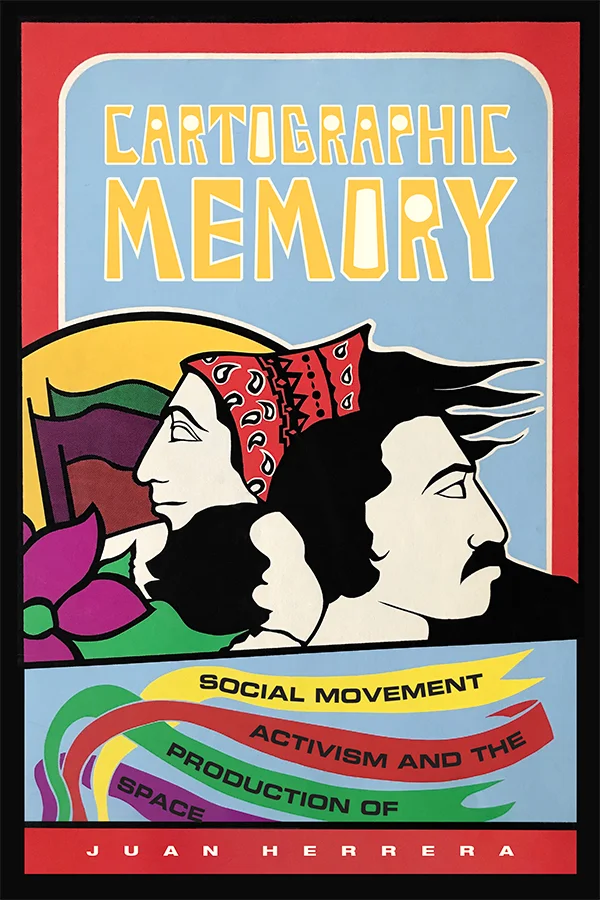
Book

Pages: 264

Illustrations: 31 illustrations

Published: September 2022

Author: Juan Herrera

In Cartographic Memory, Juan Herrera maps 1960s Chicano movement activism in the Latinx neighborhood of Fruitvale in Oakland, California, showing how activists there constructed a politics forged through productions of space. From Chicano-inspired street murals to the architecture of restaurants and shops, Herrera shows how Fruitvale’s communities and spaces serve as a palpable, living record of movement politics and achievements. Drawing on oral histories with Chicano activists, ethnography, and archival research, Herrera analyzes how activism has shaped Fruitvale. Herrera examines the ongoing nature of activism through nonprofit organizations and urban redevelopment projects like the Fruitvale Transit Village that root movements in place. Revealing that the social justice activism in Fruitvale fights for a space that does not yet exist, Herrera brings to life contentious politics about the nature of Chicanismo, Latinidad, and belonging while foregrounding the lasting social and material legacies of movements so often relegated to the past.

Praise

Cartographic Memory is a creative, important, and well-written book that offers a vital analysis of Latinx activism in Oakland. Juan Herrera’s concept of social movement continuities helps us analyze the range of ways that actors make social change, rather than only focusing on the most radical politics or certain epic moments. Herrera’s book is an outstanding contribution toward building a nuanced and complex understanding of Latinx social movements.” - Victoria Lawson, author of Making Development Geography

Cartographic Memory makes an important contribution to understanding how the Chicano movement emerged from specific spaces and in relationship to the more well-documented Black Power movement. Juan Herrera’s concept of cartographic memory provides a beautiful new way of mapping ongoing and unfinished social movement traditions and dreams. His writing is clear and compelling, and his voice and storytelling bring you to the neighborhood, to the front porch, and into movement leaders’ memories and archives.” - Erica Kohl-Arenas, author of The Self-Help Myth: How Philanthropy Fails to Alleviate Poverty

“In Cartographic Memory, Juan Herrera carefully and elegantly examines Chicano movement activism and its legacies in Oakland, California’s Fruitvale neighborhood. . . . In these two ways—its analysis of the movement’s dynamic production of space, and in its focus on Oakland—Cartographic Memory is a signal achievement.” - Laura Barraclough, Society and Space

"This book will helpfully inform the next generation of geographers, activists, and students on the crucial impact space has on social movements, and the ways social movements shape space and place." - Aída R. Guhlincozzi, Environment, Space, Place

"In Cartographic Memory, Herrera shares with us his process of understanding Fruitvale, California, a part of the Bay Area just south of Oakland, and how it has emerged in relation to community activism. Herrera offers a twist on autoethnographic practice because he is not from Fruitvale but becomes a member of that community over time. This book traces how a sense of belonging forms through the interpersonal practice of research." - Elizabeth Rodriguez Fielder, MELUS

"Cartographic Memory is a well argued and important addition to the historiographies of social movement history and geographic place-­making." - Jazmin Muñoz, Journal of American Ethnic History

Buy

Availability: Loading...

Price: Loading...

Buy the e-book:

Open Access

Read OA Edition

Funding information for the OA format is found at the bottom of the page.

Request a desk or exam copy Spring 2026 Web Sale

Information

Author/Editor Bios

Back to Top
Juan Herrera is Assistant Professor of Geography at the University of California, Los Angeles.

Table Of Contents

Back to Top
Acknowledgments  vii
Introduction. Putting Fruitvale on the “Map”  1
1. Making Place  31
2. The Other Minority  61
3. Revolution Interrupted  89
4. Development for the People!  114
5. Mapping Interlinkages  144
Conclusion. Activism in Space-Time  171
Notes  197
References  219
Index  231

Rights

Back to Top

Sales/Territorial Rights: World

Rights and licensing

Additional Information

Back to Top
Related Links Paper ISBN: 978-1-4780-0674-9 / Hardcover ISBN: 978-1-4780-0607-7 / eISBN: 978-1-4780-0749-4 / DOI: https://doi.org/10.1215/9781478007494

Funding Information

Back to Top
This book is freely available in an open access edition thanks to TOME (Toward an Open Monograph Ecosystem)—a collaboration of the Association of American Universities, the Association of University Presses, and the Association of Research Libraries—and the general support of Arcadia, a charitable fund of Lisbet Rausing and Peter Baldwin, and the UCLA Library.