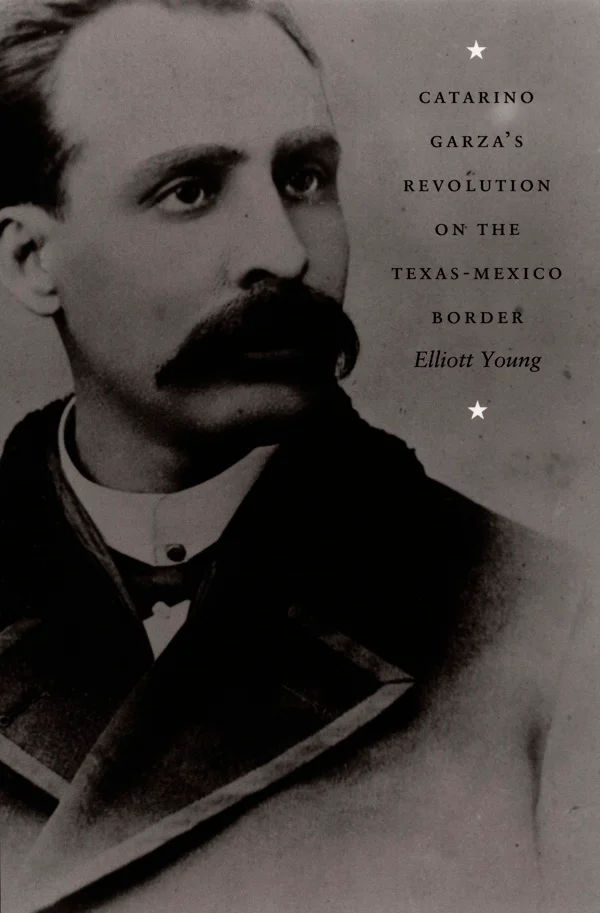
“[A] rich, fascinating narrative, filled with interesting characters and sudden turns of events. Young’s work provides a superior invitation to explore the distinctive history of the U.S.-Mexico borderlands.” - Joseph Heyman , Journal of the West
“[T]his well-written monograph is a valuable addition to the history of the US-Mexico border region. It also adds depth to our knowledge of Porfirian Mexico on the eye of the Mexican Revolution.” - Suzanne Pasztor , Journal of Latin American Studies
“This terrific account of politics and culture during the Porfiriato stands as one of the most impressive published histories of the U.S.-Mexico borderlands region to date. . . . Young’s brilliant historical study should help redefine Latin American Studies, American Studies, and Ethnic Studies in years to come.” - Stephen Pitti , The Americas
“Young admirably uses Garza, his region, and his period to paint a noteworthy transnational ideological picture that reaches beyond the traditional focus on industrialization, mining, land, and governmental politics.” - Robin Robinson, Bulletin of Latin American Research
“Young skillfully traces Garza’s career in the context of the racial, political, and economic problems that made South Texas unstable and potentially explosive on the one hand and a haven from the repressive Mexican government on the other. . . . Young is to be congratulated on a book that will aid in our understanding of the much larger and ultimately successful revolutionary movements against Díaz. . . .” - Linda B. Hall , Western Historical Quarterly
“Young succeeds not only in vividly re-creating Garza’s circles and the movement that he led, but in locating them in the larger context of the U.S.-Mexico border and modern nationalism more generally. . . . The archival research, including letters of Garza’s in private hands, is extremely impressive. Young’s close attention to Garza’s own writings and other literary and journalistic portrayals of the border will also make this book of interest to literary scholars.” - Benjamin Heber Johnson , Texas Books in Review
“Young's book is an ambitious, well written, and meticulously researched study of the years during which both the regime of Porfirio Díaz and the U.S.-Mexican border were consolidated: the former as a true political system, and the latter as a cultural space.” - Luis Barrón , EIAL
"[T]he research base is more than solid for [Young's] work on Garza's revolution on the Texas-Mexico border." - W. Dirk Raat, Journal of American History
"Elliott Young has written an important book that will influence our understandings of the border, its creation, and its symbolic power. . . . Scholars and history buffs alike will enjoy this book." - Anthony Quiroz , Southwestern Historical Quarterly
"In this important book, Elliott Young seeks to recover a story that has been largely forgotten. . . . This work is the product of indefatigable research on both sides of the border, but its greatest strength is Young’s ambitious and creative reading of the sources he turned up. . . . [This is] a book that combines serious empiricism with interdisciplinary flair and theoretical sophistication. . . . [T]his book opens new avenues in the study of the border. Anyone interested in the region should read it." - Samuel Brunk , Journal of Latin American Anthropology
"In this lively, detailed, and largely balanced telling of the struggle, Elliot Young roots for Garza but does not suppress the rebel's shortcomings. . . . Young tells this exciting, if somewhat bizarre story in marvelous detail. . . . His contextualization is strong. . . . [T]he heart and soul of this book is the riveting story itself, and the author tells it very well." - Paul Vanderwood, Hispanic American Historical Review
"Revolutions on the Rio Grande are becoming hot topics in the academic world. . . . Now Elliott Young . . . has just published Catarino Garza’s Revolution on the Texas-Mexico Border, another chapter in the valley's bloody past." - Martin Winchester , The Monitor (McAllen TX)
"This book is valuable for those studying the U.S. West or South or, indeed the era of empire. . . . [A] stunning introduction to borderlands history that beautifully places the story in its nuanced, broad, transnational context drawing on a wide variety of theoretical and methodological tools without sacrificing clarity and accessibility. . . . [B]rilliant." - Sarah Deutsch , Journal of Southern History
"Young has done extensive research for this work, including the use of private, state, and federal archives in both Mexico and the United States. . . . His book offers additional revisionist insights into what was certainly more than a minor insurrection on the border. The work also provides important background to the broader insurrections that would lead to the Mexican Revolution of 1910." - Don M. Coerver , American Historical Review
"Young makes significant contributions to the increasingly popular field of Borderlands history in this first in-depth study of Catarino Garza's revolution based on bi-national archival research." - Sonia Hernandez, Journal of Colonialism & Colonial History
"Young's version of the border is all encompassing, culturally rich and diverse, filled with people with their own agendas. . . . Recommended." - J. A. Stuntz, Choice
“Launched from South Texas in 1891, a rebellion against Mexican dictator Porfirio Díaz spread quickly to both sides of the permeable U.S.-Mexico border. In this smart transnational study, Elliott Young locates the wellsprings of this nearly forgotten episode in the life of its remarkable leader, journalist Catarino Garza, and in the social, racial, and political inequities that characterized borderlands society.” - David J. Weber, Director of the Clements Center for Southwest Studies at Southern Methodist University
“This is an original, provocative, and far-reaching book that breaks with the existing conceptualization of fields of study and national historiographical traditions. It not only makes a case for the importance of the Garza revolt itself but also uses the rebellion to reflect upon broad themes, including those of U.S.-Mexican relations; comparative colonialisms; the formation of borders; Latin American liberalism; and race, gender, and class. ” - William French, author of A Peaceful and Working People: Manners, Morals, and Class Formation in Northern Mexico