
Home / Books / Children of the Soil

Children of the Soil

The Power of Built Form in Urban Madagascar
Book

Pages: 376

Illustrations: 73 illustrations

Published: October 2023

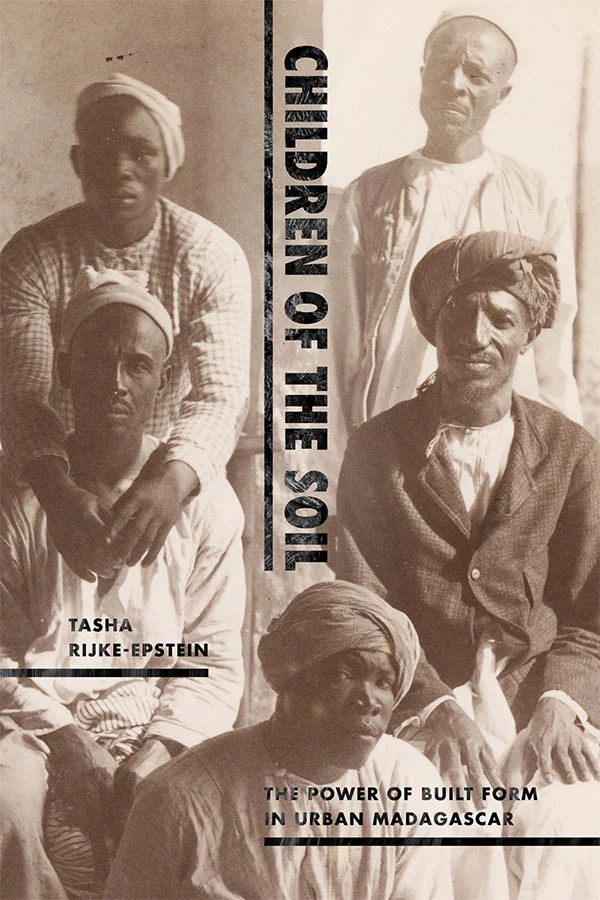
In Children of the Soil, Tasha Rijke-Epstein offers an urban history of the port city of Mahajanga, Madagascar, before, during, and after colonization. Drawing on archival and ethnographic evidence, she weaves together the lives and afterlives of built spaces to show how city residents negotiated imperial encroachment, colonial rule, and global racial capitalism over two centuries. From Mahajanga’s hilltop palace to the alluvial depths of its cesspools, the city’s spaces were domains for ideological debates between rulers and subjects, French colonizers and indigenous Malagasy peoples, and Comorian migrants and Indian traders. In these spaces, Mahajanga’s residents expressed competing moral theories about power over people and the land. The built world was also where varying populations reckoned with human, ancestral, and ecological pasts and laid present and future claims to urban belonging. Migrants from nearby Comoros harnessed built forms as anticipatory devices through which they sought to build their presence into the landscape and transform themselves from outsiders into "children of the soil" (zanatany). In tracing the centrality of Mahajanga’s architecture to everyday life, Rijke-Epstein offers new ways to understand the relationships between the material world, the more-than-human realm, and the making of urban life.

Praise

“A landmark exploration of the built environment as a medium of social life, a register of history making, and a historical source. Set in a Malagasy city of migrants and stretching from the eighteenth century to the present, Tasha Rijke-Epstein’s Children of the Soil resets the agenda for writing about the politics of mobility and belonging.” - David L. Schoenbrun, author of The Names of the Python: Belonging in East Africa, 900 to 1930

“A lucid and engaging history of the materiality of placemaking and belonging. This book charts decisively new, exceptionally rich terrain for urban studies and ethnographically informed architectural history.” - Laura Fair, author of Reel Pleasures: Cinema Audiences and Entrepreneurs in Twentieth-Century Urban Tanzania

"Meticulously researched and beautifully written, Children of the Soil will be of interest to a broad readership as well as to specialists of the history and social worlds of Madagascar and the Indian Ocean. Highly recommended." - Andrew Walsh, International Journal of African Historical Studies

"Children of the Soil is a valuable contribution to the discourse on Africa’s material histories. Rijke-Epstein uncovers forgotten histories within buildings, revealing that Africa was not ignorant of modernity or the use of stone and concrete before colonialism. . . . This book is recommended to historians, urban analysts, and policymakers on the activities of Africans and colonial administrators in making African cities." - Mathias Chukwudi Isiani, African Studies Quarterly

". . . [I]t makes valuable contributions in its focus on built form and in discovering new insights in the archives. Particularly welcome are the large number of images embedded in the text, including maps and colonial photographs, some of which appeared on postcards and, surprisingly, on chocolate wrappers." - Michael Lambek, Journal of Development Studies

"Within Madagascar studies, [Children of the Soil] is an important contribution. . . . Seldom have I read a work that brings the material and the more-than-human into such deep and sustained conversation." - Lynn M. Thomas, African Studies Review

"Children of the Soil suggests that relations to land must sometimes exist in tension with other sources and processes of belonging. Tracing these other sources of belonging as Rijke-Epstein does, holds promise to open up new visions of politics, affect, and conviviality in contemporary understandings of African history." - Claudia Gastrow, African Studies Review

" Rijke-Epstein writes . . . in an accessible manner and Children of the Soil deserves to be read not only by scholars of Madagascar, but also those interested in studying architecture and the African past." - Jane Hooper, Politique africaine

"Children of the Soil is a timely, well-argued, and innovative take on the significance of built form and indigeneity in Mahajanga. . . . [It] is a valuable addition to the literature on the histories of cities in Africa, especially those that foreground the experiences of the men and women struggling to survive in them." - Ademide Adelusi-Adeluyi, African Studies Review

"A significant contribution not only for scholars of Madagascar but also for all those who work on urban history, belonging, placemaking and the links between humans, materiality and other-than-human actors in other African contexts and beyond." - Marco Gardini, Journal of Modern African Studies

"Children of the Soil impressively engages multiple historical fields, including urban history, migration history, histories of technology, infrastructure, and skill, labor history, Africanist and non-Africanist approaches to materiality, and historiographies of belonging. . . . Rijke-Epstein has given historians a new way to look at long histories of urban built worlds." - Joshua Grace, Journal of African History

Buy

Availability: Loading...

Price: Loading...

Request a desk or exam copy

Information

Author/Editor Bios

Back to Top
Tasha Rijke-Epstein is Assistant Professor of History at Vanderbilt University.

Table Of Contents

Back to Top
Note on Toponyms  ix
Acknowledgments  xi
Introduction: Material Histories  1
I. Building Power
1. Casting the Land: Architectural Tactics and the Politics of Durability  27
2. Vibrant Matters: The Rova and More-Than-Human Forces  54
II. Anticipatory Landscapes
3. Storied Refusals: Labor and Laden Absences  87
4. Sedimentary Bonds: Treasured Mosques and Everyday Expertise  123
III. Residual Lives and Afterlives
5. Garnered Presences: Constructing and Belonging in the Zanatany City  161
6. Violent Remnants: Infrastructures of Possibility and Peril  195
Epilogue: Unfinished Histories  225
Notes  241
Bibliography  293
Index  339

Rights

Back to Top

Sales/Territorial Rights: World

Rights and licensing

Additional Information

Back to Top
Paper ISBN: 978-1-4780-2529-0 / Hardcover ISBN: 978-1-4780-2048-6 / eISBN: 978-1-4780-2740-9 / DOI: https://doi.org/10.1215/9781478027409