
Home / Books / City of Screens

City of Screens

Imagining Audiences in Manila's Alternative Film Culture
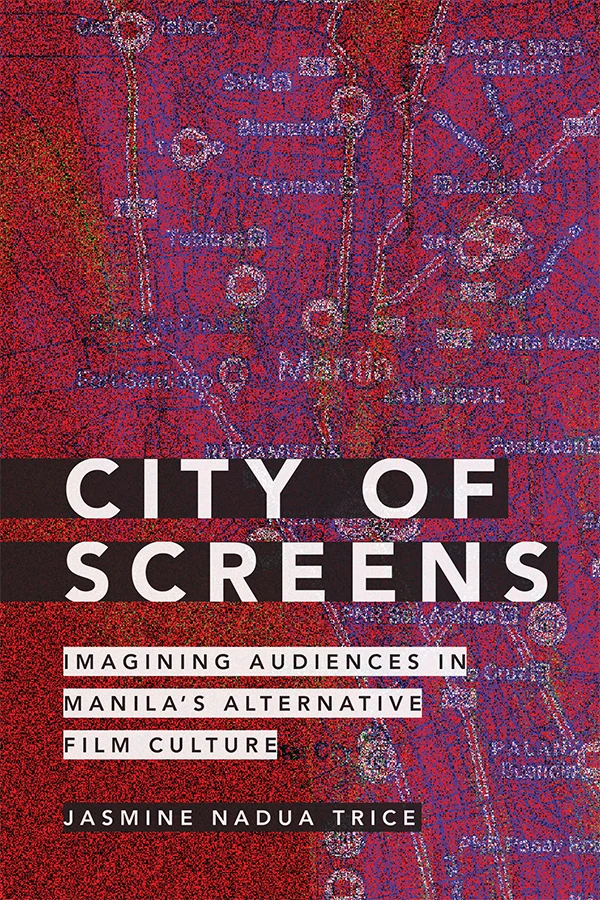
Book

Pages: 328

Illustrations: 21 illustrations

Published: March 2021

In City of Screens Jasmine Nadua Trice examines the politics of cinema circulation in early-2000s Manila. She traces Manila's cinema landscape by focusing on the primary locations of film exhibition and distribution: the pirated DVD district, mall multiplexes, art-house cinemas, the university film institute, and state-sponsored cinematheques. In the wake of digital media piracy and the decline of the local commercial film industry, the rising independent cinema movement has been a site of contestation between filmmakers and the state, each constructing different notions of a prospective, national public film audience. Discourses around audiences become more salient given that films by independent Philippine filmmakers are seldom screened to domestic audiences, despite their international success. City of Screens provides a deeper understanding of the debates about the competing roles of the film industry, the public, and the state in national culture in the Philippines and beyond.

Praise

“From the pirate video stalls of the old city center to the shopping mall multiplexes of Manila, Jasmine Nadua Trice examines the fragmented and multifaceted assemblage of alternative Philippine cinema. Her passionate attention to detail and wide-ranging engagement with critical theory provide a compelling model for the study of cinema cultures in the global South.” - Michael Curtin, Distinguished Professor of Film and Media Studies, University of California, Santa Barbara

“Jasmine Nadua Trice persuasively argues that film circulation both envisions and occasionally actualizes the dream of a national film audience for counterdominant cinema in the Philippines. She confronts head-on one of the thorniest problems of politically or aesthetically progressive Philippine film: filmmakers’ attempts to reach the alienated domestic moviegoer. Her fresh, syncretic approach and elegant thinking make City of Screens a groundbreaking, must-read book not only for readers not only interested in Philippine cinema but also for those attuned to the dynamics of distribution, exhibition, and circulation beyond Hollywood. Representing a wholly original and highly generative departure from previous scholarship, City of Screens is a major intervention.” - Bliss Cua Lim, author of Translating Time: Cinema, the Fantastic, and Temporal Critique

"Overall, there are a number of themes to appreciate in City of Screens, especially if one is not familiar with local independent cinema and its circuits of distribution. The book’s contribution also lies in its use of interdisciplinarity, applying rhetoric, urban studies, geography, and anthropology to explain why alternative cinema remains limited in its circulation. . . . The book’s most poignant yet most grounded point may be Trice’s assertion that the formation of alternative film culture and speculative publics will remain an asymptotic process—never being fully finished but always within reach." - Cherish Aileen A Brillon, Philippine Studies

"Trice displays a generosity to her marginalized objects of study by offering possible questions and connections instead of forcing predetermined approaches and interpretations. Her book is distinguished by its careful selection of less obvious examples, which are described and analyzed in rich language that yields compelling insights with every reading. . . . With its innovative methods and unexpected ideas, which distill the lost vibrancy of a transitional historical moment, this monograph will reverberate with readers yet to come." - Elmo Gonzaga, Journal of Cinema and Media Studies

Buy

Availability: Loading...

Price: Loading...

Request a desk or exam copy

Information

Author/Editor Bios

Back to Top
Jasmine Nadua Trice is Assistant Professor of Cinema and Media Studies at the University of California, Los Angeles.

Table Of Contents

Back to Top
Acknowledgments  ix
Introduction  1
1. Revanchist Cinemas and Bad Audiences, Multiplex Fiestas and Ideal Publics  39
2. The Quiapo Cinematheque and Urban-Cinematic Authenticity  79
3. Alternative Exhibition and the Rhythms of the City  113
4. "Not for Public Exhibition": Cinema Regulation, Alternative Cinema, and a Rational Body Politic  153
5. "Hollywood Is Not Us": National Circulation and the Speculative State  189
Epilogue  230
Notes  241
Bibliography  281
Index  299

Rights

Back to Top

Sales/Territorial Rights: World

Rights and licensing

Additional Information

Back to Top
Paper ISBN: 978-1-4780-1169-9 / Hardcover ISBN: 978-1-4780-1058-6 / eISBN: 978-1-4780-2125-4 / DOI: https://doi.org/10.1215/9781478021254