
Home / Books / Climate Lyricism

Climate Lyricism

Book

Pages: 256

Illustrations: 5 illustrations

Published: February 2022

Author: Min Hyoung Song

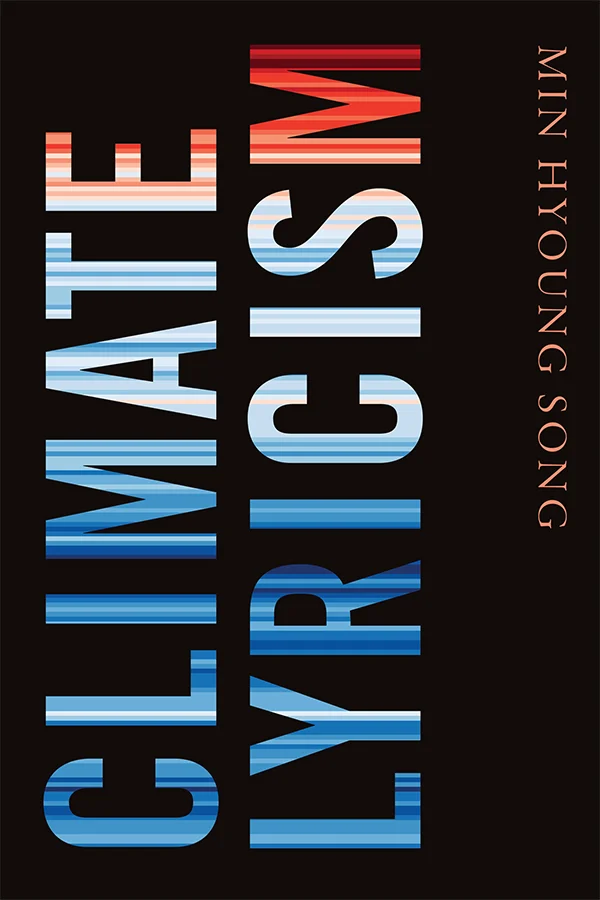
In Climate Lyricism Min Hyoung Song articulates a climate change-centered reading practice that foregrounds how climate is present in most literature. Song shows how literature, poetry, and essays by Tommy Pico, Solmaz Sharif, Frank O’Hara, Ilya Kaminsky, Claudia Rankine, Kazuo Ishiguro, Teju Cole, Richard Powers, and others help us to better grapple with our everyday encounters with climate change and its disastrous effects, which are inextricably linked to the legacies of racism, colonialism, and extraction. These works employ what Song calls climate lyricism—a mode of address in which a first-person “I” speaks to a “you” about how climate change thoroughly shapes daily life. The relationship between “I” and “you” in this lyricism, Song contends, affects the ways readers comprehend the world, fostering a model of shared agency from which it can become possible to collectively and urgently respond to the catastrophe of our rapidly changing climate. In this way, climate lyricism helps to ameliorate the sense of being overwhelmed and feeling unable to do anything to combat climate change.

Praise

“Coining climate lyricism, Min Hyoung Song recuperates collective agency as a mingling of attention, perception, and responsiveness. He doesn’t skirt the despair of climate catastrophe but, rather, reckons with it to find reasons to continue. The book follows its own lyrical flow as it integrates personal reflections from pandemic lockdown with readings of literary texts informed by ecocriticism and critical race theory. Song shows that questions of racist exclusion and harm are never far from questions of environmental thriving, just as the struggles of climate crisis are never far away even when they are not explicit on the page.” - Heather Houser, author of Infowhelm: Environmental Art and Literature in an Age of Data

“Min Hyoung Song presents a thrilling and powerfully argued case for literature and poetry as a means of cultivating sustained attention to climate change in this tumultuous time. Using an innovative framework to draw forth the complex and multifaceted ways climate change becomes apprehensible, Climate Lyricism will undoubtedly make a significant impact on conversations in ecocriticism, contemporary literary studies, and studies of climate change.” - Margaret Ronda, author of Remainders: American Poetry at Nature’s End

"Climate Lyricism . . . moves between a more accessible, informal mode . . . and a more traditional academic style.  . . . Wise and smart and well worth the effort." - Jennifer Carson, To the Lighthouse blog

"Song poses a fascinating question: how do poems and works of fiction that do not appear to be about climate change—particularly those more explicitly engaged with race—show traces of the ongoing ecological crisis? Song’s sources are contemporary and well chosen. . . . Highly recommended. Lower-division undergraduates through faculty." - Choice

"Song’s engagement with writers of color throughout Climate Lyricism offers an important, compelling, and original intervention into both lyric studies and ecocriticism because historically, both of these fields have tended to center white voices and texts." - Heather Milne, ISLE: Interdisciplinary Studies in Literature and Environment

"Climate Lyricism provides valuable insights into how climate change affects different communities and cultures, including Asian Americans. It encourages readers to appreciate nature’s beauty and take action against climate change while emphasizing the need for solidarity among different ethnic groups when tackling environmental issues. This book is particularly relevant to Asian Americans as it urges them to play an active role in addressing this global challenge." - Ang Li, Society for US Intellectual History

"Song's work is effective: the personal tone of his writing is disarming, fostering a deep sense of connection both with the critique of the literature analyzed and with precisely that shared sense of blended agency/urgency that the ecological challenge demands." - Melanie Ebdon, Modern Language Review

"Climate Lyricism . . . has a clear value as a vantage point in offering a mode of thinking about and interrogating the use of critical inquiry in the poetic, fictional, relational, imaginative and literal forms of texts to problematise climate discourses." - Katherine Duffy, Journal of Cultural Economy

"Climate Lyricism encourages the reader to turn attention back to the human, the everyday, and the overwhelming by promoting actively reading for the climate in literature seemingly unrelated to the climate crisis." - Caroliena Cabada, Journal of the Midwest Modern Language Association

"Song’s book may not solve an ecocritic’s sleepless nights once and for all, but it does supply an encouraging call to wake up to the agential possibilities opened by more sustained and sustaining attention." - Mark Simpson, American Literary History

Buy

Availability: Loading...

Price: Loading...

Open Access

Read OA Edition

Funding information for the OA format is found at the bottom of the page.

Request a desk or exam copy

Information

Author/Editor Bios

Back to Top
Min Hyoung Song is Professor of English at Boston College and author of The Children of 1965: On Writing, and Not Writing, as an Asian American and Strange Future: Pessimism and the 1992 Los Angeles Riots, both also published by Duke University Press.

Table Of Contents

Back to Top
Introduction. The Practice of Sustaining Attention to Climate Change  1
Part I. Scope
1. What is Denial? Kazuo Ishiguro’s Never Let Me Go, Teju Cole’s Open City, and Sally Wen Mao’s “Occidentalism”  19
2. Why Revive the Lyric? Claudia Rankine’s Citizen and Craig Santos Perez’s “Love in a Time of Climate Change”  38
3. Why Stay with Bad Feelings? Ilya Kaminsky’s Deaf Republic and Tommy Pico’s IRL  65
4. How Should I Live? Inattention and Everyday-Life Projects  80
Part II. Breath
5. What’s Wrong with Narrative? The Promises and Disappointments of Climate Fiction  101
6. Where Are We Now? Scalar Variance, Persistence, Swing, and David Bowie  121
Part III. Urgency
7. The Scale of the Everyday, Part 1: The Keeling Curve, Frank O’Hara, and Bernadette Mayer  141
8. The Scale of the Everyday, Part 2: Ada Limón, Tommy Pico, and Solmaz Sharif  159
9. The Global Novel Imagines the Afterlife: George Saunders, J.M. Coetzee, and HanKang  180
Conclusion. The Foreign Present—Who Are We to Each Other?  201
Acknowledgments  213
Notes  217
Bibliography  233
Index  243

Rights

Back to Top

Sales/Territorial Rights: World

Rights and licensing

Awards

Back to Top

Winner of the 2023 Association for the Study of Literature and Environment (ASLE) Book Award for Scholarly Ecocriticism

Additional Information

Back to Top

Funding Information

Back to Top
This title is freely available in an open access edition made possible by generous support from Boston College.