
Home / Books / Composing Violence

Composing Violence

The Limits of Exposure and the Making of Minorities
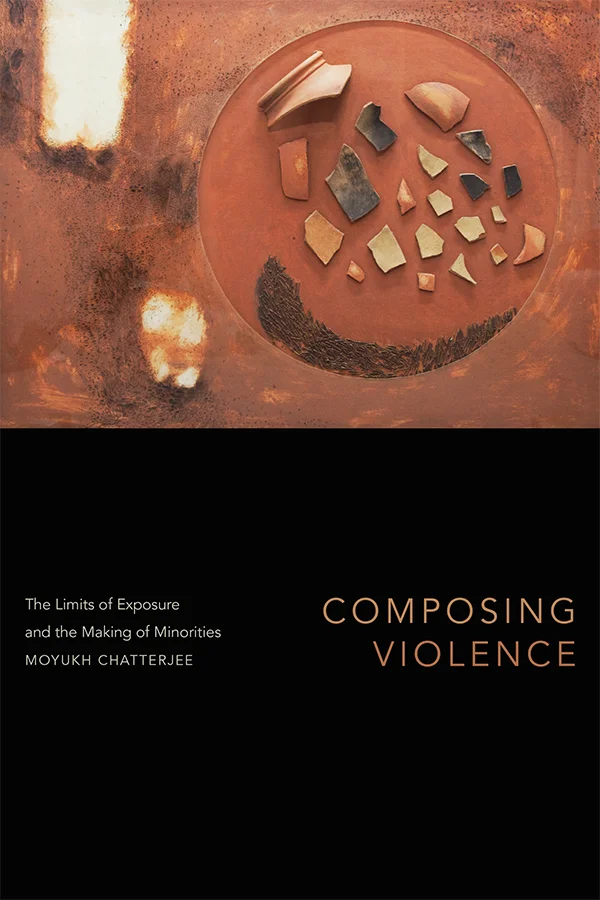
Book

Pages: 184

Illustrations: 6 illustrations

Published: February 2023

In 2002, armed Hindu mobs attacked Muslims in broad daylight in the west Indian state of Gujarat. The pogrom, which was widely seen over television, left more than one thousand dead. In Composing Violence Moyukh Chatterjee examines how highly visible political violence against minorities acts as a catalyst for radical changes in law, public culture, and power. He shows that, far from being quashed through its exposure by activists, media, and politicians, state-sanctioned anti-Muslim violence set the stage for transforming India into a Hindu supremacist state. The state's and civil society’s responses to the violence, Chatterjee contends, reveal the constitutive features of modern democracy in which riots and pogroms are techniques to produce a form of society based on a killable minority and a triumphant majority. Focusing on courtroom procedures, police archives, legal activism, and mainstream media coverage, Chatterjee theorizes violence as a form of governance that creates minority populations. By tracing the composition of anti-Muslim violence and the legal structures that transform that violence into the making of minorities and majorities, Chatterjee demonstrates that violence is intrinsic to liberal democracy.

Praise

“In this powerful book, Moyukh Chatterjee gives us a brief, elegant, and novel way of thinking about violence.” - Nancy Rose Hunt, author of A Nervous State: Violence, Remedies, and Reverie in Colonial Congo

“Moyukh Chatterjee offers an ethnography of the infrastructure of political violence—which is also the infrastructure of democracy—across the diverse registers of policing, activism, and the media. By mobilizing political philosophy, literary theory, legal theory, anthropology, and the sociology of knowledge, Chatterjee makes insights that are equally relevant to South Asia, the United States, and to democracies across the world.” - Prathama Banerjee, author of Elementary Aspects of the Political: Histories from the Global South

"It is through scholarship of the kind offered by Composing Violence that we can grapple with questions of mass violence, impunity and justice after violence in South Asia, and beyond, in any meaningful way."

- Chulani Kodikara, Social and Legal Studies

"Composing Violence provides us with a necessary punch in the stomach. Its urgency lies in the way in which it forces us to look at, and begin to think anew with, what we know well but persist in overlooking: that violence against (religious) minorities is not exceptional or deviant, but mainstream." - Vera Lazzaretti, Religion and Society

"Chatterjee is at his best when he observes, records, and analyses in his own voice; Composing Violence is a testimonial to the importance of the activist-academic in combating the ideological and institutional forms of right-wing majoritarianism in India and elsewhere." - Suvir Kaul, American Ethnologist

"The book provides significant insights into the ways the Gujarati authorities made use of the communal violence to produce and reproduce a relationship between Muslim minorities and Hindu majorities that is intertwined with the political struggle of belonging and citizenship in India more widely. Chatterjee’s argument, that democracy (free and fair elections, rule of law, due process) institutes a relationship between population numbers and power that locks societies into a trajectory of either minority or majority rule, merits closer review through case studies of other locales." - Nishkala Suntharalingam, Asian Affairs

"Composing Violence is of great interest to researchers of social issues of race, religion, ethics and violence. It will also interest those who study the South Asian region and are engaged in Indian studies." - Georgi Asatryan, Ethnic and Racial Studies

"Composing Violence is an important read in the face of, and as a form of equipment against, globally rising right-wing politics and the everyday threat of Hindu nationalism." - Anushka Chaudhuri, Contemporary South Asia

"Composing Violence is a much needed intervention in understanding the nature of emerging religious disturbances across Indian cities and countering the ‘bulldozer justice’ hegemon that operates in the garb of the rule of law." - Devansh Shrivastava, Social Identities

Buy

Availability: Loading...

Price: Loading...

Request a desk or exam copy

Information

Author/Editor Bios

Back to Top
Moyukh Chatterjee is a Lecturer in the Department of Social Anthropology in the University of Edinburgh.

Table Of Contents

Back to Top
Acknowledgments  ix
Introduction. The Limits of Exposure  1
1. A Minor Reading  34
2. Composing the Archive  56
3. Against the Witness  76
4. Anti-Impunity Activism  93
5. Beyond the Unspeakable  107
Conclusion. Minor, Minorities, Minorization  127
Notes  139
Bibliography  151
Index  163

Rights

Back to Top

Sales/Territorial Rights: World

Rights and licensing

Additional Information

Back to Top
Related Links Paper ISBN: 978-1-4780-1966-4 / Hardcover ISBN: 978-1-4780-1702-8 / eISBN: 978-1-4780-2429-3 / DOI: https://doi.org/10.1215/9781478024293