
Home / Books / Concrete Dreams

Concrete Dreams

Practice, Value, and Built Environments in Post-Crisis Buenos Aires
Book

Pages: 312

Illustrations: 55 illustrations

Published: November 2019

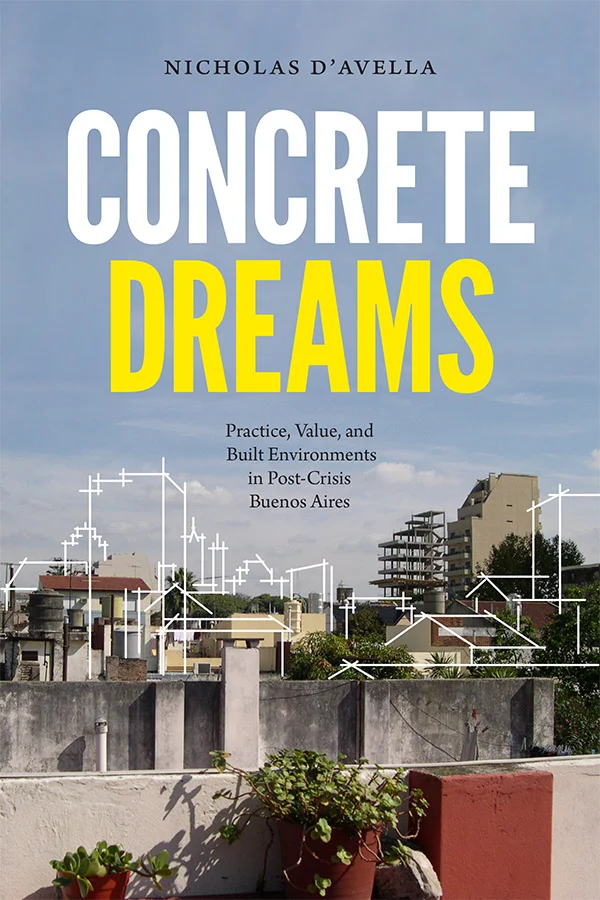
In Concrete Dreams Nicholas D’Avella examines the changing social and economic lives of buildings in the context of a construction boom following Argentina's political and economic crisis of 2001. D’Avella tells the stories of small-scale investors who turned to real estate as an alternative to a financial system they no longer trusted, of architects who struggled to maintain artistic values and political commitments in the face of the ongoing commodification of their work, and of residents-turned-activists who worked to protect their neighborhoods and city from being overtaken by new development. Such forms of everyday engagement with buildings, he argues, produce divergent forms of value that persist in tension with hegemonic forms of value. In the dreams attached to built environments and the material forms in which those dreams are articulated—from charts and graphs to architectural drawings, urban planning codes, and tango lyrics—D’Avella finds a blueprint for building livable futures in which people can survive alongside and even push back against the hegemony of capitalism.

Praise

Concrete Dreams is a beautifully written ethnography that focuses on how the specific everyday practices of lay investors, real estate analysts, and architects produce divergent forms of value in the volatile political and economic landscape of recent Argentine history. The ethnographic narratives show exactly how ‘buildings’ emerge as partially connected conceptual and concrete entities that hold value as investments, as objects of design, and as homes. The power of the analysis lies in the combination of a deep understanding of dominant economic modes of valuation with a sensitivity to the fragile relational spaces where alternative possibilities are kept alive.” - Penny Harvey, University of Manchester

“Nicholas D’Avella has managed to take a topic central to the historical sweep of Argentine political economy and written an intimate, engaging portrait of quotidian life amid economic uncertainty. He makes real estate markets and municipal zoning understandable at the macro-scale with which they crash economies and at the micro-scale that causes people to strap money to their bodies. Ambitious and weighty, subtle and intimate, Concrete Dreams is an exceptional urban ethnography.” - Kregg Hetherington, editor of Infrastructure, Environment, and Life in the Anthropocene

“...Concrete Dreams is a welcome contribution to the study of contemporary urban transformation in Latin America.... At a time when Buenos Aires is confronting the growth of high-rise luxury developments and mega real estate projects, D’Avella offers a glimmer of hope amid the threats to green spaces, heritage and barrio life.” - Cecilia Dinardi, International Journal of Urban and Regional Research

“The book develops an innovative approach to comprehending broad historical shifts in political economy from an ethnographic perspective. D’Avella’s writing is eloquent and engaging.... [Concrete Dreams] is definitely a rewarding read for a broad interdisciplinary social science audience.” - Virág Molnár, American Journal of Sociology

Concrete Dreams is an engaging and rigorous ethnographic exploration of built environments within post-crisis Buenos Aires.... Any reader ... who wishes to know more about the built environments of Buenos Aires, the people in them, and the history of them, would do well to pick it up.”
  - Jeremy R. Grossman, Journal of Cultural Economy

“Taking an anthropological approach to everyday life in post-crisis Buenos Aires, Concrete Dreams does not reduce practices to a market-centered matrix.... D’Avella’s book allows us to avoid oversimplifying ways of living in the city.” - Gonzalo Saavedra, American Anthropologist

Concrete Dreams is a worthwhile and engaging ethnography that has much to offer to those interested in methodological innovations in anthropology and in refreshing perspectives on the built environment in the city of Buenos Aires and beyond.”
  - Adriana Premat, Anthropos

“With Concrete Dreams, D’Avella brings an opportunity to renew methodological and disciplinary discussions about the way we know the city, its ecology and its economy.” [Translated from Spanish]

- María Florencia Labiano, Sudamérica

“[Concrete Dreams] one of the best and most nuanced studies on Buenos Aires, Argentina, and urban Latin America.... [D’Avella’s] examination of the prelude and aftermath of the 2001 crisis is dexterous, insightful, and relevant in cultural, political economy, and affective terms.” - Juan M. del Nido, Bulletin of Latin American Research

“D’Avella brings to life the everyday experiences of residents of single-floor homes as high-rise buildings blocked the sun, casting shadows over urban gardens.” - Denisa Jashari, Latin American Research Review

Buy

Availability: Loading...

Price: Loading...

Request a desk or exam copy

Information

Author/Editor Bios

Back to Top
Nicholas D’Avella is an anthropologist who lives in Brooklyn, New York.

Table Of Contents

Back to Top
Acknowledgments  vii
Introduction. Concrete Dreams  1
1. Crisis Histories, Brick Futures: Economic Storytelling and Investments in Real Estate  32
2. A Market in Square Meters: Numbers and Narrative in Real Estate Market Analysis  67
3. Barrio Ecologies: Parks, Patios, and the Politics of Articulation  94
4. Recoding the City: Plans, Codes, and the Politics of Voice  140
5. Architecture is for Everyone: Bodies, Drawing, and the Politics of Care  179
Epilogue. Enduring Values  222
Notes  235
Works Cited  255
Index  271

Rights

Back to Top

Sales/Territorial Rights: World

Rights and licensing

Additional Information

Back to Top
Paper ISBN: 978-1-4780-0630-5 / Hardcover ISBN: 978-1-4780-0535-3 / eISBN: 978-1-4780-0511-7 / DOI: https://doi.org/10.1215/9781478005117