
Home / Books / Cooking Data

Cooking Data

Culture and Politics in an African Research World
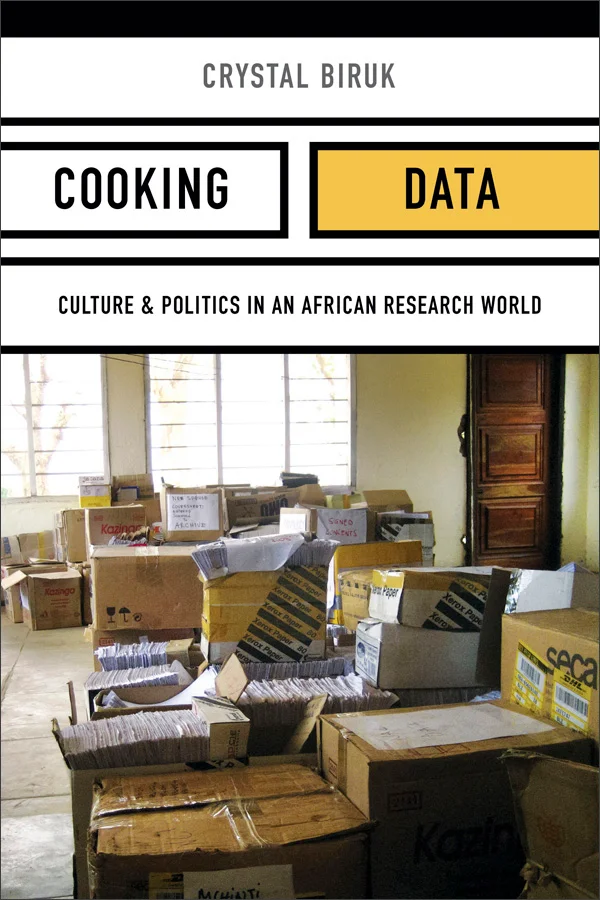
Cooking Data cover image

Critical Global Health: Evidence, Efficacy, Ethnography

More about this series

Read the Introduction

Book

Pages: 296

Illustrations: 8 illustrations

Published: April 2018

In Cooking Data Cal Biruk offers an ethnographic account of research into the demographics of HIV and AIDS in Malawi to rethink the production of quantitative health data. While research practices are often understood within a clean/dirty binary, Biruk shows that data are never clean; rather, they are always “cooked” during their production and inevitably entangled with the lives of those who produce them. Examining how the relationships among fieldworkers, supervisors, respondents, and foreign demographers shape data, Biruk examines the ways in which units of information—such as survey questions and numbers written onto questionnaires by fieldworkers—acquire value as statistics that go on to shape national AIDS policy. Her approach illustrates how on-the-ground dynamics and research cultures mediate the production of global health statistics in ways that impact local economies and formulations of power and expertise.

Praise

"This book is going to find a wide audience throughout and beyond global health and anthropology—Crystal Biruk's attention to language and metaphor makes Cooking Data eminently teachable. This is superior scholarship that is very well grounded in everyday life and the peculiar world of research. I learned a great deal." - Claire L. Wendland, author of A Heart for the Work: Journeys through an African Medical School

"This is not a simple revelation story in which we learn that data in research projects is socially contingent. It is a cultural study of demography research in the field, and the end product is the best we can do in anthropology—familiar things are made unfamiliar, conditional, and fragile. Crystal Biruk's work is quite simply fantastic." - Vincanne Adams, author of Markets of Sorrow, Labors of Faith: New Orleans in the Wake of Katrina

Cooking Data is a readable and engaging book. Biruk builds a sophisticated theoretical argument through ethnographically grounded storytelling. The narrative moves beyond familiar oppositions between the rich complexity of people’s lives and the uncaring simplicity of numbers that characterize much critical writing about the processes that turn human beings and communities, with their complicated life stories and histories, into quantitative data.” - Brendan Tuttle, Anthropology Book Forum

“A brilliant example of an ethnography of global health. Crystal Biruk offers a very insightful, convincingly argued and well-substantiated account of the effects of what has become the most common type of research not only in global health but the development industry more generally.”

- Anna Wolkenhauer, LSE Review of Books

"Bookended by a thoughtful introduction and conclusion . . . I recommend this book to anyone who does survey work in Africa. . . . Its prose is scholarly but accessible and Biruk does a good job of marrying theoretical concepts to real world examples." - Kevin Fridy, Journal of Modern African Studies

"Cooking Data succeeds . . . by giving life to the trajectory of data from raw to cooked and troubling what we think we know about what happens in the field." - Monica Grant, Population and Development Review

"Impressive in its focus and scope, Cooking Data makes a clear and compelling case for the social thickness of numbers. . . . This is a substantive contribution to our understanding of the role of data in global health." - Damien Droney, Somatosphere

"Cooking Data is a powerful critique of the understanding that survey data are an objective and complete representation of reality. . . . I strongly recommend using this publication as a required reading in undergraduate and graduate courses in Anthropology, Demography, Sociology, and related social sciences that teach students to design and conduct qualitative as well as quantitative research. Further, those interested in African Studies, Global Health, and International Development will tremendously benefit from reading this publication as these disciplines are strongly influenced by survey research. The book is also a must-read for agencies, policy makers, and funding agencies. . . ." - Alexander Rödlach, Anthropos

“The continued relevance of Biruk’s work is clear in the midst of the global COVID-19 pandemic…. At a time when trust in numbers is increasingly shaken, Biruk offers nuanced insights on the production of numbers that prompts discussion about the role of feminist science studies to both critically examine how numbers attain their authority and simultaneously build capacity for fact based decision making in a post-truth era where powerful leaders intentionally spread harmful misinformation.” - Angela Okune, Catalyst

Cooking Data is a sharply written, meticulously organised and creatively argued book…. Cooking Data is more than an ethnography of demographic practice: it is a glimpse into the worlds that enumeration brings into being. It is also a forceful call for all researchers, especially anthropologists, to be more expansive in considering field ethics, more mindful in their par­ticipation in asymmetrical relations and more useful in their contributions to global health.” - Arianna Huhn, Anthropologica

“This book provides a valuable contribution to different fields of anthropology.... Also, the book provides great methodological insights into the process of ‘fieldwork within fieldwork,’ especially the elements of autoethnography (for example, the conflict of dual identity as an anthropologist and fieldwork supervisor).” - Suzana Ignjatovic, Anthropological Notebooks

Buy

Availability: Loading...

Price: Loading...

Open Access

Request a desk or exam copy

Information

Author/Editor Bios

Back to Top
Cal (Crystal) Biruk is Assistant Professor of Anthropology at Oberlin College.

Table Of Contents

Back to Top
Acknowledgments  ix
Introduction. An Anthropologist among the Demographers: Assembling Data in Survey Research Worlds  1
1. The Office in the Field: Building Survey Infrastructures  31
2. Living Project to Project: Brokering Local Knowledge in the Field  67
3. Clean Data, Messy Gifts: Soap-for-Information Transactions in the Field  100
4. Materializing Clean Data in the Field  129
5. When Numbers Travel: The Politics of Making Evidence-Based Policy  166
Conclusion. Anthropology in and of (Critical) Global Health  200
Appendix. Sample Household Roster Questions  217
Notes  223
Bibliography  237
Index  269

Rights

Back to Top

Sales/Territorial Rights: World

Rights and licensing

Additional Information

Back to Top
Related Links Paper ISBN: 978-0-8223-7089-5 / Hardcover ISBN: 978-0-8223-7074-1 / eISBN: 978-0-8223-7182-3 / DOI: https://doi.org/10.1215/9780822371823

Publicity material