
Home / Books / Cooling the Tropics

Cooling the Tropics

Ice, Indigeneity, and Hawaiian Refreshment
Book

Pages: 264

Illustrations: 10 illustrations

Published: December 2022

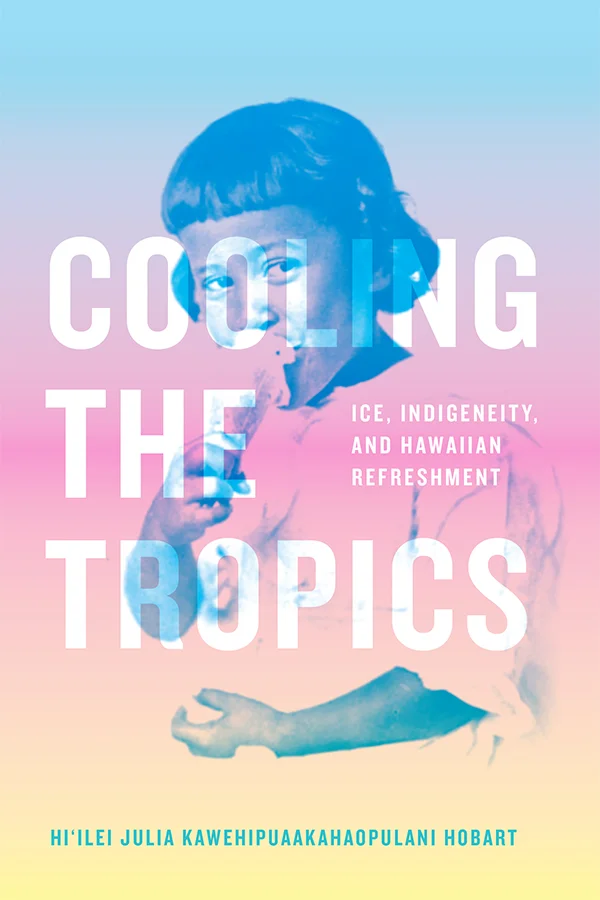
Beginning in the mid-1800s, Americans hauled frozen pond water, then glacial ice, and then ice machines to Hawaiʻi—all in an effort to reshape the islands in the service of Western pleasure and profit. Marketed as “essential” for white occupants of the nineteenth-century Pacific, ice quickly permeated the foodscape through advancements in freezing and refrigeration technologies. In Cooling the Tropics Hiʻilei Julia Kawehipuaakahaopulani Hobart charts the social history of ice in Hawaiʻi to show how the interlinked concepts of freshness and refreshment mark colonial relationships to the tropics. From chilled drinks and sweets to machinery, she shows how ice and refrigeration underpinned settler colonial ideas about race, environment, and the senses. By outlining how ice shaped Hawaiʻi’s food system in accordance with racial and environmental imaginaries, Hobart demonstrates that thermal technologies can—and must—be attended to in struggles for food sovereignty and political self-determination in Hawaiʻi and beyond.

Praise

“In this remarkable book, Hi‘ilei Julia Kawehipuaakahaopulani Hobart looks to the deep, and not so deep, histories of ice and coldness in Hawai‘i to provide theoretical and ethnographic insight into the relationships between settler colonialism, American imperialism, the environment, racism, bodies, aesthetics, taste, and Kanaka Maoli sovereignty. It is a beautifully written, genre-bending contribution that is one of the only truly transdisciplinary books I have ever read.” - Paige West, Claire Tow Professor of Anthropology, Barnard College and Columbia University

“By showing how cold drinks and foods were a way for white American settlers to make Hawai‘i feel more like home and to further emphasize how uncivilized Native Hawaiians were for not understanding ice and using it correctly, Hi‘ilei Julia Kawehipuaakahaopulani Hobart demonstrates that the management of climate and taste is a significant mode of power that settler colonialism operates through. This outstanding, compelling, and important book will make a significant impact on our understandings of Hawaiian history and settler colonialism writ large.” - Maile Arvin, author of Possessing Polynesians: The Science of Settler Colonial Whiteness in Hawai‘i and Oceania

"Cooling the Tropics offers a compelling model for future research focused on the simultaneously sensorial, biopolitical, and ecological implications of colonialism’s thermal infrastructures." - Hsuan L. Hsu, The Senses and Society

"Fascinating and thoughtful. . . . Recommended. General readers and advanced undergraduates through faculty." - F. Ng, Choice

Cooling the Tropics is well worth reading. … With many revealing and fascinating examples, [Hobart] tells an engaging story of the American colonisation of Hawaii that is open, unfixed and challengeable.”

- Helene Brembeck, Review of Agricultural, Food, and Environmental Studies

"Contributing to a rich, contemporary conversation of critical ruminations on materiality, the elements, and questions of race and indigeneity, Cooling the Tropics pushes readers to think about how indigeneity is shaped in colonial discourses. … This well researched book will fascinate and keep readers on the hook."

- Jen Rose Smith, Society and Space

"Well researched, and it is also well written ... Cooling the Tropics is certainly worth reading. It pulls together ideas on food pathways, extractive industries, indigenous studies, and environmental forms of knowledge in a way that is both provocative and productive."

- Kenna Archer, H-Environment, H-Net Reviews

"Throughout the book, Hobart’s eloquent, witty, yet to-the point writing style is outstanding. . . . By bringing together analyses of settler colonialism, sensorial experiences, and food, the author creates evocative word combinations and points to seemingly mundane phenomena—such as to melting ice toward the end of the book—that form new concepts." - Mascha Gugganig, Gastronomica

"A work like Hobart’s Cooling the Tropics is a much-needed investigation into how ice served as a necessary conduit for American influence to grow and expand within the Hawaiian
Islands. . . . Hobart’s work is a chilling reminder that despite encroaching American influence, the tropics and, by extension, Native Hawaiian bodies could not be packed, moulded, or served alongside icy commodities. Instead, Kanaka Maoli persevered in the face of shifting power dynamics by remaining cool and collected, and ultimately reaffirmed their presence in the islands." - Kale Kanaeholo, Journal of Pacific History

"With Cooling the Tropics, Hobart has contested these depictions and convincingly opened a path for future studies of colonialism, Indigeneity, and foodways in the Pacific. For these reasons, scholars across disciplines and fields will find Hobart’s careful study . . . refreshing." - Issay Matsumoto, Journal of American Ethnic History

"Until reading this book, I had not fully grasped the impacts of thermal dependency on our lives and futures. . . . After reading this book I now realize that my thinking about Indigenous resurgence and futurity needs to also attend to issues of temperature control, refrigeration, and ice."
  - Hokulani K. Aikau, Native American and Indigenous Studies

"Cooling the Tropics has a substantial bibliography and notes and will fit beautifully into an undergraduate or graduate course in ethnography, anthropology, sociology, Hawaiian Studies, food and culture courses, and political science. Hobart weaves a narrative that leads towards another way to consider the history and culture of the Kanaka Maoli of Hawai‘i." - Kristin McAndrews, Hawaiian Journal of History

"Cooling the Tropics crafts a detailed history of ice and refrigeration to reveal the operations of thermal colonialism in Hawai?i." - Mariko Chin Whitenack, Catalyst

"Cooling the Tropics is an engaging text that will make generative reading for anyone interested in the relationship between foodways and colonial history but may hold specific interest for those interested in technological development and thermal media." - Briand Gentry, Journal of Cinema and Media Studies

Buy

Availability: Loading...

Price: Loading...

Request a desk or exam copy

Information

Author/Editor Bios

Back to Top
Hiʻilei Julia Kawehipuaakahaopulani Hobart is Assistant Professor of Native and Indigenous Studies at Yale University and editor of The Foodways of Hawaiʻi: Past and Present.

Table Of Contents

Back to Top
Note on ‘Ōlelo Hawai‘i Usage  vii
Acknowledgments  ix
Introduction: Feeling Cold in Hawai‘i  1
1. A Prehistory of the Artificial Cold in Hawai‘i  21
2. Vice, Virtue, and Frozen Necessities in the Sovereign City  47
3. Making Ice Local: Technology, Infrastructure, and Cold Power in the Kalākaua Era  71
4. Cold and Sweet: The Taste of Territorial Occupation  91
5. Local Color, Rainbow Aesthetics, and the Racial Politics of Hawaiian Shave Ice  113
Conclusion: Thermal Sovereignties  137
Notes  147
Bibliography  205
Index  233

Rights

Back to Top

Sales/Territorial Rights: World

Rights and licensing

Awards

Back to Top

Co-Winner of the 2023 Native American and Indigenous Studies Association (NAISA) First Book Award

Honorable Mention, 2023 Lora Romero First Book Prize, presented by the American Studies Association

DUP First Book Fund Recipient