
Home / Books / Counterlife

Counterlife

Slavery after Resistance and Social Death
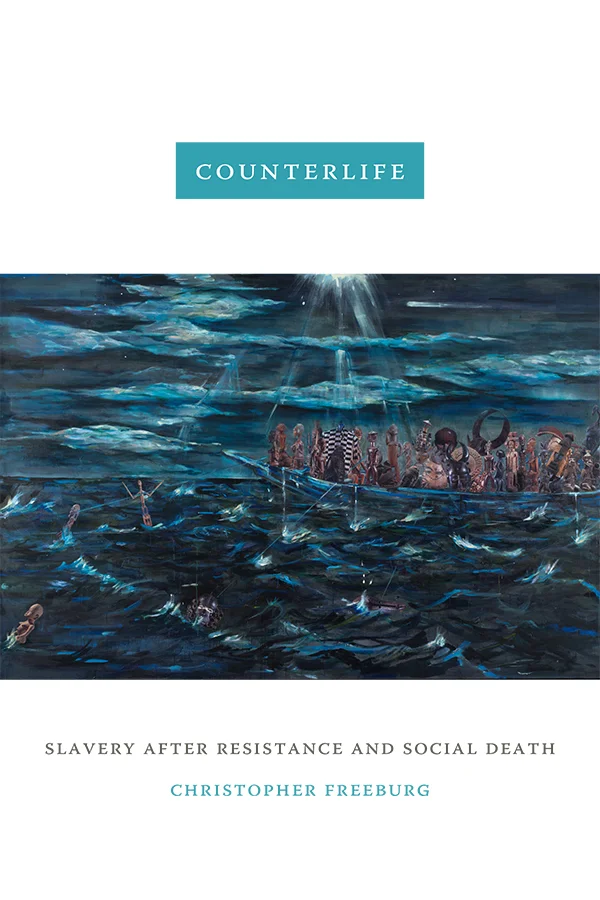
Book

Pages: 152

Illustrations: 5 illustrations

Published: January 2021

In Counterlife Christopher Freeburg poses a question to contemporary studies of slavery and its aftereffects: what if freedom, agency, and domination weren't the overarching terms used for thinking about Black life? In pursuit of this question, Freeburg submits that current scholarship is too preoccupied with demonstrating enslaved Africans' acts of political resistance, and instead he considers Black social life beyond such concepts. He examines a rich array of cultural texts that depict slavery—from works by Frederick Douglass, Radcliffe Bailey, and Edward Jones to spirituals, the television cartoon The Boondocks, and Quentin Tarantino's Django Unchained—to show how enslaved Africans created meaning through artistic creativity, religious practice, and historical awareness both separate from and alongside concerns about freedom. By arguing for the impossibility of tracing slave subjects solely through their pursuits of freedom, Freeburg reminds readers of the arresting power and beauty that the enigmas of Black social life contain.

Praise

“The boldness and ambition of Christopher Freeburg's Counterlife are apparent on every page. Freeburg challenges decades of work on U.S. slavery that highlights either slave resistance or white dominance, but often not more than that. As an alternative, Freeburg insists that we consider the many possibilities of both Black life during slavery and the ways that we now dare to imagine and reference that life.” - Robert F. Reid-Pharr, author of Archives of Flesh: African America, Spain, and Post-Humanist Critique

“Christopher Freeburg's theory of counterlife is the refreshing new grammar that breaks out of slavery studies' conscious and unconscious lapses into the binary of social death or social life. Counterlife adds crucial new dimensions to the study of the artistic representation of enslaved Africans. This bold, brilliant study teaches us how to stumble, with uncertainty and vulnerability, into the ever-expanding archive of slavery.” - Margo Natalie Crawford, author of Black Post-Blackness: The Black Arts Movement and Twenty-First-Century Aesthetics

“Counterlife is somewhat loosely defined. . . . The virtue of this more speculative approach is that it brings widely ranging works into dialogue with each other and takes seriously the ways in which writers might wish to write against moral and political expectations—not so much resisting slavery as resisting its dominant modes of representation.” - Colin Harrison, Modern Language Review

Buy

Availability: Loading...

Price: Loading...

Request a desk or exam copy

Information

Author/Editor Bios

Back to Top
Christopher Freeburg is Professor of English at the University of Illinois at Urbana-Champaign and author of Black Aesthetics and the Interior Life and Melville and the Idea of Blackness: Race and Imperialism in Nineteenth-Century America.

Table Of Contents

Back to Top
Acknowledgments
Introduction: Slavery's Hereafter
1. Sambo's Cloak
2. Kaleidoscope Views
3. Sounds of Blackness
4. The Last Black Hero
Coda: Chasing Ghosts
Notes
Bibliography

Rights

Back to Top

Sales/Territorial Rights: World

Rights and licensing