
Home / Books / Cowards Don′t Make History

Cowards Don′t Make History

Orlando Fals Borda and the Origins of Participatory Action Research
Book

Pages: 312

Illustrations: 39 illustrations

Published: October 2020

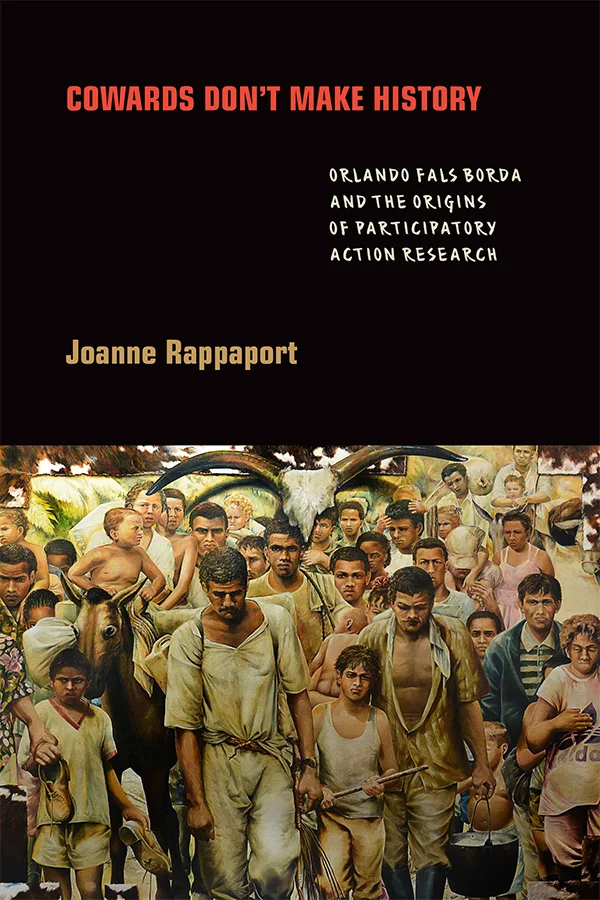
In the early 1970s, a group of Colombian intellectuals led by the pioneering sociologist Orlando Fals Borda created a research-activist collective called La Rosca de Investigación y Acción Social (Circle of Research and Social Action). Combining sociological and historical research with a firm commitment to grassroots social movements, Fals Borda and his colleagues collaborated with indigenous and peasant organizations throughout Colombia. In Cowards Don’t Make History Joanne Rappaport examines the development of participatory action research on the Caribbean coast, highlighting Fals Borda’s rejection of traditional positivist research frameworks in favor of sharing his own authority as a researcher with peasant activists. Fals Borda and his colleagues inserted themselves as researcher-activists into the activities of the National Association of Peasant Users, coordinated research priorities with its leaders, studied the history of peasant struggles, and, in collaboration with peasant researchers, prepared accessible materials for an organizational readership, thereby transforming research into a political organizing tool. Rappaport shows how the fundamental concepts of participatory action research as they were framed by Fals Borda continue to be relevant to engaged social scientists and other researchers in Latin America and beyond.

Praise

“All of us who attempt to practice politically engaged research have stood on the shoulders of Orlando Fals Borda. With the publication of Cowards Don't Make History we finally understand why: Joanne Rappaport's meticulous research reveals the profoundly creative and original alchemy that resulted when virtuoso academics collaborated with equally talented grassroots intellectuals in shared political struggles and knowledge production. Rappaport enables us to honor Fals Borda's life work, not as infallible model or method, but as stern inspiration for the unfinished tasks of twenty-first-century social science, still in search of the courage fully to confront the somber urgencies of the present.” - Charles R. Hale, coeditor of Otros Saberes: Collaborative Research on Indigenous and Afro-Descendant Cultural Politics

“The essential, definitive reference for this crucial stage of Orlando Fals Borda's thought, politics, and collaborative research, Cowards Don't Make History reaches beyond Latin America to all who are concerned with the social construction of knowledge and the politics and sociology of knowledge. This stimulating, innovative, and rigorous book is a model for exploratory, interactive research.” - Catherine C. LeGrand, coeditor of Close Encounters of Empire: Writing the Cultural History of US-Latin American Relations

"This book is for the specialist but will find wide appeal across the social sciences; sociologists will read the book, as well as anthropologists, historians and folks interested in graphic novels/comics as sources.… Rappaport's work forces researchers and scholars outside of Colombia to think more critically about scholarship and activism." - Michael J. LaRosa, ReVista

"Cowards Don’t Make History is an informative read for anthropologists of education. Engaged and activist researchers will appreciate the archival examination of a seminal researcher operating in a contentious political context. . . . Critical teacher educators will welcome the book as a tool for deconstructing the ethical, cultural, and political nature of education. Finally, researchers who are curious about the politics of socially constructed knowledge will find this book both compelling and thought provoking." - Kyle Kopsick, Anthropology and Education Quarterly

"An impressive volume." - Christine Hünefeldt, The Americas

"... provide[s] one of, if not the most comprehensive English-language account of PAR’s origins, filling a crucial gap given that much of Fals Borda’s work remains untranslated." - Pedro Reynolds-Cuéllar, Tapuya

Buy

Availability: Loading...

Price: Loading...

Request a desk or exam copy

Information

Author/Editor Bios

Back to Top
Joanne Rappaport is Professor of Latin American Literature and Cultural Studies at Georgetown University and author of The Disappearing Mestizo: Configuring Difference in the Colonial New Kingdom of Granada, Beyond the Lettered City: Indigenous Literacies in the Andes, and Intercultural Utopias: Public Intellectuals, Cultural Experimentation, and Ethnic Pluralism in Colombia, all also published by Duke University Press.

Table Of Contents

Back to Top
List of Illustrations  ix
Cast of Characters  xi
Preface  xvii
Introduction  1
1. The Fundación del Caribe in Córdoba  29
2. Archives and Repertoires  46
3. Participation  66
4. Critical Recovery  94
5. Systematic Devolution  130
6. Engagement and Reflection  169
7. Fals Borda's Legacy  197
Notes  233
References Cited  243
Index

Rights

Back to Top

Sales/Territorial Rights: World

Rights and licensing

Awards

Back to Top

Winner of the 2022 Michael Jiménez Award, presented by the Colombia Section of the Latin American Studies Association

Additional Information

Back to Top
Paper ISBN: 978-1-4780-1101-9 / Hardcover ISBN: 978-1-4780-0998-6 / eISBN: 978-1-4780-1254-2 / DOI: https://doi.org/10.1215/9781478012542