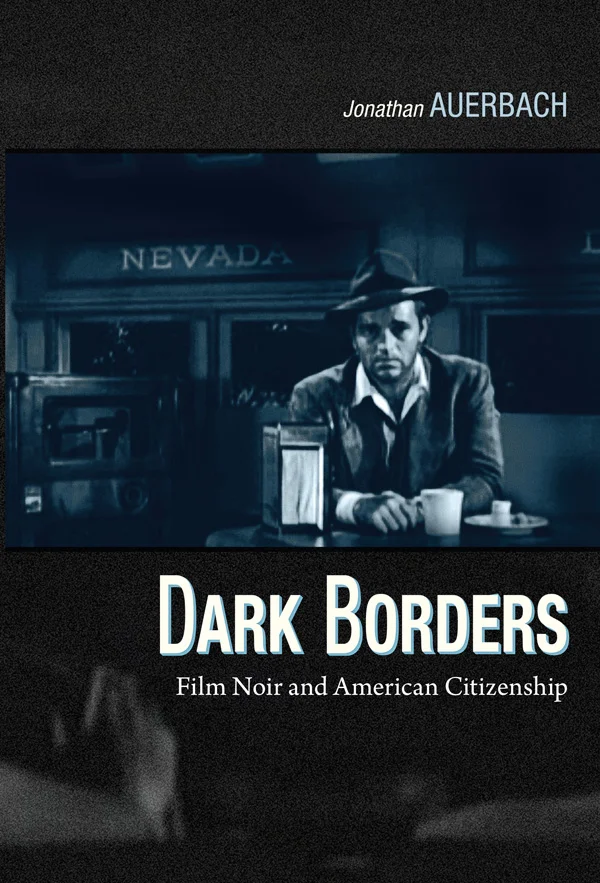
“This terrific book offers fresh insight into both the genre of film noir and the cultural production of the postwar and early Cold War period. Through rich, historically contextualized readings of a range of noir films, Jonathan Auerbach shows how the genre captured the uncanniness of a time of suspicion and paranoia. By illuminating the uncanny figures (the immigrants, the aliens, the strangers) and spaces (national borders and urban zones) that characterize the noir affect, he shows how these films dramatized the national response to the changing terms of citizenship and subjectivity as the anxious fear of the stranger within.” - Priscilla Wald, author of Contagious: Cultures, Carriers, and the Outbreak Narrative
“While scholars have long attended to film noir as one of the preeminent genres of U.S. cinema, they ironically have rarely studied it in terms of its specific engagements with national self-identity and self-definition. Deftly employing his strong and reputed background in American studies to far-reaching ends, Jonathan Auerbach shows precisely how film noir was central to the country’s self-questioning in the fraught times of the Cold War. This is a groundbreaking study that comes up with trenchant insights about a genre that one might have thought had nothing new to yield to critical inquiry.” - Dana Polan, author of Julia Child’s The French Chef
“[A] wholly original, ground-level reconsideration of noir's cultural setting. . . . Auerbach's book augurs . . .a theory-to-come of U.S. film that can leam to disable those old tropes and inspire truly fresh lines of aesthetic and political questioning.” - Matt Tierney, Film Criticism
“The book as a whole is exemplary in its analysis of the interrelation between film noir and the social and political history of the 1940s and early 50s.” - Martin Fradley, Film Quarterly
“Auerbach provides unique close readings of a select group of films that assist us in seeing film noir in relation to concerns over citizenship and Cold War paranoia. It provides a valuable starting point from which we can hope future scholarship will further delve into such connections.” - Christopher Robé, Journal of American History
“Dark Borders utilizes a pluralistic and intermedia methodology in order to investigate the complex issues involving boundary setting in highly significant areas of American culture. Of course, an underlying yet unacknowledged truth is that these same areas are problematic today. Therefore, there is much to learn about American ideology in Dark Borders.” - Brian E. Butler, New Review of Film and Television Studies
“This insightful study wisely ranges beyond the genre’s usual suspects. Recommended. All readers.” - M. Yacowar, Choice
“[I]f you have an abiding interest in film noir . . . you will find Dark Borders has a lot to offer. While most books on film noir take a rather broad approach in their examination of the genre, Auerbach chose a core of films to study in order to link the book’s overriding theme. By concentrating on a handful of films, he provides a comprehensive insight to each one, and therein lies the strength of the book.” - Phil Stufflebean, American Film Noir
“]Auerbach’s] rigorous and creative readings of these films will prove indispensable for serious students of noir. . . . some of the most exciting moments to be noted in Auerbach’s compelling book demonstrate nuanced uses of cultural history to inform his film analysis. Such exciting subjects include Lucky Luciano and the Second World War, Hemingway’s annoyance over inefficient government help during the 1935 hurricane, and the emergence of corporate and managerial structures of power and identity.” - Sam B. Girgus, American Literature
“Auerbach offers some significant fresh insights into territory one would have thought to now be fully excavated.“ - Tony Williams, Screening the Past
“Auerbach evokes the ever-present sense of fear existing in an early Cold War American public through his analysis of these films. Both insightful and unique in its undertaking, this book speaks openly and convincingly to the relationship between political agenda, disenfranchisement and art.” - Laura Crawford, Media International Australia
“Dark Borders is a terrific book, showing that film noir is the gift that keeps on giving. . . . [A] truly significant addition to films studies, American Studies, queer studies and studies on the left, providing deep insights into the Cold War and its affects — and effects.” - Paula Rabinowitz, Against the Current
“By historically contextualizing each film, drawing perceptive connections within and between films, and weaving together an impressive range of insights into a nuanced and complex analysis of some of noir’s more subtle dimensions, Auerbach provides a valuable contribution to our understanding of how film noir reflected cold war fears surrounding American citizenship and national identity.” - David Friedkin, Film & History
“Auerbach’s book is a thoughtful, well-researched, and historically grounded study that offers a valuable contribution to the study of film noir and to the concept of citizenship during a time of crisis.” - Victoria L. Smith, Quarterly Review of Film and Video
"Dark Borders deserves to be highlighted as a major, thoughtful contribution to the landscape of noir studies, and as one that offers a sound and exciting theoretical premise on the protection of America’s political boundaries and the probing of noir’s filmic limits as being part of the same venture." - Christina Parker-Flynn, Alphaville