
Home / Books / Defending Rumba in Havana

Defending Rumba in Havana

The Sacred and the Black Corporeal Undercommons
Book

Pages: 336

Illustrations: 22 illustrations

Published: January 2025

Author: Maya J. Berry

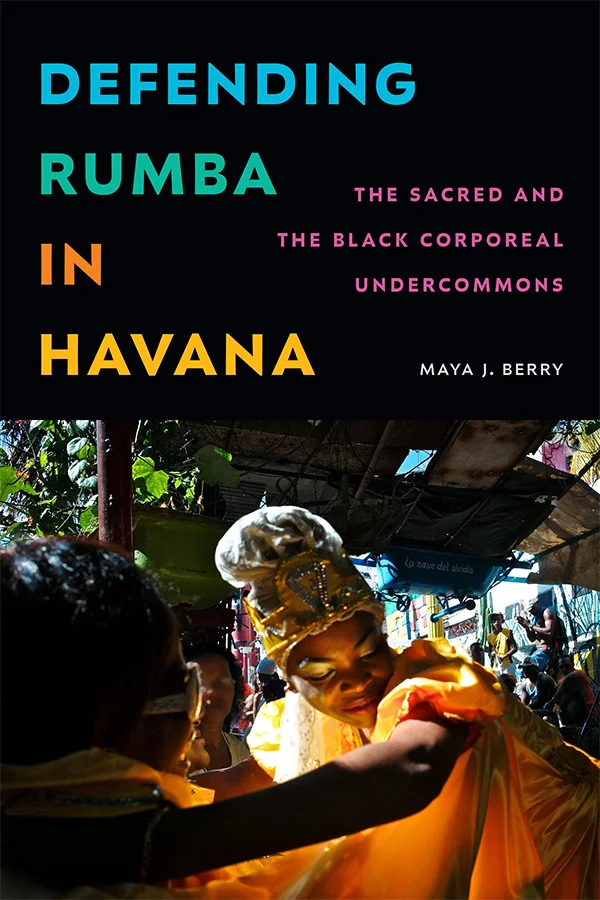
In Defending Rumba in Havana, anthropologist and dancer Maya J. Berry examines rumba as a way of knowing the embodied and spiritual dimensions of Black political imagination in post-Fidel Cuba. Historically a Black working-class popular dance, rumba, Berry contends, is a method of Black Cuban struggle that provides the community, accountability, sustenance, and dignity that neither the state nor the expanding private market can. Berry’s feminist theorization builds on the notion of the undercommons to show how rumba creates a space in which its practitioners enact deeply felt and dedicatedly defended choreographies of reciprocity, refusal, sovereignty, devotion, and pleasure, both on stage and in their daily lives. Berry demonstrates that this Black corporeal undercommons emphasizes mutual aid and refuses neoliberal development logics, favoring instead a collective self-determination rooted in African diasporic spiritual practices through which material compensation and gendered power dynamics are negotiated. By centering rumba to analyze how poor Black Cubans navigate gendered and racialized life, Berry helps readers better understand the constraints and yearnings that move diasporic Black struggles to seek refuge beyond the bounds of the nation-state.

Praise

“It’s not often that one gets to read something that builds so beautifully and interdisciplinarily on the theoretical areas with which one has been engaged while also inspiring new directions for thought and action. Defending Rumba in Havana is analytically exciting and methodologically caring, offering new avenues for fruitfully engaging the embodied formulation of life otherwise in the wake of both the plantation and the revolutionary state.” - Deborah A. Thomas, author of Political Life in the Wake of the Plantation: Sovereignty, Witnessing, Repair

“Meticulously researched and beautifully written, Defending Rumba in Havana is among the best Cuban ethnographies in the Post-Fidel era. Maya J. Berry’s work is especially important because of its connections to the religious and spiritual as well as the sort of infrapolitical views of Cuban political-economy in which race and culture are not only imbricated but constitutive and inequitably remunerative. This book will be an enduring and leading work in anthropology, Black studies, gender and feminist studies, and Cuban studies.” - Jafari S. Allen, author of There’s a Disco Ball Between Us: A Theory of Black Gay Life

"Maya Berry's analysis of Cuban rumba is riveting." - Yvonne Daniel, Medical Anthropology Quarterly

"Defending Rumba in Havana  is a wonderful contribution to the field of anthropology, ethnomusicology, feminist studies and African religious studies." - Tony Kail, Anthropology Book Forum

"This book is field-defining and a boon for anthropologists and scholars of Cuban studies, Black studies, feminist studies, performance studies, religious studies, and dance studies. ... Run, don't walk—or better yet, dance—to get a copy and behold the brilliance and heart in page after page, step after step." - Elizabeth Schwall, Journal of Anthropological Research

Buy

Availability: In stock

Price: $29.95

Request a desk or exam copy Spring 2026 Web Sale

Information

Author/Editor Bios

Back to Top
Maya J. Berry is Assistant Professor of African, African American, and Diaspora Studies at the University of North Carolina at Chapel Hill.

Table Of Contents

Back to Top
Preface  ix
Acknowledgments  xvii
Introduction  1
1. Black Inclusion, Black Enclosure  47
2. Black Feminist Aptitudes  88
3. Sacred Swagger and Its Social Order  129
4. Moving Labor across Markets  169
5. Underworld Assembly  219
Conclusion  249
Epilogue  259
Notes  267
References  281
Index  299

Rights

Back to Top

Sales/Territorial Rights: World

Rights and licensing

Awards

Back to Top

DUP First Book Fund Recipient

Additional Information

Back to Top
Related Links Paper ISBN: 978-1-4780-3133-8 / Hardcover ISBN: 978-1-4780-2814-7 / eISBN: 978-1-4780-6035-2 / DOI: https://doi.org/10.1215/9781478060352