
Home / Books / Digital Sound Studies

Digital Sound Studies
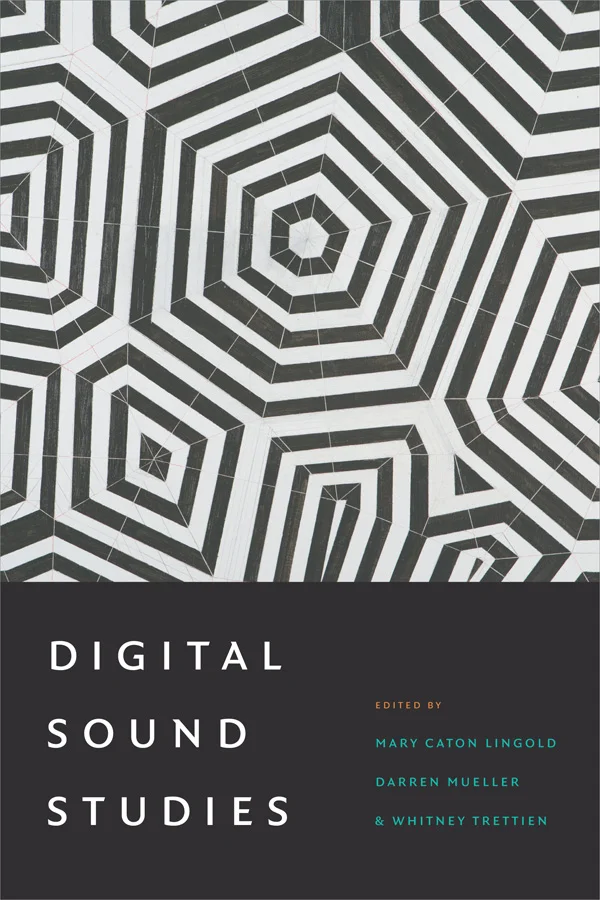
Book

Pages: 312

Illustrations: 24 illustrations

Published: October 2018

The digital turn has created new opportunities for scholars across disciplines to use sound in their scholarship. This volume’s contributors provide a blueprint for making sound central to research, teaching, and dissemination. They show how digital sound studies has the potential to transform silent, text-centric cultures of communication in the humanities into rich, multisensory experiences that are more inclusive of diverse knowledges and abilities. Drawing on multiple disciplines—including rhetoric and composition, performance studies, anthropology, history, and information science—the contributors to Digital Sound Studies bring digital humanities and sound studies into productive conversation while probing the assumptions behind the use of digital tools and technologies in academic life. In so doing, they explore how sonic experience might transform our scholarly networks, writing processes, research methodologies, pedagogies, and knowledges of the archive. As they demonstrate, incorporating sound into scholarship is thus not only feasible but urgently necessary.

Contributors. Myron M. Beasley, Regina N. Bradley, Steph Ceraso, Tanya Clement, Rebecca Dowd Geoffroy-Schwinden, W. F. Umi Hsu, Michael J. Kramer, Mary Caton Lingold, Darren Mueller, Richard Cullen Rath, Liana M. Silva, Jonathan Sterne, Jennifer Stoever, Jonathan W. Stone, Joanna Swafford, Aaron Trammell, Whitney Trettien
 

Praise

“Listen up. Be provoked. This adventurous book offers experiments, meditations, analyses, and ideas for a noisier digital humanities, for creative play with the intersection of print and sound recording, and for humanistic approaches to sound that could be rendered in the digital realm. Teachers, theorists, and scholar-artists who want to take new risks will find it timely and refreshing.” - Louise Meintjes, author of Dust of the Zulu: Ngoma Aesthetics after Apartheid

“This much-needed book inaugurates a new and interdisciplinary field—digital sound studies—at the intersection of sound studies and digital humanities. Its contributors rigorously explore a wide array of methodologies and practices—pedagogy, archival work, computational analysis, deformation, and platform building—to mark out the possibilities and risks of working in an emerging discipline through experimental modes.” - Tara McPherson, author of Feminist in a Software Lab: Difference + Design

"Digital Sound Studies contributors prompt productive conversations even while probing assumptions behind the use of digital tools and technologies in academia. . . . These essays explore the urgency and necessity of incorporating sonic experience into scholarly networks, writing processes, research methodologies, pedagogies, and knowledges of the archive." - John F. Barber, Leonardo Reviews

"Digital Sound Studies offers a fascinating variety of perspectives on digital sound studies ... Works that link digital humanities and sound studies are somewhat rare, and the present volume is a rich addition to a growing body of knowledge. Summing Up: Highly recommended. Lower-division undergraduates through faculty and professionals." - M. Anderson, Choice

"Sound in this book is interpreted mainly as a tool to accomplish different strategies, and not as the main object of investigation. Its unconventional use in unusual areas is intended to inspire and to enable distinct approaches. And the aim of the editors seems to assemble a wider arena where these different methodologies can communicate to each other, possibly producing further cross-pollinated experiments." - Neural

"Digital Sound Studies fuses theory and critical thinking with creative sonic practices, a fusion that is both promising and very appealing." - Vincent Meelberg, Journal of Sonic Studies

“This text provides a contemporary possibility of classroom and research work that is innovative and communal. The essays in Digital Sound Studies examine how sound is contained but held in the body, held through the body but heard through institutions and a cacophony of additional casual, aural effects.” - Kimberly Williams, Journal for the Society of American Music

Digital Sound Studies ... is an excellent resource for people interested in non-conventional experiences that defy standard and mainstream methods of learning and teaching within the humanities. It invites critical thought from cultural, social, and artistic frameworks, with a sustained and sustainable focus on the potential of sound and listening.” - Tracey El Hajj, Digital Humanities Quarterly

Digital Sound Studies is a provocation and a resource: timely in its inquiries and generative in its scope. In chapter after chapter, the reader encounters essays written in a register of experimental play, a quality which enacts a genre-bending intellectual style predicated on listening.” - Joella Bitter, Technology and Culture

Buy

Availability: Loading...

Price: Loading...

Open Access

Request a desk or exam copy

Information

Author/Editor Bios

Back to Top
Mary Caton Lingold is Assistant Professor of English at Virginia Commonwealth University.

Darren Mueller is Assistant Professor of Musicology at the Eastman School of Music, University of Rochester.

Whitney Trettien is Assistant Professor of English at the University of Pennsylvania.

Table Of Contents

Back to Top
Preface  vii
Acknowledgements  xi
Introduction / Mary Caton Lingold, Darren Mueller, and Whitney Trettien  1
I. Theories and Genealogies
1. Ethnodigital Sonics and the Historical Imagination / Richard Cullen Rath  29
2. Performing Zora: Critical Ethnography, Digital Sound, and Not Forgetting / Myron M. Beasley  47
3. Rhetorical Folkness: Reanimating Walter J. Ong in the Pursuit of Digital Humanity / Jonathan W. Stone  64
II. Digital Communities
4. The Pleasure (Is) Principle: Sounding Out! and the Digitizing of Community / Aaron Trammell, Jennifer Lynn Stover, and Liana Silva  83
5. Becoming OutKasted: Archiving Contemporary Black Southernness in a Digtal Age / Regina N. Bradley  120
6. Reprogramming Sounds of Learning: Pedagogical Experiments with Critical Making and Community-Based Ethnography / W. F. Umi Hsu  130
III. Disciplinary Translations
7. Word. Spoken. Articulating the Voice for High-Performance Sound Technologies for Access and Scholarship (HiPSTAS) / Tanya E. Clement  155
8. "A Foreign Sound to Your Ear": Digital Image Sonification for Historical Interpretation / Michael J. Kramer  178
9. Augmenting Musical Arguments: Interdisciplinary Publishing Platforms and Augmented Notes / Joanna Swafford  215
IV. Points Forward
10. Digital Approaches to Historical Acoustemologies: Replication and Reenactment / Rebecca Dowd Geoffroy-Schwinden  231
11. Sound Practices for Digital Humanities / Steph Ceraso  250
Afterword. Demands of Duration: The Futures of Digital Sound Scholarship / Jonathan Sterne, with Mary Caton Lingold, Darren Mueller, and Whitney Trettien  267
Contributors  285
Index  291

Rights

Back to Top

Sales/Territorial Rights: World

Rights and licensing

Additional Information

Back to Top
Paper ISBN: 978-0-8223-7060-4 / Hardcover ISBN: 978-0-8223-7048-2 / eISBN: 978-0-8223-7199-1 / DOI: https://doi.org/10.1215/9780822371991

Publicity material