
Home / Books / Dockside Reading

Dockside Reading

Hydrocolonialism and the Custom House
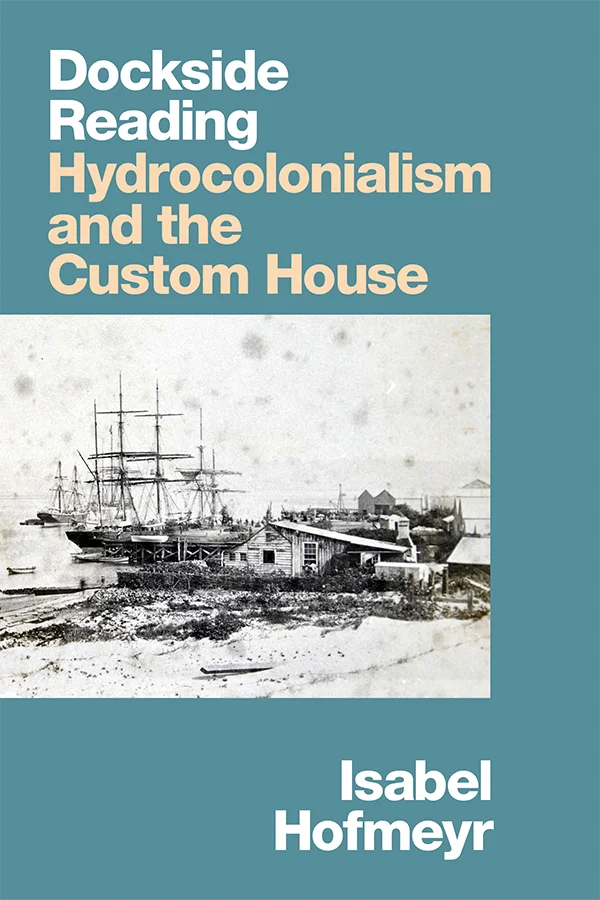
Book

Pages: 136

Illustrations: 3 illustrations

Published: February 2022

Author: Isabel Hofmeyr

In Dockside Reading Isabel Hofmeyr traces the relationships among print culture, colonialism, and the ocean through the institution of the British colonial Custom House. During the late nineteenth and early twentieth centuries, dockside customs officials would leaf through publications looking for obscenity, politically objectionable materials, or reprints of British copyrighted works, often dumping these condemned goods into the water. These practices, echoing other colonial imaginaries of the ocean as a space for erasing incriminating evidence of the violence of empire, informed later censorship regimes under apartheid in South Africa. By tracking printed matter from ship to shore, Hofmeyr shows how literary institutions like copyright and censorship were shaped by colonial control of coastal waters. Set in the environmental context of the colonial port city, Dockside Reading explores how imperialism colonizes water. Hofmeyr examines this theme through the concept of hydrocolonialism, which puts together land and sea, empire and environment.

Praise

“As we have come to expect from Isabel Hofmeyr, Dockside Reading is dazzlingly creative, intellectually playful, and immaculately crafted. This is a brilliant history of the ideas and textual forms that emerged from the damp crates that customs officials scoured at the water’s edge for signs of contamination. Setting sail from South Africa, ranging across the world’s oceans, this is a quietly revolutionary, fully aquatic literary history for our times.” - Sunil Amrith, Dhawan Professor of History, Yale University

“What happens to books when they cross borders? Isabel Hofmeyr sets her radically new history of literature not in the library but at the dock. In pages where authors and scholars are upstaged by censors, customs officers, and even dockhands, she challenges literary critics to think beyond the text as a static entity tied to a single nation or a single landmass. This is that rare book that will make it impossible to continue doing business as usual—for literary critics, for legal scholars, and for book historians.” - Leah Price, author of What We Talk about When We Talk About Books: The History and Future of Reading

“Hofmeyr addresses themes that acknowledge but transcend the particularities of place, revealing instead the connecting threads that bind disparate parts of the world together.” - Dane Kennedy, International Journal of African Historical Studies

“Hofmeyr’s scholarship is exemplary in its marriage of evocative detail with magisterial overview. She gives a compelling account of how customs procedure developed and changed over the course of almost a century. . . . She teaches us a new way to read.” - Matthew P.M. Kerr, Modern Language Review

"[Hofmeyr's] work sheds important light on the interdependency between reading practices and the book as object. . . . Hofmeyr deftly interweaves her research into customs documents with environmental and postcolonial theory, animating what is usually perceived as a dull or colorless archive through semantic resignification." - Neelam Srivastava, Journal of Postcolonial Inquiry

"As an oceans-oriented contribution to the field of law and literature, Dockside Reading suggests that 'the dock' or 'the customs officer' might be just as powerful a paradigm as 'the ship' or 'the lawyer.' And most suggestively, Dockside Reading encourages an underwater, more than human perspective for future decolonial approaches to the ocean as a literary and legal site and scene." - Stephanie Jones, Journal of Postcolonial Inquiry

"Even while [Hofmeyr] attends rigorously to the empirical . . . she manages to bring vividly to life traditionally 'dry' subjects—copyright and censorship. . . . Dockside Reading . . . ranges beyond traditional disciplinary bounds, while expanding our understanding of literary institutions." - Kate Highman, Journal of Postcolonial Inquiry

"In her stimulating investigation, Dockside Reading, Isabel Hofmeyr offers a fresh perspective on book history in the British Empire." - Katharine Anderson, Journal of British Studies

“Immeasurably useful … an excellent way to ... have the multivalent meanings of hydrocolonialism opened to further scholarship.” - Julia Stryker, H-Environment, H-Net Reviews

"Hofmeyr has produced a remarkable volume combining elements of both historical and 'literary' scholarship. It is a must read for those who study English Literature, the British Empire, the history of material culture, and international trade transactions of both human and non-human 'cargo.'”

- Paul Chiudiza Banda, African Studies Review

Dockside Reading is replete with fascinating historical insights.” - Philip Steer, Victorian Studies

“Hofmeyr’s exploratory text provides a useful and enticing illustration of the new questions and perspectives that an amphibious approach, equally attuned to developments on land and water, can generate. If, as Rachel Carson once remarked, the edge of the sea is a strange and beautiful boundary then Dockside Reading provides a glimpse of how intellectually rewarding this shifting and slippery frontier can be.” - Devika Shankar, American Historical Review

Buy

Availability: Loading...

Price: Loading...

Request a desk or exam copy Spring 2026 Web Sale

Information

Author/Editor Bios

Back to Top
Isabel Hofmeyr is Professor Emeritus at the University of the Witwatersrand and Global Distinguished Professor at New York University. She is coeditor of Ten Books That Shaped the British Empire: Creating an Imperial Commons, also published by Duke University Press, and author of Gandhi’s Printing Press: Experiments in Slow Reading.

Table Of Contents

Back to Top
Acknowledgments  ix
Introduction. Hydrocolonialism: The View from the Dockside  1
1. The Custom House and Hydrocolonial Governance  27
2. Customs and Objects on a Hydrocolonial Frontier  39
3. Copyright on a Hydrocolonial Frontier  49
4. Censorship on a Hydrocolonial Frontier  63
Conclusion. Dockside Genres and Postcolonial Literature  77
Notes  85
Bibliography  103
Index  117

Rights

Back to Top

Sales/Territorial Rights: World

Rights and licensing

Awards

Back to Top

Honorable Mention, 2025 Academy of Science of South Africa Humanities Book Award in the Established Researcher category

Additional Information

Back to Top