“Noémi Tousignant's innovative historical ethnography of Senegalese toxicology moves science and technology studies in Africa beyond familiar images of postcolonial domination and simplified historical continuities by carefully attending to the fragments of past efforts and their valence for present and future relations between science, state, and citizens. Without losing view of global exploitation and violence, her scrutiny of African scientific institutions' failure to protect citizens retains profound respect for the sustained efforts and achievements of African scientists, and their striving for civic and professional virtue, public service, and professional advancement. A must-read for all interested in twenty-first-century Africa, toxic exposures, and global science.” - Paul Wenzel Geissler, Professor of Social Anthropology, University of Oslo
“An impressive contribution to the historical record and an urgent call to action, Noémi Tousignant's account of toxicological research in Senegal is both riveting and horrifying. Her analysis of the impacts of structural adjustment on scientific capacity in postcolonial Senegal considerably adds to discussions about the anthropology of science and the history of public health (and thus the state) in postcolonial Africa; gender in science; and the social dimensions of environmental health sciences.” - Kim Fortun, author of Advocacy after Bhopal: Environmentalism, Disaster, New Global Orders
"Edges of Exposure has much to recommend it and belongs on the bookshelf of anyone interested in postcolonial and African science, toxic exposure and risk, global health, or contemporary Africa. At a brisk 149 pages of readable prose and relatively accessible academic language, it would also fit well on graduate or upper-level undergraduate reading lists." - Kirsten Moore-Sheeley, Journal of the History of Medicine
"Edges of Exposure is a powerful contribution to ethnographically grounded STS research focused on toxicology, global environmental health science, and what might be termed postcolonial laboratory life. . . . It is a unique contribution to the broader anthropology of toxics and global environmental health science studies." - Peter C. Little, Anthropological Quarterly
"Edges of Exposure . . . drives home the starkness of our uneven global economy of health. . . . Tousignant offers a much-needed ethnography of the ways that scientists can perform an emerging state, coupled with an in-depth exploration of the ramifications therein, and leaves us with the fundamental question of how to address global inequities that demand such precarious performances." - Marlee Tichenor, Somatosphere
"Tousignant makes the consequences of precariousness, uncertainty, and lack of autonomy in research concrete and tangible. In this regard, Edges of Exposure provides a timely warning of the dangers to which, as inhabitants of an increasingly toxic, interconnected, and unequal world, we are all exposed, both as citizens and as public scientists."
- Agata Mazzeo, Isis
"Tousignant powerfully narrates both obsolescence (when funding runs dry, when political commitments fade) and persistence (when scientists continue to work even in the context of limited capacity). Tousignant’s Edges of Exposure brings a laser-like focus not only to faltering toxicology in the Global South, but also to the material circumstances that render the case of Senegal one extreme on a continuum of global toxicity." - Tita Chico, Year's Work in Critical and Cultural Theory
"[Edges of Exposure] offers no easy answers, but it does present an informed, subject-sensitive case study in the historical anthropology of African science. [Tousignant] shows the immense value of seeing science not through the eyes of the state or the international community but through the experiences of those who, with an often remarkable degree of commitment and tenacity, themselves practice it." - David Arnold, Bulletin of the History of Medicine
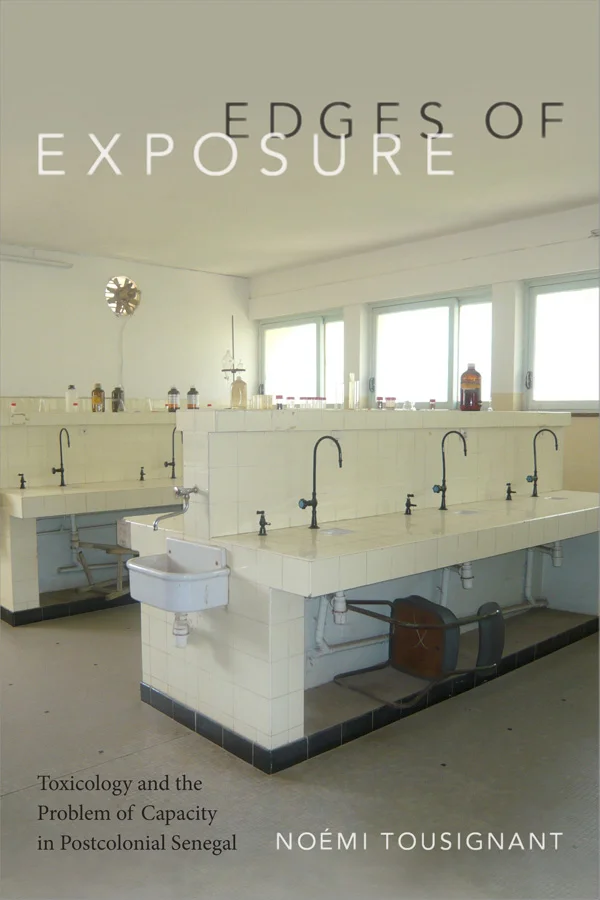
"Among the particularly innovative aspects of the book is Tousignant’s methodological treatment of laboratory equipment, substances, and techniques, whose various states of decay she uses to probe the 'rhythms' (p. 20) of toxicological research capacity across time. ... Tousignant’s contribution to theoretical discussions in medical anthropology, post-colonial studies, and STS are artfully woven throughout the book and highlight the broad-ranging appeal her study will have to scholars in these disciplines." - Stefanie Graeter, Medical Anthropology Quarterly
"Edges of Exposure is certainly important reading for those interested in the history and anthropology of African health, science and technology studies in Africa, environmental health, and the growing literature on toxicologies. It is a great addition to these fields and greatly contributes to growing concerns over toxins in Africa." - Kristin Peterson, Catalyst
"Grounded in ethnographic research and using history as a heuristic device, Noémi Tousignant in Edges of Exposure provides a riveting and stimulating account of efforts at doing public interest toxicological science in postcolonial Senegal." - Akwasi Kwarteng Amoako-Gyampah, Technology and Culture