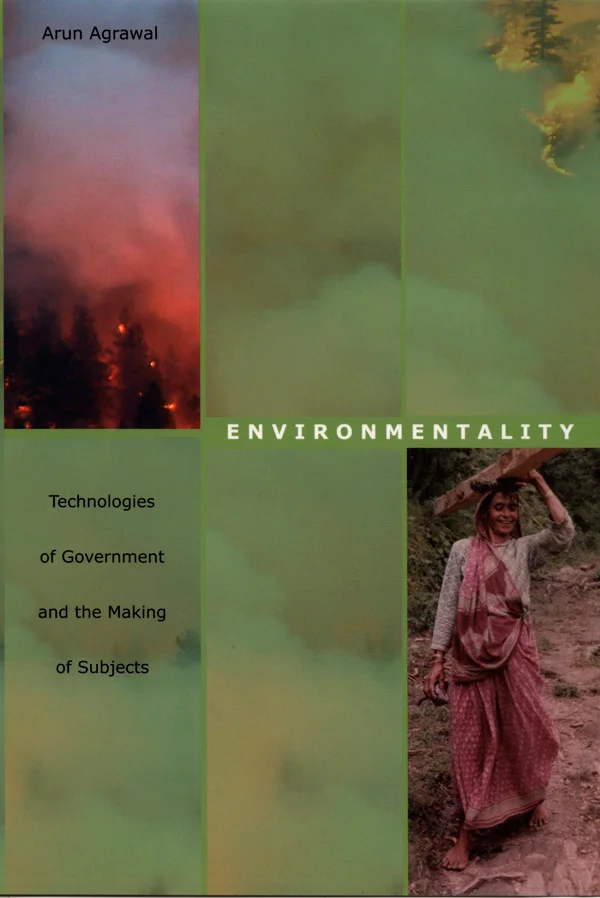
“Environmentality . . . is a significant and welcome departure from what has come before, and it is destined to become a hallmark. . . . Agrawal does a truly remarkable job of showing how social capital is actually formed through the production and management of a certain kind of self. The empirics here are so compelling that I imagine few studies will ever demonstrate this principle as thoroughly as Agrawal does.” - Paul Robbins, Geographical Review
“Environmentality offers readers in the fields of anthropology, environmental studies, and history a useful and interesting case study. . . . Environmentality is an excellent piece of scholarship, and a valuable addition to the fields of environmental anthropology and history, as well as to the general literature on colonial and postcolonial India.” - Sarah Strauss, American Anthropologist
“Environmentality stands out as an excellent ethnographic exploration of a democratic alternative to more coercive forms of conservation and government. Environmentality certainly could be used in a variety of advanced undergraduate and graduate seminars on environmental anthropology and political ecology… [as well as] a course on the state, power, and resistance.” - Krista Harper, American Ethnologist
“[E]minently readable, well theorized, and a fine, reflective piece of scholarship.”--
- Vinita Damodaran, Journal of Asian Studies
“Agrawal addresses important questions of environmental consciousness mediated by regulatory bodies and provides encouraging evidence that community-based conservation is alive and well. It is thought-provoking and well-written and has the potential to serve as a valuable resource for those in interdisciplinary environmental fields.”
- Heather Goldsworthy, Journal of Environment & Development
“Arun Agrawal has developed a new, integrative framework for thinking about environmental politics.” - J. Mark Baker, Pacific Affairs
“In sum, like many excellent books, Environmentality raises as many important questions as it answers. Eschewing familiar paths of analysis, it offers value to readers interested in both theoretical and practical aspects of environmental politics and to those with interests far beyond northern India. Ambiguous in its normative implications, complex in its theoretical argument, the book ultimately rewards patient readers with what it promises: nothing less than the beginnings of a newanalytical perspective on environmental politics.”
- Leigh Raymond, Comparative Political Studies
“In this innovative historical and political study, the author analyzes this striking transformation by explaining the emerging environmental identities and the changes in attitudes toward conservation.” - , Abstracts of Public Administration, Development and the Environment
“Indeed, Agrawal is intent on breaking new ground, which he does convincingly…. Most significantly perhaps, he removes the rigid dichotomy between the state and the individual, showing how both actors shape and form each other, albeit unequally, and deflates the idea that subjectivity results only from a unidirectional exertion of state power.” - Valerie M. Sebestyen, Environment and Planning A
“This is a rare and valuable book with an easy style that interweaves interconnected but separate themes. . . . This is that rare work that combines the longer view with a sense of the immediate and the intimate. Its resonances and consequences will occupy scholars, students, and citizens for some time to come.” - Mahesh Rangarajan, Environmental History
"[A] particularly useful and timely piece of scholarship as it attempts to transgress what are often distant and diverse literatures. This book helps to shed light on the connections between environmental regulation, practice and subjectivity. And in that way, this book illustrates the complexity and connectivity of environmental conflicts and struggles that are often overlooked by more limited or constrained analytical approaches. The book is very clearly organized and well written. . . ." - Michael Mascarenhas, Rural Sociology
"[An] engaging and groundbreaking investigation of environmental politics and how people come to care for the environment. . . . Using carefully constructed arguments, Agrawal successfully achieves his purpose of creating a framework for environmental policy analysis." - Joanne Bauer, Ethics and International Affairs
"Interesting. . . . The strength of the book lies in its exploration of agency among the local populations and the serious treatment of the culture that environmental regulation affects. . . . This book offers an insightful critique of the assumptions that both the state and peasant resistance are monolithic . . . and provides a useful starting point to understand the phenomena of community forestry that governments are implementing around the world." - Gregory Barton, American Historical Review
“Arun Agrawal achieves, in Environmentality, something of a breakthrough to new analytical territory where the binaries of state and society, structure and agency, public and private are transcended. He parlays the humble subject of community-based forestry and Foucault’s concept of ‘governmentality’ into the makings of an original and subtle analysis of modernity and nature.” - James C. Scott, Yale University
“Arun Agrawal has written an amazing book that draws on a very-long-term case study to make general lessons. He analyzes the development of the mentality of citizens and officials related to the environment in a particular setting undergoing major shifts from centralization to a form of decentralization. All of us can take some important lessons from this book about how people’s mentalities change when they have power and knowledge to cope with a problem. That shift in knowledge and power took time and effort, but is one of the rare success stories of recent history.” - Elinor Ostrom, coeditor of Seeing the Forest and the Trees: Human-Environment Interactions in Forest Ecosystems