
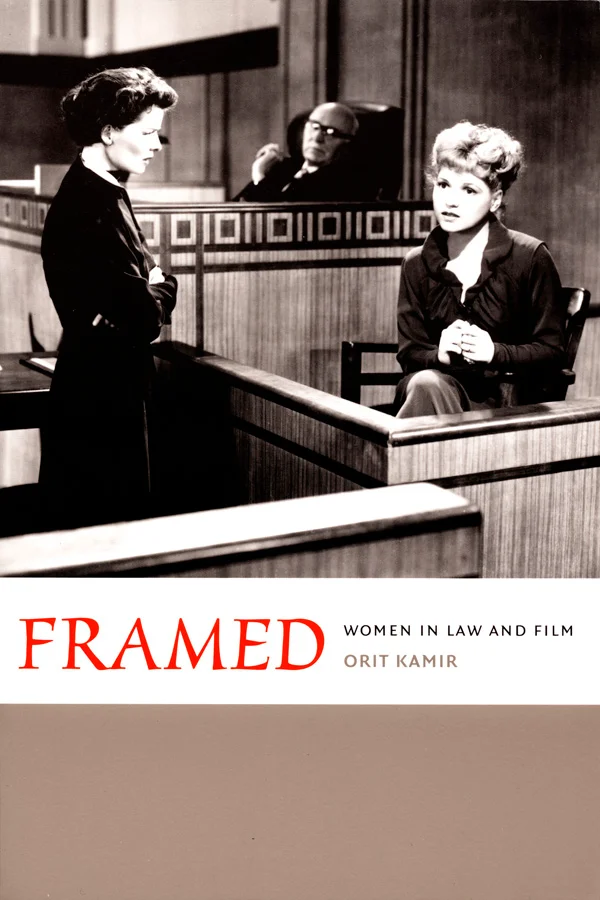
Framed
Women in Law and Film
Buy
Availability: Loading...
Price: Loading...
This title will be released on January 19, 2006
Buy the e-book:
Information
Author/Editor Bios
Back to TopOrit Kamir is Professor of Law and Gender at Hebrew University in Jerusalem and a Visiting Professor at the University of Michigan Law School. She is co-director of the Israeli Center for Human Dignity and the author of Every Breath You Take: Stalking Narratives and the Law; Israeli Honor and Dignity: Social Norms, Gender Politics, and the Law (in Hebrew); and Feminism, Rights, and the Law (also in Hebrew).
Table Of Contents
Back to Top
Acknowledgments ix
Preface xi
Introduction: Conceptual Framework 1
Part I. Feminist Critique of Law Films that Honor-Judge Women
1. Rashomon (Japan, 1950): Construction of Woman as Guilty Object 43
2. Pandora’s Box (Germany, 1928): Exorcising Pandora-Lilith in the Weimar Republic 73
3. Blackmail (England, 1929): Hitchcock’s Sound and the New Woman’s Guilty Silence 90
4. Anatomy of a Murder (U.S.A., 1959): Hollywood’s Hero-Lawyer Revives the Unwritten Law 112
Part II. Cinematic Women Demanding Judgment
From Liberal Attitudes to Radical Feminist Jurisprudence and the Ethics of Care
5. Adam’s Rib (U.S.A., 1949): Hollywood’s Female Lawyer and Family Values (Read with Disclosure and Legally Blonde) 135
6. Nuts (U.S.A., 1987): The Mad Woman’s Day in Court 160
7. Death and the Maiden (U.S.A., 1994): Challenging Trauma with Feminine Judgment and Justice (Read with The Piano) 185
Part III. Women Resisting and Subverting Judgment
Beyond Conventional Feminist Jurisprudence
8. A Question of Silence (Netherlands, 1982): Feminist Community as Revolution (Read against “A Jury of Her Peers”) 217
9. Set it Off (U.S.A., 1996): Minority Women at the Point of No Return 243
10. High Heels (Spain, 1991): Almodovar’s Postmodern Transgression 264
Notes 285
Bibliography 299
Index 313
Preface xi
Introduction: Conceptual Framework 1
Part I. Feminist Critique of Law Films that Honor-Judge Women
1. Rashomon (Japan, 1950): Construction of Woman as Guilty Object 43
2. Pandora’s Box (Germany, 1928): Exorcising Pandora-Lilith in the Weimar Republic 73
3. Blackmail (England, 1929): Hitchcock’s Sound and the New Woman’s Guilty Silence 90
4. Anatomy of a Murder (U.S.A., 1959): Hollywood’s Hero-Lawyer Revives the Unwritten Law 112
Part II. Cinematic Women Demanding Judgment
From Liberal Attitudes to Radical Feminist Jurisprudence and the Ethics of Care
5. Adam’s Rib (U.S.A., 1949): Hollywood’s Female Lawyer and Family Values (Read with Disclosure and Legally Blonde) 135
6. Nuts (U.S.A., 1987): The Mad Woman’s Day in Court 160
7. Death and the Maiden (U.S.A., 1994): Challenging Trauma with Feminine Judgment and Justice (Read with The Piano) 185
Part III. Women Resisting and Subverting Judgment
Beyond Conventional Feminist Jurisprudence
8. A Question of Silence (Netherlands, 1982): Feminist Community as Revolution (Read against “A Jury of Her Peers”) 217
9. Set it Off (U.S.A., 1996): Minority Women at the Point of No Return 243
10. High Heels (Spain, 1991): Almodovar’s Postmodern Transgression 264
Notes 285
Bibliography 299
Index 313
Rights
Back to TopSales/Territorial Rights: World
Rights and licensingAdditional Information
Back to Top
Paper ISBN:
978-0-8223-3624-2 /
Hardcover ISBN:
978-0-8223-3636-5 /
eISBN:
978-0-8223-8776-3 /
DOI:
https://doi.org/10.1215/9780822387763
Publicity material