
From Hate to Hallows
Reframing Black Church Arson
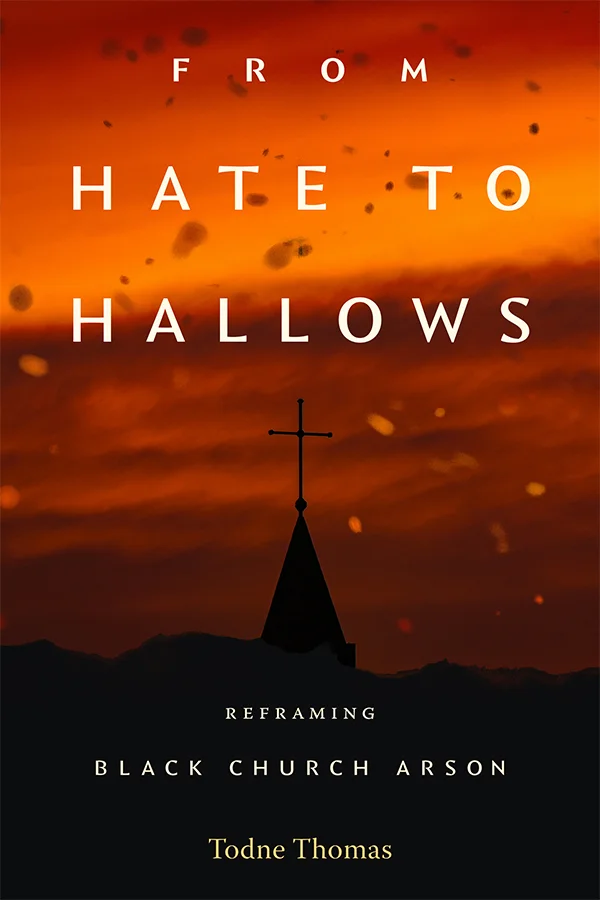
Book
Pages: 256
Illustrations: 16 illustrations
Release Date: December 08, 2026
Author: Todne Thomas
Praise
Buy
Availability: Loading...
Price: Loading...
This title will be released on December 08, 2026
Information
Author/Editor Bios
Back to Top
Todne Thomas is Associate Professor of Divinity and Religious Studies at Yale University. She is the author of Kincraft: The Making of Black Evangelical Sociality, also published by Duke University Press.
Table Of Contents
Back to Top
Acknowledgments ix
Introduction: The Burned Black Church and Matrifocal Methodology 1
Interlude—“All They Did Was Just Open Up a Can of Love” 39
Part I. Moral, Religious, and Black Cultural Frames
1. The White Supremacist: Black Church Arson, Hate Crime, and Moral Dispossession 43
Interlude—“A Smoldering Remains” 78
2. A Black Arsonist? Bias, Class, and Intramural Religious Violence 80
Interlude—“I Want Jesus to Walk with Me” 116
Part II. Economic and Material Cultural Frames
3. The Developer: Black Church Arson, Born-Again Redevelopment, and Hallowed Geography 121
Interlude—“The Remnant” 157
4. The Icon: Black Sacred Matter/s 160
Interlude—(Do) People Still Burn Black Churches (?) 186
Interlude—A Libation and Reparation: An Opening of Genre 189
Afterwor(l)d: The Burned Black Mother Church That Remains 193
Notes 211
References 219
Index
Introduction: The Burned Black Church and Matrifocal Methodology 1
Interlude—“All They Did Was Just Open Up a Can of Love” 39
Part I. Moral, Religious, and Black Cultural Frames
1. The White Supremacist: Black Church Arson, Hate Crime, and Moral Dispossession 43
Interlude—“A Smoldering Remains” 78
2. A Black Arsonist? Bias, Class, and Intramural Religious Violence 80
Interlude—“I Want Jesus to Walk with Me” 116
Part II. Economic and Material Cultural Frames
3. The Developer: Black Church Arson, Born-Again Redevelopment, and Hallowed Geography 121
Interlude—“The Remnant” 157
4. The Icon: Black Sacred Matter/s 160
Interlude—(Do) People Still Burn Black Churches (?) 186
Interlude—A Libation and Reparation: An Opening of Genre 189
Afterwor(l)d: The Burned Black Mother Church That Remains 193
Notes 211
References 219
Index
Rights
Back to TopSales/Territorial Rights: World
Rights and licensingAdditional Information
Back to Top
Paper ISBN:
978-1-4780-3940-2 /
Hardcover ISBN:
978-1-4780-3438-4 /
eISBN:
978-1-4780-6298-1 /
Publicity material