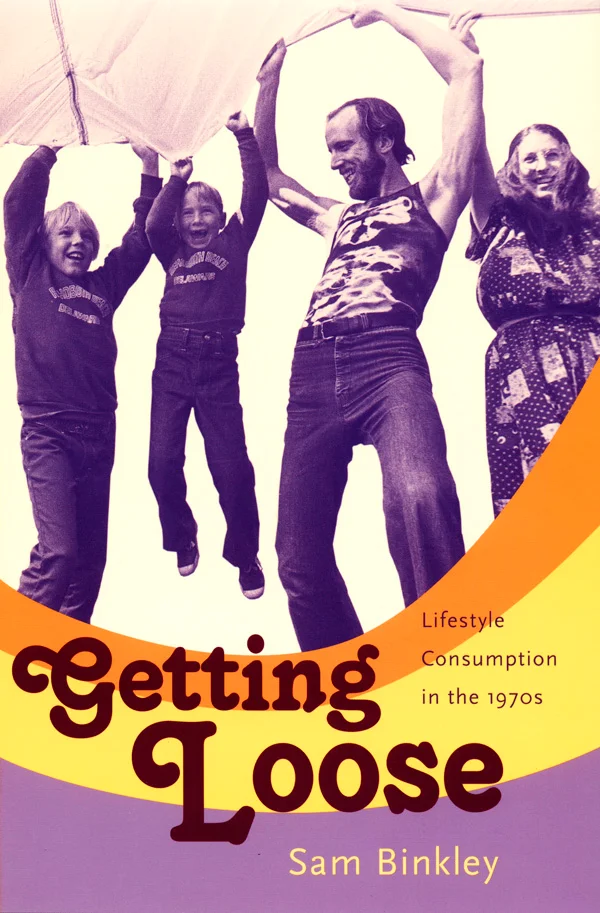
• Getting Loose: Lifestyle Consumption in the 1970s

    Author(s):
    Pages: 336
    Illustrations: 27 illustrations
    Sales/Territorial Rights: World
  • Cloth: $99.95 - In Stock
    978-0-8223-3973-1
  • Paperback: $26.95 - In Stock
    978-0-8223-3989-2
  • Quantity
  • Add To Bag
  • List of Illustrations ix

    Acknowledgments xi

    Introduction / Mediated Immediacy: Living in the Now 1

    Part I / Middle Class in the Maelstrom

    1. Of Swingers and Organization Men: Loose Modernities 27

    2. Experts Unbound: Intimate Professionals and the Value of Lifestyle 77

    3. Book as Tool: Lifestyle Print Culture and the West Coast Publishing Boom 101

    Part II / Caring Texts

    4. Being One: From Knowledge to Consciousness in the Spaceship Society 129

    5. Loving Each Other: From Phony to Real in the New Togetherness 165

    6. Letting It All Hang Out: From Mind to Muscle in the Relaxed Body 207

    Conclusion / Morning in America: Pulling in the Slack 243

    Notes 251

    Bibliography 263

    Index 287
  • [G]etting Loose is a persuasive and rich account of the rise of both a new class and the importance of lifestyle. The book is packed with fascinating and detailed examples that are difficult to do justice to in a review. . . . [T]his is key reading for anyone working on lifestyle and consumer culture.”

    Getting Loose gives us a valuable take on the place of self-help and self-making in the production and regulation of the mainstream cultural landscape of the 1970s, one that encourages us to ask those further questions, and that is all to the good.”

    Getting Loose is a fascinating guide to the mutation of political radicalism into feel good ideas of self-improvement.”

    “[Getting Loose’s] wide scope and depth of analysis make it essential reading for anyone interested in the discourses of American selfhood.”

    “[O]ne of the greatest strengths of Getting Loose is its ability to animate the seemingly vague notion of ‘loosening’ in its attention to the specifics of these texts. Perhaps the greatest insight offered is the transformation of the counter-culturally inspired loose life-style into the commercialized mainstream. . . . Binkley’s insights are original and compelling.”

    “[T]his clearly written study explores the emergence in that decade of a new form of late-modern identity derived from the 1960s counterculture. . . . Recommended.”

    “Binkley’s work is a useful addition to recent scholarship that drags the countercultural out of flower-child stereotypes and into broader relevancy.”

    “With nearly 600 bibliographic entries, Getting Loose is among the most thorough studies of its kind.The book surveys the period in American society when 1960s counterculture developed into the consumer lifestyles we know today. But Binkley does more than simply mark the transition from yippie to yuppy. He shows how the emancipatory impulses of rebellion helped usher in the new world order of unrestrained global capital.”

    Reviews

  • [G]etting Loose is a persuasive and rich account of the rise of both a new class and the importance of lifestyle. The book is packed with fascinating and detailed examples that are difficult to do justice to in a review. . . . [T]his is key reading for anyone working on lifestyle and consumer culture.”

    Getting Loose gives us a valuable take on the place of self-help and self-making in the production and regulation of the mainstream cultural landscape of the 1970s, one that encourages us to ask those further questions, and that is all to the good.”

    Getting Loose is a fascinating guide to the mutation of political radicalism into feel good ideas of self-improvement.”

    “[Getting Loose’s] wide scope and depth of analysis make it essential reading for anyone interested in the discourses of American selfhood.”

    “[O]ne of the greatest strengths of Getting Loose is its ability to animate the seemingly vague notion of ‘loosening’ in its attention to the specifics of these texts. Perhaps the greatest insight offered is the transformation of the counter-culturally inspired loose life-style into the commercialized mainstream. . . . Binkley’s insights are original and compelling.”

    “[T]his clearly written study explores the emergence in that decade of a new form of late-modern identity derived from the 1960s counterculture. . . . Recommended.”

    “Binkley’s work is a useful addition to recent scholarship that drags the countercultural out of flower-child stereotypes and into broader relevancy.”

    “With nearly 600 bibliographic entries, Getting Loose is among the most thorough studies of its kind.The book surveys the period in American society when 1960s counterculture developed into the consumer lifestyles we know today. But Binkley does more than simply mark the transition from yippie to yuppy. He shows how the emancipatory impulses of rebellion helped usher in the new world order of unrestrained global capital.”

  • Getting Loose is a work of historical sociology that both draws on and challenges central theoretical perspectives on consumption and consumer culture, identity, postmodernism and late modernity, post-Fordism, and contemporary moral culture through exceptionally creative analyses of 1970s lifestyle philosophies and practices.” — Don Slater, author of, Consumer Culture and Modernity

    Getting Loose is an important and quite interesting study of the discourses of the 1970s lifestyle movement. It casts a whole new light not only on that epoch but, more importantly, on its relationship to contemporary self, identity, and the economy, especially consumer culture. Sam Binkley moves comfortably and insightfully between the most abstract of social theories and the most prosaic of social phenomena, using the former to offer new insights into the latter. He presents a panoramic view of the movement from the 1970s era of the loosening of the self to the reality of the early twenty-first century, where ‘we’re all loose now.’” — George Ritzer, Distinguished University Professor, University of Maryland, and founding editor,, Journal of Consumer Culture

  • Permission to Photocopy (coursepacks)

    If you are requesting permission to photocopy material for classroom use, please contact the Copyright Clearance Center at copyright.com;

    If the Copyright Clearance Center cannot grant permission, you may request permission from our Copyrights & Permissions Manager (use Contact Information listed below).

    Permission to Reprint

    If you are requesting permission to reprint DUP material (journal or book selection) in another book or in any other format, contact our Copyrights & Permissions Manager (use Contact Information listed below).

    Images/Art

    Many images/art used in material copyrighted by Duke University Press are controlled, not by the Press, but by the owner of the image. Please check the credit line adjacent to the illustration, as well as the front and back matter of the book for a list of credits. You must obtain permission directly from the owner of the image. Occasionally, Duke University Press controls the rights to maps or other drawings. Please direct permission requests for these images to permissions@dukeupress.edu.
    For book covers to accompany reviews, please contact the publicity department.

    Subsidiary Rights/Foreign Translations

    If you're interested in a Duke University Press book for subsidiary rights/translations, please contact permissions@dukeupress.edu. Include the book title/author, rights sought, and estimated print run.

    Disability Requests

    Instructions for requesting an electronic text on behalf of a student with disabilities are available here.

    Rights & Permissions Contact Information

    Email: permissions@dukeupress.edu
    Email contact for coursepacks: asstpermissions@dukeupress.edu
    Fax: 919-688-4574
    Mail:
    Duke University Press
    Rights and Permissions
    905 W. Main Street
    Suite 18B
    Durham, NC 27701

    For all requests please include:
    1. Author's name. If book has an editor that is different from the article author, include editor's name also.
    2. Title of the journal article or book chapter and title of journal or title of book
    3. Page numbers (if excerpting, provide specifics)
    For coursepacks, please also note: The number of copies requested, the school and professor requesting
    For reprints and subsidiary rights, please also note: Your volume title, publication date, publisher, print run, page count, rights sought
  • Description

    From “getting loose” to “letting it all hang out,” the 1970s were filled with exhortations to free oneself from artificial restraints and to discover oneself in a more authentic and creative life. In the wake of the counterculture of the 1960s, anything that could be made to yield to a more impulsive vitality was reinvented in a looser way. Food became purer, clothing more revealing, sex more orgiastic, and home decor more rustic and authentic.

    Through a sociological analysis of the countercultural print culture of the 1970s, Sam Binkley investigates the dissemination of these self-loosening narratives and their widespread appeal to America’s middle class. He describes the rise of a genre of lifestyle publishing that emerged from a network of small offbeat presses, mostly located on the West Coast. Amateurish and rough in production quality, these popular books and magazines blended Eastern mysticism, Freudian psychology, environmental ecology, and romantic American pastoralism as they offered “expert” advice—about how to be more in touch with the natural world, how to release oneself into trusting relationships with others, and how to delve deeper into the body’s rhythms and natural sensuality. Binkley examines dozens of these publications, including the Whole Earth Catalog, Rainbook, the Catalog of Sexual Consciousness, Celery Wine, Domebook, and Getting Clear.

    Drawing on the thought of Pierre Bourdieu, Zygmunt Bauman, and others, Binkley explains how self-loosening narratives helped the middle class confront the modernity of the 1970s. As rapid social change and political upheaval eroded middle-class cultural authority, the looser life provided opportunities for self-reinvention through everyday lifestyle choice. He traces this ethos of self-realization through the “yuppie” 1980s to the 1990s and today, demonstrating that what originated as an emancipatory call to loosen up soon evolved into a culture of highly commercialized consumption and lifestyle branding.

    About The Author(s)

    Sam Binkley is Assistant Professor of Sociology at Emerson College.
    Visit the author’s blog.

Explore More
Share

Create a reading list or add to an existing list. Sign-in or register now to continue.


Contact Us

  • Duke University Press
  • 905 W. Main St. Ste 18-B
  • Durham, NC 27701
  • U.S. phone (toll-free): 888-651-0122
  • International: 1-919-688-5134
  • orders@dukeupress.edu