
Home / Books / Ghostly Past, Capitalist Presence

Ghostly Past, Capitalist Presence

A Social History of Fear in Colonial Bengal
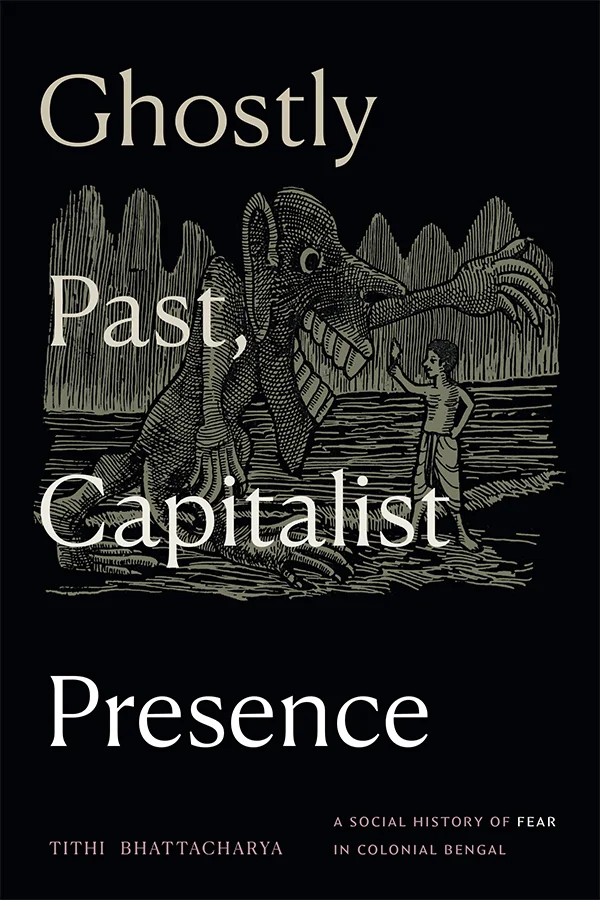
Book

Pages: 232

Illustrations: 6 illustrations

Published: August 2024

In Ghostly Past, Capitalist Presence, Tithi Bhattacharya maps the role that Bengali ghosts and ghost stories played in constituting the modern Indian nation, and the religious ideas seeded therein, as it emerged in dialogue with European science. Bhattacharya introduces readers to the multifarious habits and personalities of Bengal’s traditional ghosts and investigates and mourns their eventual extermination. For Bhattacharya, British colonization marked a transition from the older, multifaith folk world of traditional ghosts to newer and more frightening specters. These "modern" Bengali ghosts, borne out of a new rationality, were homogeneous specters amenable to "scientific" speculation and invoked at séance sessions in elite drawing rooms. Reading literature alongside the colonial archive, Bhattacharya uncovers a new reordering of science and faith from the middle of the nineteenth century. She argues that these shifts cemented the authority of a rising upper-caste colonial elite who expelled the older ghosts in order to recast Hinduism as the conscience of the Indian nation. In so doing, Bhattacharya reveals how capitalism necessarily reshaped Bengal as part of the global colonial project.

Praise

“The best account I have yet read of the enchanted and uncanny world of stories and beliefs that Bengalis like myself grew up in.” - Amitav Ghosh

“This strikingly original study returns ghosts, long unjustly neglected, back to their rightful place at the heart of the history of Bengali colonial modernity. By a fascinating series of literary, historical, and theoretical analyses, it reveals colonial reason’s obsession with the irrational and presents the narrative of replacement of decorous magical ghosts of premodernity by new forms of the uncanny and monstrous lodged in the disenchanted structures of capitalist economies and modern nation-states.” - Sudipta Kaviraj, Professor of Middle Eastern, South Asian, and African Studies, Columbia University

"As I read Tithi Bhattacharya’s book, I felt like I had stepped into the textual iteration of a comparable ghost dance. The five chapters combine a motley crew of Bengali and British specters to conceptualize a social history of fear. . . . Ghosts turn out to be unexpected but impressively credible interlocutors in colonial historiography as hidden dimensions and interactions of the three dominant social characters of this period. . . ."

  - Sreyashi Ray, South Asian Review

"Readers already knowledgeable about this period in Indian history will especially appreciate the sophistication of Bhattacharya’s work. Recommended. Graduate students and faculty." - M. H. Fisher, Choice

"Her readings of famous male Bengali Hindu litterateurs offer much insight into their worlds, as well as the larger world of colonial capitalist transformation in the late nineteenth century." - Neilesh Bose, South Asian History and Culture

“Riveting. . . . Older ghosts survived in the cracks and the shadows, and Ghostly Past, Capitalist Presence is an admirable attempt to make analytical room for their continued presence and whispery speech.” - Amit R. Baishya, H-Asia, H-Net Reviews

"Cultural history at its most inventive. . . . Bhattacharya reveals something profound about the creativity and violence of historical change itself." - Ankush Pal, Scroll

"[Bhattacharya] brings methodological clarity and firmness to the analysis of varied epistemic concerns without losing sight of caste, class and gender." - Aheli Moitra, Religion

Buy

Availability: In stock

Price: $26.95

Request a desk or exam copy

Information

Author/Editor Bios

Back to Top
Tithi Bhattacharya is Associate Professor of History at Purdue University, author of The Sentinels of Culture: Class, Education, and the Colonial Intellectual in Bengal, 1848–1885, and coauthor of Feminism for the 99%: A Manifesto.

Table Of Contents

Back to Top
A Note on Conventions  vii
Acknowledgments  ix
Introduction. Uncanny Histories: Ghosts, Fear, and Reason in Colonial Bengal  1
1. “Undisciplined, Playful and Yet Bhadra”: Old Ghosts and Their Advocates in an Age of Enlightenment  22
2. The New Spirits  55
3. Deadly Spaces: Haunted Homes and Haunting Histories  82
4. Enacting Ghosts: New Spirits, New Rituals  97
5. National Ghosts, Ghostly Nations  130
Conclusion. Thinking about Ends and Beginnings  155
Notes  159
Bibliography  187
Index  203

Rights

Back to Top

Sales/Territorial Rights: World exc South Asia

Rights and licensing

Awards

Back to Top

Winner of the 2025 John F. Richards Prize in South Asian History, presented by the American Historical Association

Additional Information

Back to Top
Related Links Paper ISBN: 978-1-4780-3071-3 / Hardcover ISBN: 978-1-4780-2646-4 / eISBN: 978-1-4780-5969-1 / DOI: https://doi.org/10.1215/9781478059691