
Home / Books / Hegemonic Mimicry

Hegemonic Mimicry

Korean Popular Culture of the Twenty-First Century
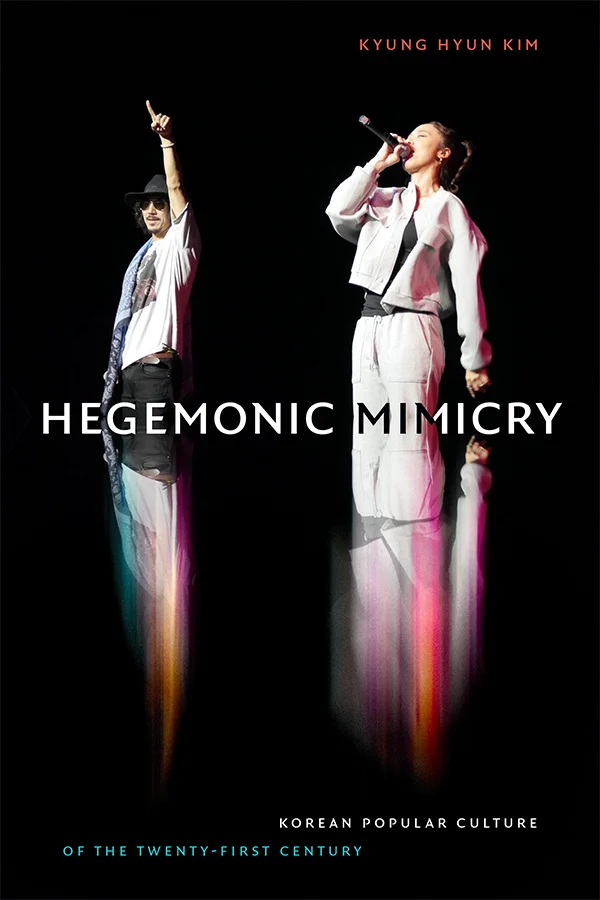
Book

Pages: 328

Illustrations: 36 illustrations

Published: November 2021

Author: Kyung Hyun Kim

In Hegemonic Mimicry, Kyung Hyun Kim considers the recent global success of Korean popular culture—the Korean wave of pop music, cinema, and television, which is also known as hallyu—from a transnational and transcultural perspective. Using the concept of mimicry to think through hallyu's adaptation of American sensibilities and genres, he shows how the commercialization of Korean popular culture has upended the familiar dynamic of major-to-minor cultural influence, enabling hallyu to become a dominant global cultural phenomenon. At the same time, its worldwide popularity has rendered its Koreanness opaque. Kim argues that Korean cultural subjectivity over the past two decades is one steeped in ethnic rather than national identity. Explaining how South Korea leaped over the linguistic and cultural walls surrounding a supposedly “minor” culture to achieve global ascendance, Kim positions K-pop, Korean cinema and television serials, and even electronics as transformative acts of reappropriation that have created a hegemonic global ethnic identity.

Praise

Hegemonic Mimicry presents a much-needed update on today's South Korean pop culture—one of the most fascinating epicenters of global cultural flows. Offering a probing insight into a wide spectrum of media productions, it is bound to be a must-read for those hoping to capture the symptomatic signs of the new millennium.” - Suk-Young Kim, author of K-Pop Live: Fans, Idols, and Multimedia Performance

Hegemonic Mimicry provides insightful, critical analyses of Korean cultural products explored through a variety of lenses: national identity, transnationalism, convergence, social class, Confucianism, simulacra, and cynicism. Unlike many previous studies, Kyung Hyun Kim's book is very effective in theorizing developments in hallyu and its global proliferation. Anyone interested in contemporary Korean culture will learn a lot from this book and enjoy Kim's ability to connect ideas and events in brilliant new ways.” - Roald Maliangkay, author of Broken Voices: Postcolonial Entanglements and the Preservation of Korea’s Central Folksong Traditions

Hegemonic Mimicry is an impressive volume that outlines the reasons behind the recent global success of South Korean popular culture.... Kim’s erudition is considerable, something to be expected given his two earlier well-received monographs.” - Keith Howard, Asian Studies Review

"Hegemonic Mimicry is a valuable and significant contribution to the literature on Korean popular culture studies by introducing the concept of ‘hegemonic mimicry’ in detail and approaching Korean popular culture in an interdisciplinary way. This feature of the book will attract scholars from various academic disciplines as well as university students from different backgrounds." - Beyza Dogan, LSE Review of Books

“This book and its central premise will go far. Kim’s concept of and coinage of the term hegemonic mimicry alone will no doubt appear in countless essays, book chapters and discussions of South Korean popular culture. . . . Kim is the real deal, a genuine intellect and the book successfully captures the author’s voice and it is filled with insight that will be of interest to both cinema scholars and those who study Asian popular culture.” - Robert Hyland, Asian Cinema

"Hegemonic Mimicry is a critical addition to Korean popular culture studies literature and will surely be an essential foundation for future studies." - Jung-Min Mina Lee, Journal of Asian Studies

"A timely response to the explosive demand for a textbook that provides both historical and theoretical frameworks to analyze the global popularity of contemporary South Korean popular culture, including K-pop music, cinema, television, and online subcultures."

- Soyi Kim, Cultural Critique

"Hegemonic Mimicry is a timely book that provides an updated overview of Korean popular culture. ... [It] offers readers an insightful perspective on the media we consume every day."

- Sojeong Park, Korean Studies

"This book serves as a valuable resource for understanding how hallyu is both influenced by and influencing other nations and cultures. Additionally, those teaching classes on the globalization of culture, cultural redefinitions, and cultural fandom would benefit greatly from Kim’s analysis." - Aarum F. Youn-Heil, Cultural Studies

"Kim’s perspective enriches the understanding of Korean rap as not merely a localized adaptation of a global genre but as a meaningful site of the negotiation and reinterpretation of cultural and ethnic identity in Korea. . . . This book is recommended for those in English-speaking countries who wish to study modern and contemporary Korean history through a comparison with the localization of Korean popular culture in their own cultures." - Wonjung Min, Seoul Journal of Korean Studies

". . . Kyung Hyun Kim’s book is a significant addition to an underappreciated and underdeveloped critical literature on Hallyu, especially for its historical re-contextualization of the global cultural phenomena." - Gooyong Kim, Harvard Journal of Asiatic Studies

Buy

Availability: Loading...

Price: Loading...

Request a desk or exam copy

Information

Author/Editor Bios

Back to Top
Kyung Hyun Kim is Professor in East Asian Studies at the University of California, Irvine, author of Virtual Hallyu: Korean Cinema of the Global Era and The Remasculinization of Korean Cinema, and coeditor of The Korean Popular Culture Reader, all also published by Duke University Press.

Table Of Contents

Back to Top
Preface: Writing Pop Culture in the Time of Pandemic  ix
Introduction: Of Mimicry and Miguk  1
1. Short History of K-Pop, K-Cinema, and K-Television  35
2. The Souls of Korean Folk in the Era of Hip-Hop  85
3. Dividuated Cinema: Temporality and Body in the Overwired Age  118
4. Running Man: The Korean Television Variety Program and Affect Confucianism  140
5. The Virtual Feast: Mukbang, Con-Man Comedy, and the Post-Traumatic Family in Extreme Job (2019) and Parasite (2019)  164
6. Korean Meme-icry: Samsung and K-Pop 195
7. Reading Muhan Dojon through the Madanggǔk  220
Notes  237
Bibliography  273
Index  289

Rights

Back to Top

Sales/Territorial Rights: World

Rights and licensing