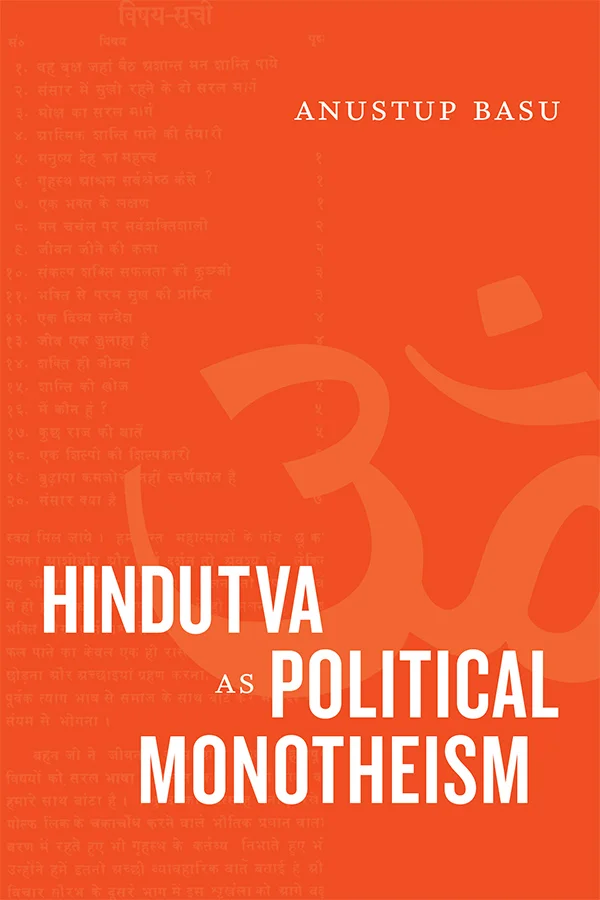
“Hindutva as Political Monotheism is an original, important book, brilliant in its juxtaposition of major strands of European Enlightenment thought and Indian nationalist thought.” - Peter van der Veer, author of The Value of Comparison
“A project of impressive intellectual scope and reach, based on erudition across a number of fields and archives. Hindutva as Political Monotheism is a much-awaited and timely study of Hindu nationalism that both extends the scope of well-worn historical terrain and reconfigures it through an utterly fresh conceptual lens. Given the present attempt to transform India’s democratic republic into a Hindu state, it could not have come at a more appropriate time. It will be an invaluable aid in understanding the contemporary situation in historical terms.” - Aamir Mufti, author of Forget English! Orientalisms and World Literatures
"A powerful, erudite, and timely study of the historical formations and contemporary manifestations of Hindu nationalism in India.... The laudable interdisciplinarity of the book and its rich archive of literature, film, and new media provide compelling and diverse entry points for a wide range of readers.” - Manav Ratti, South Asian Review
“Basu’s monograph is a path-breaking attempt to trace [Hindutva’s] genealogy as a political monotheism.... Hindutva is an eclectic and multidimensional work that makes major interventions in multiple knowledge-fields.”
- Amit R. Baishya,
Boundary 2
"The first great quality of this work lies in its innovation, in treating political Hinduism from the point-of-view of a history of ideas. . . . The comparative and reflexive dialogue that it allows can prove fruitful for thinking about the complexity of the contemporary social world. . . . Basu's book is therefore important, stimulating, and scholarly." [Translated from French] - Charlotte Thomas, Archives de sciences sociales des religions
“[Hindutva as Political Monotheism] is a scholarly and detailed study of Hindutva ideology and its evolution. Basu’s excellent questioning makes Hindutva as Political Monotheism a compelling book." - Shruti Dixit, Theology & Society
“Anustup Basu’s monograph, Hindutva as Political Monotheism, presents a hitherto underutilized lens of analysis. The book extends the works of political theorist Carl Schmitt on the monotheistic imperative found in the European theorizations of religious and ethnocentric nationhood, to India’s history with ethnonationalism. . . . [It] does an excellent job of tracing [Hindutva’s] origins.” - Iman Fathima Sheik Abdullah, Journal of Muslim Philanthropy & Civil Society
“Anustup Basu takes a researcher’s perspective and approaches the topic with academic rigor and passion, thereby contributing immensely to the study of the subject of Hindutva. . . . Elaborately designed, the text invites readers to delve deeper into the sociopolitical, religious, and cultural environment of contemporary India and with greater awareness address and encounter the fascistic structures of Hindutva 2.0.” - Swapna Gopinath, Cultural Politics
"A rich exploration of discourses and principles that form the ideological ground of Hindutva. . . . An important addition to the growing scholarship on India–Germany knowledge entanglements." - Thiago Pinto Barbosa, H-Soz-Kult
"Hindutva as Political Monotheism will remain a valuable study for all those, in South Asia and beyond, interested in thinking 'the ground of the present' (10)."
- Shefali Jha, Pacific Affairs
"An original and erudite book, Hindutva as Political Monotheism is a tour de force in critical interpretation: it constructs an intellectual genealogy of Hindu religious philosophy, tracking its steady politicization from the late nineteenth century to the present-day." - Bishnupriya Ghosh, Boundary 2
"[Hindutva as Political Monotheism] can be undoubtedly considered one of the finest works on the history of animals in South Asia."
- Mriganka Mukhopadhyay,
Religious Studies Review