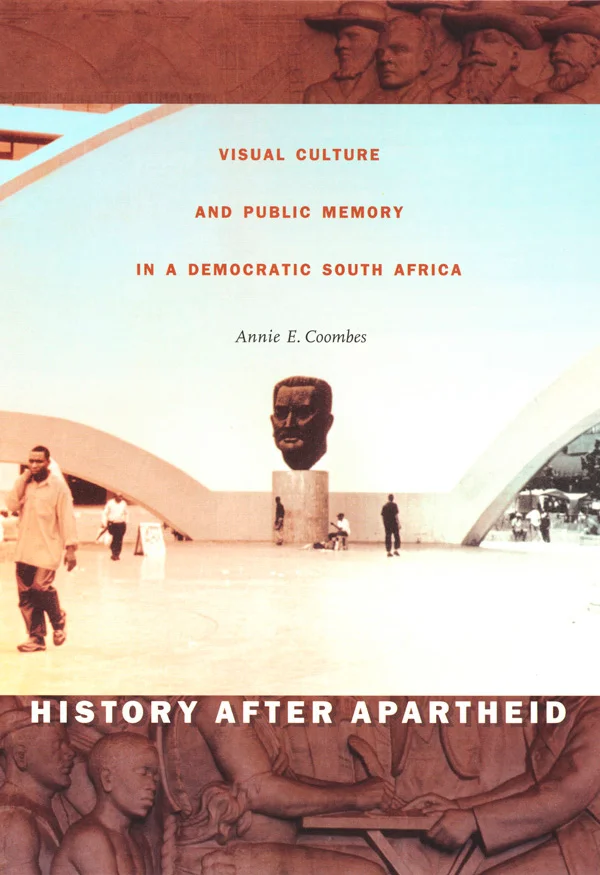
“History after Apartheid . . . offers an indispensable portrayal and critique of the difficulties of museum practice in a multicultural setting.” - Ikem Stanley Okoye , Art Journal
“[Coombes’s] richly illustrated and provocative chapters on the Voortrekker Monument, Robben Island, and District Six in Cape Town lay out the contending political, historical, aesthetic, and economic forces fighting to shape these sites.” - Mary Nolan, Radical History Review
"[A] timely and important engagement with the role that visual and material culture has played, and continues to play, in the country's transformation in the post-apartheid era. . . . History After Apartheid is an engaging read, quite generously illustrated with photographs of the sites under discussion. . . . While the work deals specifically with issues around public memory in South Africa, the issues it examines are more broadly relevant to any society in transition. The work is very accessible and should also have wider appeal to scholars in public history, sociology, politics and visual culture." - Barbara Russell , Eras
"[A] well-written and very engaging book. . . . [A]n enjoyable book that underlies the importance of history as a narrative constructed for an audience, which the audience then uses in the construction of their own popular consciousness."
- Sean Redding , Journal of African History
"[I]mportant and timely. . . . History after Apartheid will give readers a better understanding not only of why the difficulties persist but also of why there is still cause for optimism that many South African citizens will continue to offer their hands to one another." - Jeff Kelly Lowenstein, The Common Review
"[I]nteresting and unusual. . . . [A] valuable resource for art history students and professionals." - Foreign Affairs
"Annie Coombes is one of those gifted intellectuals who combine authority and analytical precision with obvious pleasure and excitement about the subject. This makes for stimulating and accessible reading. History after Apartheid is able to address a wider audience than academia without losing its rigour and integrity. This book is sorely needed for a new growth industry driven by bite-sized catchphrases that do not bear much scrutiny." - Sue Krige , African Affairs
"Annie Coombes's task was awesome. This book is intensively researched and needed to be written." - Robin M. Chandler , African Studies Review
"This book will be of interest to many students of anthropology, sociology, art history, geography, museum studies, and urban studies." - Andrea Dahlberg , Leonardo Reviews
"This is a sensitively written exposition of aspects of memory, identity and their relationship to visual and material culture, in which the writer, an art historian, ranges widely, taking a comparative approach in her methodology, providing the reader with insightful contrasts from a variety of societies, ranging from Russia to Australia. . . . [T]he treatment in the book is critical and thoughtful. . . . A major strength is that the author grapples with debates, discusses priorities and persuades the reader to think in a challenging way about how aspects of history are presented." - Alan Cousins , History
"Through her absolutely meticulous and absorbing study of social change, Coombes documents a history often overlooked. . . . History After Apartheid is itself a testimony to the transformation of visual culture in the country. It includes beautifully reproduced colour plates of works by contemporary artists . . . many of which would certainly have been banned during the apartheid era." - Susan Levine, Journal of the Royal Anthropological Institute
“Exquisitely detailed, ethically engaged, theoretically consequential, this book will delight readers across a wide spectrum of the humanities and social sciences. Annie E. Coombes captures the complexities of contemporary South Africa via an intriguing analysis of the country’s public culture. The South African case studies become portable and are intelligently linked to global debates in this highly readable study.” - Isabel Hofmeyr, University of the Witwatersrand, Johannesburg
“With verve, imagination, and engagement, Annie E. Coombes gives us an incisive account of memorial culture in South Africa since apartheid. She foregrounds the political tensions and ambiguities of rehabilitating traditional monuments, making Robben Island into an icon of resistance and liberation, creating museums of urban and township living that hover between reflective nostalgia and traumatized remembrance. Revisionism is a political necessity, but how is one to remember a brutal and painful history without rekindling the divisive passions of the past? A must read for anyone interested in memory culture on a global scale.” - Andreas Huyssen, author of Present Pasts: Urban Palimpsests and the Politics of Memory