
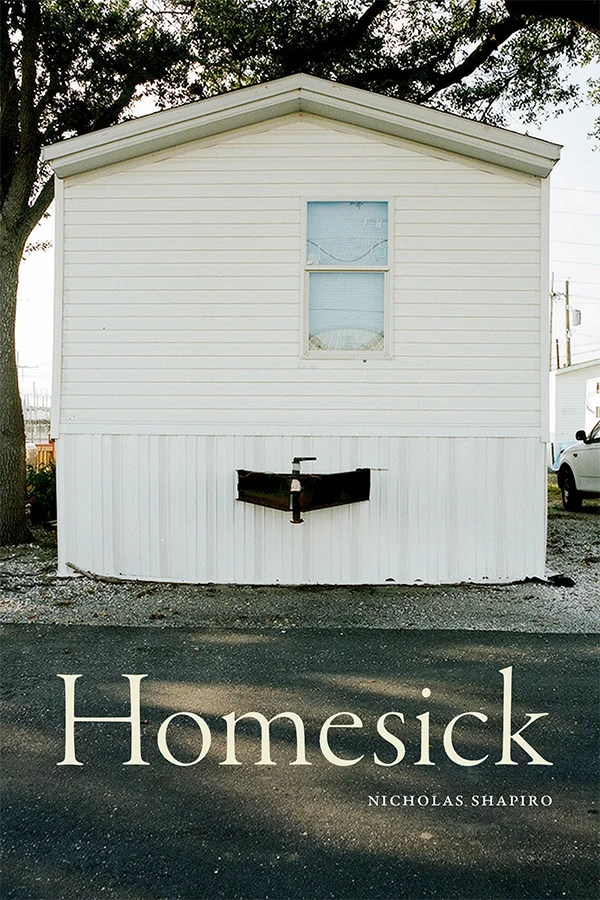
Homesick
Critical Global Health: Evidence, Efficacy, Ethnography
View the course discussion guide for Homesickhere.
Book
Pages: 256
Illustrations: 27 illustrations
Published: October 2025
Author: Nicholas Shapiro
Subjects
Anthropology > Cultural Anthropology, Science and Technology Studies, Environmental Studies
Anthropology > Cultural Anthropology, Science and Technology Studies, Environmental Studies
Praise
Buy
Availability: In stock
Price: $28.95
This title will be released on October 03, 2025
Buy the e-book:
Open Access
Funding information for the OA format is found at the bottom of this page.
Information
Author/Editor Bios
Back to Top
Nicholas Shapiro is Assistant Professor at the Institute for Society and Genetics at the University of California, Los Angeles.
Table Of Contents
Back to Top
Preface ix
Introduction: Homesick, Otherwise 1
1. At Home in the Surreal 27
2. From Chemical Fetishes to the Late Industrial Sublime 55
3. Un-knowing Exposure 79
4. Environmental Litigation and the Fantasy of Accountability 99
5. Working the Stopgap 125
6. From Policymaking to Alter-Engineered Worlds 149
Acknowledgments 173
Appendix 1 179
Appendix 2 181
Notes 183
References 199
Index 225
Introduction: Homesick, Otherwise 1
1. At Home in the Surreal 27
2. From Chemical Fetishes to the Late Industrial Sublime 55
3. Un-knowing Exposure 79
4. Environmental Litigation and the Fantasy of Accountability 99
5. Working the Stopgap 125
6. From Policymaking to Alter-Engineered Worlds 149
Acknowledgments 173
Appendix 1 179
Appendix 2 181
Notes 183
References 199
Index 225
Rights
Back to TopSales/Territorial Rights: World
Rights and licensingAwards
Back to TopHonorable Mention, 2026 Rachel Carson Prize, presented by the Society for Social Studies of Science
Additional Information
Back to Top
Related Links
Paper ISBN:
978-1-4780-3244-1 /
Hardcover ISBN:
978-1-4780-2907-6 /
eISBN:
978-1-4780-6129-8 /
DOI:
https://doi.org/10.1215/9781478061298
Publicity material
Funding Information
Back to Top
This book is freely available in an open access edition thanks to TOME (Toward an Open Monograph Ecosystem)—a collaboration of the Association of American Universities, the Association of University Presses, and the Association of Research Libraries—and the generous support of Arcadia, a charitable fund of Lisbet Rausing and Peter Baldwin, and the UCLA Library. Learn more at the TOME website.