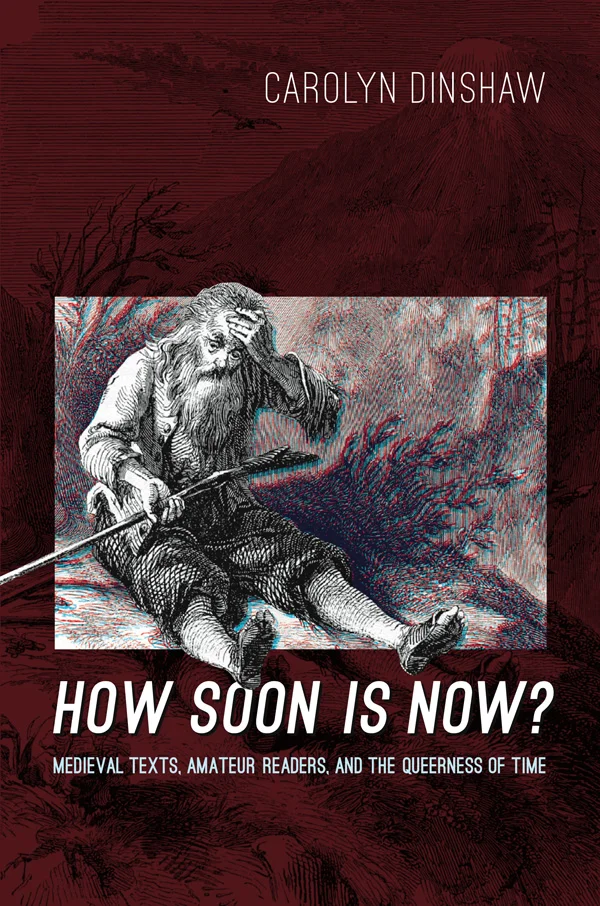
"Carolyn Dinshaw writes with love, learning, and endless good humor about asynchrony, the amateur, and the complex queerness of both. How Soon Is Now? is full of asynchrony stories, both medieval and modern, stories in which time is out of joint or so full as to be irresolvable into the the narrowly sequential conception of time that remains one of the driving engines of the heteronormative imagination. Rather than rejecting the past or the future, Dinshaw argues for the asynchrony of a now in which the very distinction between past, present, and future becomes impossible to make. In a series of beautiful and moving readings, Dinshaw makes us think about what we love. "I want more life." Who can argue with that simple but extraordinary claim?" - Amy Hollywood, author of Sensible Ecstasy: Mysticism, Sexual Difference, and the Demands of History
"Entering into an elegant slipstream of generative, generous, rigorous thought, Carolyn Dinshaw proves again her exquisite power to enchant her readers. Uniquely attractive as a theorist of time, she brilliantly addresses a temporal spread, from the seeming irrationality of medieval temporality to modernity's 'stingy' outlook on the senses. As I read How Soon Is Now?, I found her signal emphases—reading, temporality, non-linearity, queer historicity, and medieval mysticism—mattering to me, a queer theorist and non-medievalist, in the novel ways she said they would." - Kathryn Bond Stockton, author of The Queer Child, or Growing Sideways in the Twentieth Century
"How do queers relate to the distant past and experience time? Carolyn Dinshaw’s answer to this question in How Soon is Now? ranges through astute literary criticism, cogently argued theory, and snippets of autobiography. The result is a provocative essay about the value and presence of the past that is also at times profoundly moving. Her account of the amateur scholar’s privileged relation to asynchrony and affective engagement with the object of study should give all in the academy pause for thought." - Simon Gaunt, author of Love and Death in Medieval French and Occitan Courtly Literature: Martyrs to Love
“Carolyn Dinshaw’s third full-length monograph demands attention from those who do contemporary queer studies and medieval literary studies alike, and from those trying to figure out a less-alienated relationship to academic work in an increasingly corporatized university. . . . This book is clearly a labor of love while also an argument for falling in love with queer studies all over again.” - Masha Raskolnikov, GLQ
“How Soon Is Now? is scholarly, eminently readable, and insightful. Creative in its structure and wide in its ambit, Dinshaw’s long-awaited book cogently argues that the now we inhabit is denser with possibility than we have imagined—and that medieval writers as well as their amateur readers have known this conjunctive truth for a long time. The book is required reading for anyone interested in the intersections among history, community, textuality, sexuality, writing, dreaming, loving—that is, for anyone who cares about the humanities today.” - Jeffrey Jerome Cohen, Clio
“[D]elightfully original and thoughtful…Highly recommended.” - C.S. Cox, Choice
“Dinshaw has written a delightful book that takes pleasure in its subject; both professional and nonprofessional readers could enjoy and learn from it. . . . Because How Soon Is Now? argues that there is no fundamental distinction between amateur and professional, it welcomes both categories of reader into the book and into the field of medieval studies.” - Andrea Lankin, Journal of Medieval Religious Cultures
“Carolyn Dinshaw’s How Soon Is Now?, titled after the Smiths’ song, is part philosophy, part history, and part literary analysis, but its greatest value is to queer studies and medievalism. Her professed goal is ‘to claim the possibility of a fuller, denser, more crowded now … This means fostering temporalities other than the narrowly sequential. This means taking seriously lives lived in other kinds of time’ (p. 3).” - Anna Wallace, Parergon
"[An] inspiring meditation on the nature of time . . . arguing powerfully for the possibilities opened up by relationships to the past which Dinshaw identifies as queer." - Elizabeth Elliot, Year's Work in English Studies
“Readers of Christianity and Literature, both professional and amateur, who have an interest in temporality, medieval studies, queer theory, or medievalisms, will find reading this book a valuable and singularly pleasurable use of their time.” - Rebecca Dark, Christianity and Literature
“How Soon Is Now? balances urgency with careful reflection and offers a model for scholars to achieve the confidence to recognize when ideas need to be developed slowly—because, sometimes, some things, some people, and some ideas are worth the wait.” - Erin Felicia Labbie, Modern Philology
"Dinshaw weaves backwards and forwards in her pages and footnotes between vast topics— Christianity, encounters with the East, colonialism, literary theories, the history of philology, modern reception of the past, sexualities, and the development of modern academic professionalism." - Helen Phillips, Folklore
“Dinshaw does succeed in instilling in the reader a sense of the ‘queerness’ of time, and the pervasive asychrony of our reading, our landscapes, and our lives. I came away believing that we are all queers, we are all amateurs, in the ways we desire the past and in the ways we fold multiple times and lives into our own everyday-ness. The pervasive, even insistent presence of the personal in Dinshaw’s writing stakes an ideological claim against what she terms the ‘soulless professionalization of the university.’ This intensely political book shows that it’s okay – even for professionals! – to desire the past, so long as one uses that desire to broaden the possibilities of the present: to attain a ‘more just and more attached nonmodernity.’” - Kathy Cawsey, Mediaevistik
"In How Soon is Now, the author’s literary inquisitiveness, her ability to create links between very different, heterogeneous concepts, together with her narrative flexibility rooted in a plethora of examples, make for a very creative, dynamic and didactic book." - Jessica Stephens, Cercles