
Home / Books / How Things Fall Apart

How Things Fall Apart

What Happened to the Cuban Revolution
Book

Pages: 352

Published: September 2023

Author: Elizabeth Dore

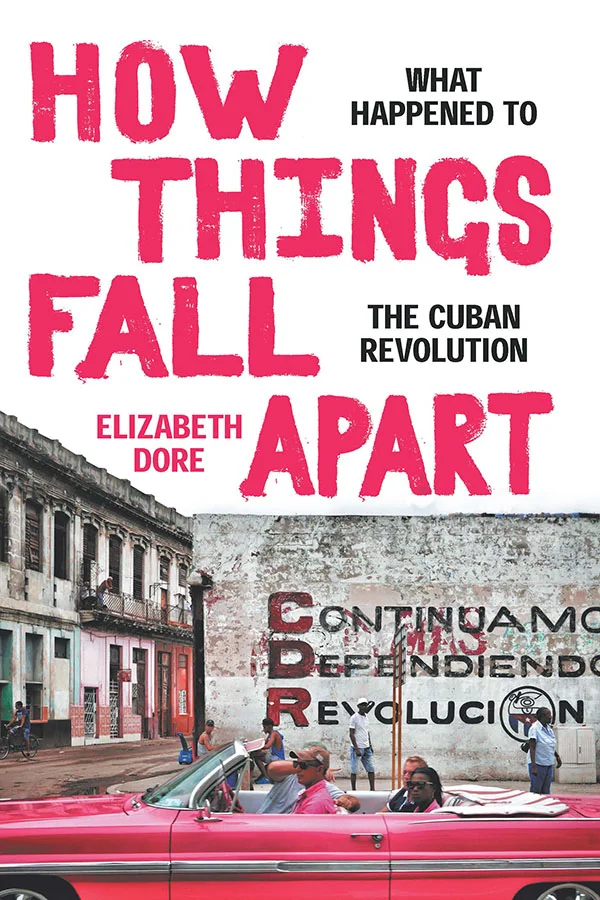
In How Things Fall Apart Elizabeth Dore reveals the decay of the Cuban political system through the lives of seven ordinary Cuban citizens. Born in the 1970s and 1980s, they recount how their lives changed over a tumultuous stretch of thirty-five years: first when Fidel Castro opened the country to tourism following the fall of the Soviet bloc; then when Raúl Castro allowed market forces to operate; and finally when President Trump’s tightening of the US embargo combined with the COVID-19 pandemic caused economic collapse. With warmth and humanity, they describe learning to survive in an environment where a tiny minority has grown rich, the great majority has been left behind, and inequality has destroyed the very things that used to give meaning to Cubans’ lives. In this book, everyday Cubans illuminate their own stories and the slow and agonizing decline of the Cuban Revolution.

Praise

“Masterful. Dore uses oral history to tell a history of Cuba from the bottom up, accompanied by her own astute commentary. How Things Fall Apart reads like a set of vivid short stories.” - Linda Gordon, author of The Second Coming of the KKK: The Ku Klux Klan of the 1920s and the American Political Tradition

“An elegant account of the evolution of a revolution. Writing on a topic which still has the power to provoke the most visceral responses across the political spectrum, Dore has done a rare thing: she has let the Cuban people speak for themselves. Dore handles their stories of triumph and hardship with honesty, compassion, and respect, and in the process has held up a mirror to the state of the Cuban Revolution in the twenty-first century. How Things Fall Apart is a vital addition to Cuba’s rich oral tradition.” - Will Grant, BBC Mexico, Central America, and Cuba Correspondent

“These life stories of Cubans are so raw, so honest, so moving that you feel as if you know each of them personally. To have gathered them together with such grace, eloquence and trust is a towering achievement. This book serves as a testament to the audacity and sorrow Cubans experienced in seeking to change not only their own history but the history of the world.” - Ruth Behar, author of Letters from Cuba

"How Things Fall Apart is a page-turner, even or perhaps especially for those readers who are familiar with the broad outlines of this story. Given the current political and economic crisis, it is hard to know when it will again be possible to conduct the kind of research that Dore was able to complete with her team. In the meantime, however, we are fortunate to have this wise and compassionate book with which to think through Cuba’s past, present, and future." - Jennifer L. Lambe, Hispanic American Historical Review

"A lifelong socialist and principled scholar, the book is evidence that Dore was dedicated to not just hearing but to actually listening to diverse, critical, and often contradictory Cuban voices and then—in the estimation of BBC Latin American correspondent Will Grant—'doing a rare thing: she let them speak for themselves.' In the book’s 26 chapters, they describe in rich, lived detail the Revolution’s many challenges, rewards, dilemmas, and failures. As such, Dore’s book captures the lives and voices of some of the people who built, supported, opposed, and even fled the Revolution."
  - Ted A. Henken, No Country Magazine

"How Things Fall Apart offers valuable insights for scholars of Latin American history and politics and for readers interested in Cuban history. For readers new to the topic, Dore's use of oral histories makes the complex subject matter more accessible. . . . Dore's work stands out for its ability to illuminate personal stories often overshadowed by grand historical narratives. While it may not provide a comprehensive analysis of the Revolution’s decline, her exploration of ordinary Cubans' everyday struggles, hopes, and disappointments offers a profoundly human perspective on a period usually dominated by political rhetoric and ideological debates. This is a compelling read for anyone interested in understanding the human impact of political and social change." - Tiffany A. Sippial, The Latin Americanist

"Splendid. . . ." - Jorge I. Domínguez, International Journal of Cuban Studies

"The testimony of Dore’s characters is compelling. She also provides helpful context. . . ." - Daniel Rey, History Today

"How Things Fall Apart invites readers inside a Cuba typically unseen in historical work. . . . A warning to historians of Cuba and Latin America, to leftists who saw or continue to see Cuba as a beacon of hope in a landscape of hypercapitalist extraction: this book might break your heart. More happily, it might inspire new historical work on the second half of the twentieth century in Cuba." - Anasa Hicks, American Historical Review

"How Things Fall Apart is absorbing, dynamic research. . . . Read it, and keep it on your bookshelf; you will come back to it." - Yoly Zentella, Journal of Global South Studies

“[How Things Fall Apart] is a tribute to Dore’s tremendous skills as a researcher and listener.” - Karen Dubinsky, Canadian Journal of Latin American and Caribbean Studies

"Told through the life stories of seven Cubans, mostly born in the 1970s and 1980s, [How Things Fall Apart] is a rich and evocative chronicle of Cuba’s dramatic transformations from the 1980s to the present." - Michelle Chase, The Americas

Buy

Availability: Loading...

Price: Loading...

Request a desk or exam copy Spring 2026 Web Sale

Information

Author/Editor Bios

Back to Top
Elizabeth Dore (1946–2022) was Professor Emeritus of Latin American History at the University of Southampton, author of Myths of Modernity: Peonage and Patriarchy in Nicaragua, and coeditor of Hidden Histories of Gender and the State in Latin America, both also published by Duke University Press.

Table Of Contents

Back to Top
Prologue  1
1. The Narrators  5
2. Backstory  8
3. Fidel’s Fall, An Omen  13
Part 1: The 1980s
4. Mario Sánchex Cortéz 21
5. Alina Rodríguez Abreu  32
6. Juan Guillard Matus  37
7. Racism  55
8. Esteban Cabrera Montes  58
9. Barbara Vegas  70
10. Fidel Castro  75
11. Pavel García Rojas  80
Part 2: Fidel and the Collapse, 1990–2006  97
12. Mario Sánchez Cortéz  103
13. Alina Rodríguez Abreu  128
14. Juan Guillard Matus  134
15. Esteban Cabrera Montes  148
16. Barbara Vegas  173
17. Pavel García Rojas  176
18. Alejandro Espada Betancourt  187
Part 3: Inequality, 2006–20  205
19. Mario Sánchez Cortéz  211
20. Alina Rodríguez Abreu  238
21. Juan Guillard Matus  253
22. Raúl Castro: The General  267
23. Esteban Cabrera Montes  270
24. Barbara Vegas  286
25. Pavel García Rojas  288
26. Alejandro Espada Betancourt  306
Conclusion  320
My Thanks  322
Endnotes  323
Index  333
 

Rights

Back to Top

Sales/Territorial Rights: United States and Canada Only

Rights and licensing

Additional Information

Back to Top
Paper ISBN: 978-1-4780-2496-5 / Hardcover ISBN: 978-1-4780-2033-2 / eISBN: 978-1-4780-2730-0 / DOI: https://doi.org/10.1215/9781478027300