
Humanity′s Ruins
Ethics, Feminism, and Genocidal Humanitarianism
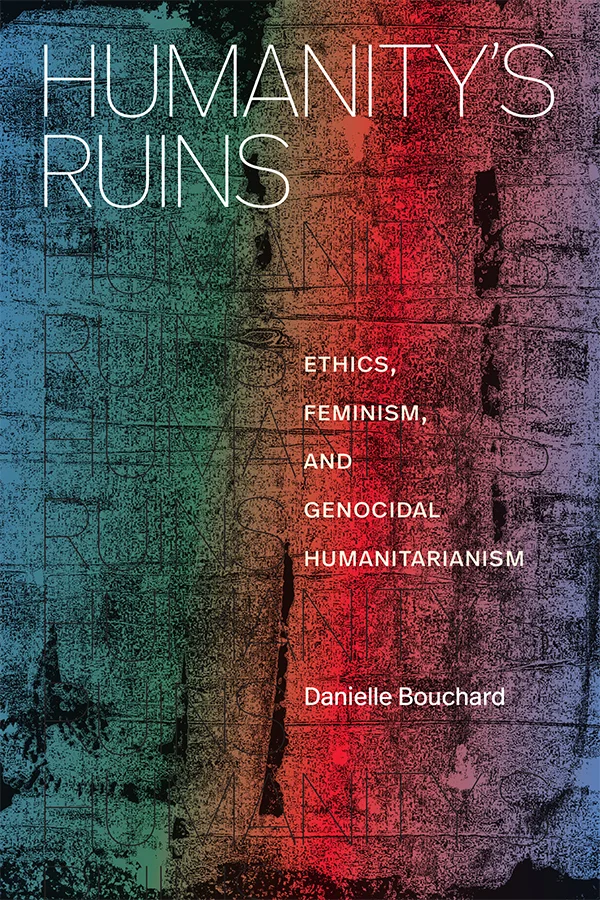
Book
Pages: 312
Illustrations: 4 illustrations
Published: August 2025
Author: Danielle Bouchard
Subjects
Gender and Sexuality > Feminism and Women’s Studies, American Studies, Critical Ethnic Studies
Gender and Sexuality > Feminism and Women’s Studies, American Studies, Critical Ethnic Studies
Praise
Buy
Availability: Loading...
Price: Loading...
This title will be released on August 15, 2025
Buy the e-book:
Information
Author/Editor Bios
Back to Top
Danielle Bouchard is Associate Professor of Women’s, Gender, and Sexuality Studies at the University of North Carolina at Greensboro and author of A Community of Disagreement: Feminism in the University.
Table Of Contents
Back to Top
Acknowledgments vii
Introduction. Cynicism, Death, and Humanitarianism: The Aesthetic of Ruination 1
1. Bomb Ethics: Vulnerable Humanity in the Anthropocene 41
2. Postcolonial Histories of the Bomb: Differential Temporalities of Destruction in Kidlat Tahimik’s Mababangong Baungugot and Soleymane Cissé’s Yeelen 77
3. Converting Absences into Signs: The War on Terror and the Humanitarian Necessity of Violence 111
4. Documentation as Eradication: The Amazon’s "Uncontacted Tribes" and the Securitizing of Humanity 149
5. A Differential Humanity: Beyond the New Feminist Ethics of Vulnerability 183
Coda. Zero Logics, Atomic Semiotics; or, an Aesthetics of Debris 218
Notes 227
Bibliography 263
Index 283
Introduction. Cynicism, Death, and Humanitarianism: The Aesthetic of Ruination 1
1. Bomb Ethics: Vulnerable Humanity in the Anthropocene 41
2. Postcolonial Histories of the Bomb: Differential Temporalities of Destruction in Kidlat Tahimik’s Mababangong Baungugot and Soleymane Cissé’s Yeelen 77
3. Converting Absences into Signs: The War on Terror and the Humanitarian Necessity of Violence 111
4. Documentation as Eradication: The Amazon’s "Uncontacted Tribes" and the Securitizing of Humanity 149
5. A Differential Humanity: Beyond the New Feminist Ethics of Vulnerability 183
Coda. Zero Logics, Atomic Semiotics; or, an Aesthetics of Debris 218
Notes 227
Bibliography 263
Index 283
Rights
Back to TopSales/Territorial Rights: World
Rights and licensingAdditional Information
Back to Top
Paper ISBN:
978-1-4780-3206-9 /
Hardcover ISBN:
978-1-4780-2879-6 /
eISBN:
978-1-4780-6099-4 /
DOI:
https://doi.org/10.1215/9781478060994
Publicity material