
Home / Books / Infamous Bodies

Infamous Bodies

Early Black Women’s Celebrity and the Afterlives of Rights
Book

Pages: 264

Illustrations: 36 illustrations

Published: August 2020

Author: Samantha Pinto

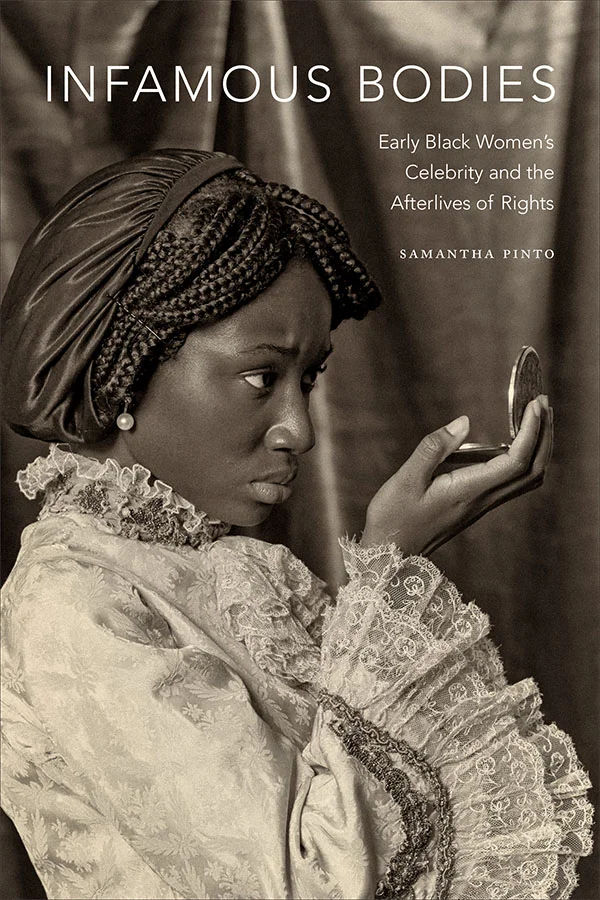
The countless retellings and reimaginings of the private and public lives of Phillis Wheatley, Sally Hemings, Sarah Baartman, Mary Seacole, and Sarah Forbes Bonetta have transformed them into difficult cultural and black feminist icons. In Infamous Bodies, Samantha Pinto explores how histories of these black women and their ongoing fame generate new ways of imagining black feminist futures. Drawing on a variety of media, cultural, legal, and critical sources, Pinto shows how the narratives surrounding these eighteenth- and nineteenth-century celebrities shape key political concepts such as freedom, consent, contract, citizenship, and sovereignty. Whether analyzing Wheatley's fame in relation to conceptions of race and freedom, notions of consent in Hemings's relationship with Thomas Jefferson, or Baartman's ability to enter into legal contracts, Pinto reveals the centrality of race, gender, and sexuality in the formation of political rights. In so doing, she contends that feminist theories of black women's vulnerable embodiment can be the starting point for future progressive political projects.

Praise

Infamous Bodies is required reading for scholars of black feminist theory. This ambitious, provocative book interrogates female celebrity as a crucial genre through which black women come into political view. Samantha Pinto's careful and thoughtful wrestling with black women celebrities who have become—or perhaps always were—‘difficult’ in and for black feminist studies requires that scholars probe the very meaning of the ‘political’ for black feminist thought. Black feminist theory will be both challenged and transformed by Pinto's careful and counterintuitive readings of black women's representation and by Pinto’s call for the necessary centrality of vulnerability to our scholarly and political work.” - Jennifer C. Nash, author of Black Feminism Reimagined: After Intersectionality

“With theoretical innovation and a commitment to bringing to light forgotten cultural moments, Samantha Pinto considers notorious figures of black female historical celebrity for what they can tell us about the limits of liberal humanist conceptions of freedom, agency, and consent. Fueled by a powerful sense of urgency, Pinto’s rich and valuable contribution pushes black studies and feminist and queer studies of representation and history to new places while prompting readers to think about how celebrity culture continues to treat black women with the broadest strokes.” - Francesca T. Royster, author of Sounding Like a No-No: Queer Sounds and Eccentric Acts in the Post-Soul Era

"[A] must-have counterintuitive, historical analysis. . . . The book is well written . . . and would be ideal for the following departments: sociology, women's studies, and African American studies. The book would pair well with the following courses: women authority and power, women's right and status; and feminism." - Shauntey James, Ethnic and Racial Studies

"The work is a rewarding if challenging read, and opens space for celebrity studies to dive deeply into discussions of race, gender, and sexuality in the context of national belonging, a surprisingly delightful application." - Lydia Kelow-Bennett, Celebrity Studies

This excellent text is a must read for those studying cultural and Black feminist representations to understand how those that proliferated in the past inform contemporary debates related to '[B]lack women’s sexual, embodied visibility as always politically suspect.'" - C. B. Regester, Choice

"Pinto’s work is skilfully crafted. . . . With a theoretical focus of Black feminism, structured through a framework of human rights discourse, and with a call to reframe Black feminist thought and historiography, Pinto’s work offers scholars new possibilities for asking different questions of our material and the way in which we see, read and write about them." - Rebecca J. Fraser, European Journal of American Culture

"Infamous Bodies feels acutely timely. Dense with citation and conceptual triangulation, Pinto’s is an up-to-date intervention rooted in the history of the field. There are many potential audiences for this text—within literary studies, media studies, sexuality studies, and political theory—but any feminist scholar keeping abreast of contemporary debates will find something of interest here." - Deborah Thurman, Year's Work in Critical and Cultural Theory

"Infamous Bodies is a generative contribution to the field of Black feminist theory, particularly for scholars interested in the early intersections of contracts, labor, and international human rights. This is also an insightful text for practitioners of art criticism and performance theory." - Margarita Lila Rosa, The Black Scholar

"Pinto offers new radical political futures for black feminist studies. . . . She adds to existing critical human rights scholarship on vulnerability with a novel reconfiguration of what agency and freedom look like." - Marietta Kosma, US Studies Online

"This book will prove to be an important tool for those studying Black women's celebrity in the historical present and considering how we can think differently about the relationship between cultural representations and political subjectivities. Because of Pinto's deft interdisciplinarity . . . this book has the potential to be useful in Black studies, Performance studies, Black Feminist studies, English Literature, and Legal studies, to name a few." - Daelena Tinnin, E3W Review of Books

"This book has the potential to find use in a variety of classes. . . . It naturally lends itself to a variety of fields and interdisciplinary courses." - Danielle Bainbridge, Feminist Formations

"One of the canny moves Pinto makes in Infamous Bodies is to quietly affirm that the white male analytical gaze does not have to be the origin of scholarly inquiry. Infamous Bodies pushes us to consider the way that the ongoing objectification of women like Wheatley, Hemings, Baartman, Seacole, and Bonetta does complex work that exists outside normative routes of power in the representational sphere. . . . Pinto’s work is notable for its transnational cultural critique and its rigorous theoretical engagement." - Kristin Moriah, Early American Literature

"Pinto’s is an innovative study which expands upon the contemporary discourses central to black feminist scholarship and will likely become an essential read in its field." - Laura Skinner, Journal of Gender Studies

Buy

Availability: In stock

Price: $27.95

Open Access

Read OA Edition

Funding information for the OA format is found at the bottom of the page.

Request a desk or exam copy

Information

Author/Editor Bios

Back to Top
Samantha Pinto is Associate Professor of English at the University of Texas at Austin, author of Difficult Diasporas: The Transnational Feminist Aesthetic of the Black Atlantic, and coeditor of Writing beyond the State: Post-Sovereign Approaches to Human Rights in Literary Studies.

Table Of Contents

Back to Top
Acknowledgments  vii
Introduction. Infamous Bodies, Corrective Histories  1
1. Fantasies of Freedom: Phillis Wheatley and the "Deathless Fame" of Black Feminist Thought  31
2. The Romance of Consent: Sally Hemings, Black Women's Sexuality, and the Fundamental Vulnerability of Rights  65
3. Venus at Work: The Contracted Body and Fictions of Sarah Baartman  105
4. Civic Desire: Mary Seacole's Adventures in Black Citizenship  139
5. #DevelopmentGoals: Sovereignty, Sarah Forbes Bonetta, and the Production of the Black Feminist Political Subject  173
Conclusion. Black Feminist Celebrity and the Political Life of Vulnerability  203
Notes  207
References  221
Index 243

Rights

Back to Top

Sales/Territorial Rights: World

Rights and licensing

Awards

Back to Top

Named to the Shortlist, 2021 ASAP (Association for the Study of Arts of the Present) Book Prize

A 2021 CHOICE Magazine Outstanding Academic Title

Funding Information

Back to Top
The open-access edition of Infamous Bodies was made possible by an award from the National Endowment for the Humanities Fellowships Open Book Program.