
Home / Books / Infertile Environments

Infertile Environments

Epigenetic Toxicology and the Reproductive Health of Chinese Men
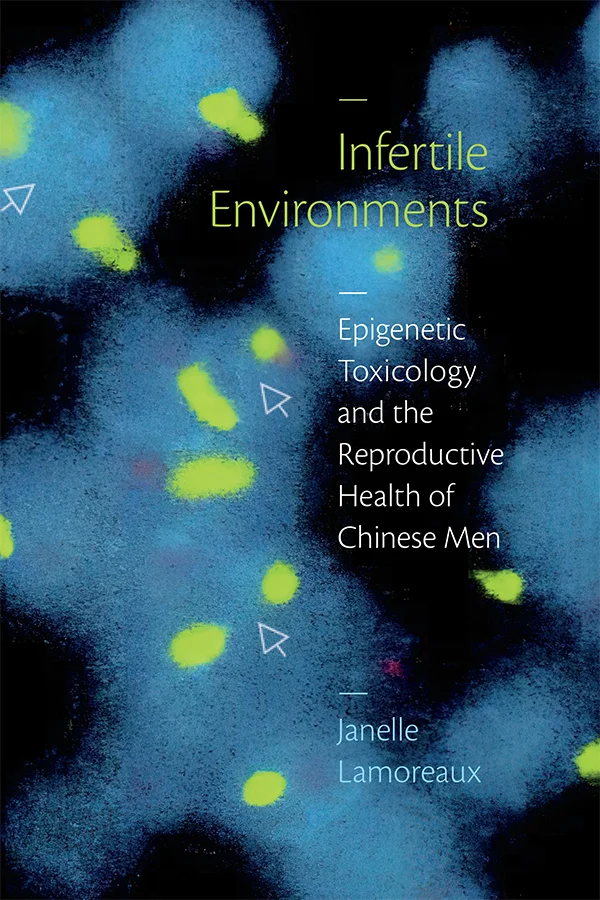
Infertile Environments cover image

Critical Global Health: Evidence, Efficacy, Ethnography

More about this series

Read the Introduction

Book

Pages: 160

Illustrations: 3 illustrations

Published: January 2023

In Infertile Environments, Janelle Lamoreaux investigates how epigenetic research into the effects of toxic exposure conceptualizes and configures environments. Drawing on fieldwork in a Nanjing, China, toxicology lab that studies the influence of pesticides and other pollutants on male reproductive and developmental health, Lamoreaux shows how the lab’s everyday research practices bring national, hormonal, dietary, maternal, and laboratory environments into being. She situates the lab’s work within broader Chinese history as well as the contemporary cultural and political moment, in which declining fertility rates and reproductive governance and technology are growing concerns. She also points to how toxicology in China is a transnational endeavor tied to both local conditions and international research agendas and infrastructures, which highlights the myriad scales and scope of epigenetic environments. At a moment of growing concerns about toxins, endocrine-disrupting chemicals, and climate change, Lamoreaux demonstrates that epigenetic research’s proliferation of environments produces new kinds of toxic relations that impact multiple generations of humans.

Praise

“Janelle Lamoreaux’s Infertile Environments is a beautifully written book that has the virtues of a classic ethnography, both providing specificity of time and place and shedding light on broader trends at the intersection of science and society and enduring epistemological and ontological questions. The five palimpsests of Nanjing epigenetic toxicology—national, hormonal, dietary, maternal, and laboratory environments—work beautifully to highlight what is at stake in modern toxic exposures and their effects on gendered reproductive ability. In addition, Lamoreaux situates the book through concise and generously cited accounts of scholarship on reproductive technologies and on the history of modern Chinese biology.” - Charis Thompson, author of Good Science: The Ethical Choreography of Stem Cell Research

“Janelle Lamoreaux’s deep ethnographic dive into genotoxicity not only reinvents biological anthropology and environmental studies; it offers us a whole new perspective on reproductive politics. This is a brilliant must-read with profound implications for how we understand race, sex, gender, and nation as well as science, food, and DNA.” - Sarah Franklin, author of Biological Relatives: IVF, Stem Cells, and the Future of Kinship

"What does the wide-scale environmental contamination poisoning China’s water, air, and food mean for our understandings of science, kinship, and reproduction in the twenty-first century?. . . Lamoreaux combines traditional laboratory ethnography with extensive reading of scientific and popular literature to argue that a distinctively Chinese variety of 'epigenetics' might be able to answer this question." - Katherine A. Mason, Journal of Asian Studies

"Infertile Environments is concise and approachable, deftly rendering complex topics in the fields of environmental epigenetics, reproductive toxicology, medical and reproductive anthropology, and science and technology studies (STS)." - Jessica P. Cerdeña, Journal of Anthropological Research

"Janelle Lamoreaux’s timely ethnography greatly contributes to . . . our understanding of the intersections between postgenomic sciences, environmental toxicities, and health. . . . Infertile Environments provides lasting contributions to medical and environmental anthropology, as well as feminist science studies."

- Fionna Fahey, Somatosphere

Buy

Availability: Loading...

Price: Loading...

Request a desk or exam copy Spring 2026 Web Sale

Information

Author/Editor Bios

Back to Top
Janelle Lamoreaux is Associate Professor of Anthropology at the University of Arizona and coeditor of the Routledge Handbook of Genomics, Health, and Society.

Table Of Contents

Back to Top
Preface  ix
Acknowledgments  xv
Introduction  1
1. The National Environment  21
2. The Hormonal Environment  35
3. The Dietary Environment  52
4. The Maternal Environment  64
5. The Laboratory Environment  77
Coda  92
Epilogue  97
Notes  103
References  109
Index  129

Rights

Back to Top

Sales/Territorial Rights: World

Rights and licensing

Additional Information

Back to Top
Paper ISBN: 978-1-4780-1933-6 / Hardcover ISBN: 978-1-4780-1670-0 / eISBN: 978-1-4780-2397-5 / DOI: https://doi.org/10.1215/9781478023975