
Home / Books / Laboratory Epistemologies

Laboratory Epistemologies

A Hands-On Perspective
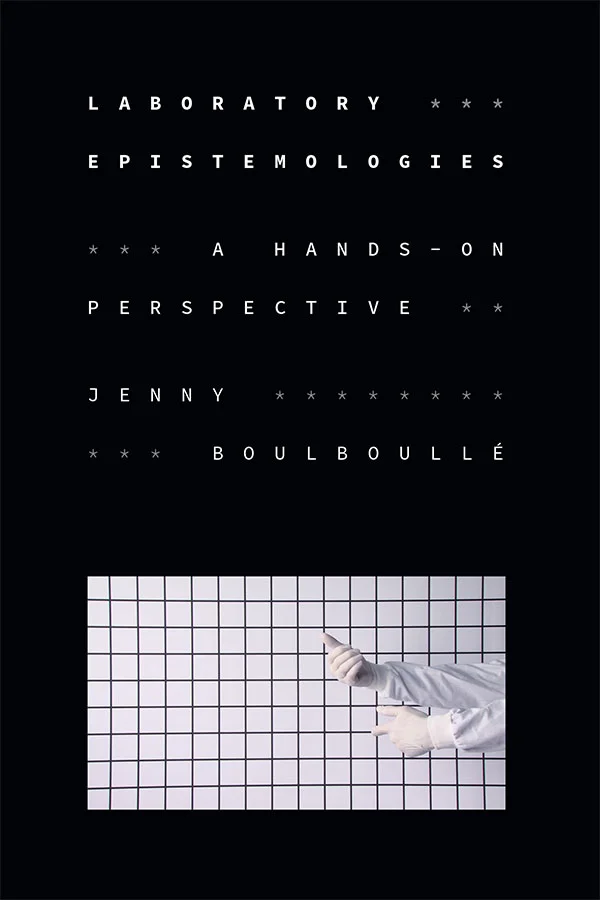
Laboratory Epistemologies cover image

Experimental Futures: Technological Lives, Scientific Arts, Anthropological Voices

More about this series

Read the Introduction

Book

Pages: 376

Illustrations: 35 illustrations

Published: November 2024

In Laboratory Epistemologies: A Hands-On Perspective, Jenny Boulboullé examines the significance of hands-on experiences in contemporary life sciences laboratories. Addressing the relationship between contemplation and manipulation in epistemology, Boulboullé combines participant observations in molecular genetics labs and microbiological cleanrooms with a longue durée study of the history and philosophy of science. She radically rereads Descartes’s key epistemological text Meditations on First Philosophy, reframing the philosopher as a hands-on knowledge maker. With this reading, Boulboullé subverts the pervasive modern conception of the disembodied knower and puts the hands-on experimenter at the heart of life sciences research. In so doing, she contributes a theoretical model for understanding how life processes on cellular and molecular levels are manually produced in today’s techno-scientific spaces. By reassessing the Cartesian legacy and arguing that epistemology should be grounded in the standpoint of a hands-on practitioner, Boulboullé offers the philosophical and historical foundation to understand and study contemporary life sciences research as multisensory embodied practices.

Praise

"Jenny Boulboullé brilliantly revises superficial clichés about Descartes: as foundational to French rationality, as opposed to British practicality, and to the dualism of subject versus object; as conceiving of cogito as purely in the mind; and as invested in skepticism as his primary method. An experimentalist and vivisectionist, Descartes was prouder of his experiments than his philosophy, and, with his correspondents, helped devise the ‘literary technology’ that led to the scientific method of the Royal Society. Boulboullé argues that Laboratory Epistemologies begin in touch and the sensory followed by cogito-mathematical consolidations that often erase their empirical origins, and for Descartes required a theological overlay." - Michael M. J. Fischer, author of Probing Arts and Emergent Forms of Life

“Jenny Boulboullé calls her study a ‘multisited historioethnographical investigation,’ thus condensing its spirit in one combined expression. The book brings together an impressively wide reading in contemporary historical and ethnographical science studies, a longue dureée philosophical perspective, and hands-on participatory experiences both in molecular biology and in the aesthetic practices of contemporary bio-artists. A highly original study of scientific practice that makes for fascinating reading.” - Hans-Jörg Rheinberger, author of Split and Splice: A Phenomenology of Experimentation

“This book is a theoretically ambitious interdisciplinary contribution. . . . In tracing the historical-philosophical erasure of manual labour and material manipulation from rationalism’s canon, Boulboullé reframes Cartesian epistemology as entangled with the bodily regimes it purportedly transcended, giving her critique its distinctive force. Her argument challenges persistent myths about modern science’s origins, while offering a material genealogy of rationalist epistemology.”

- L. Bican Polat, British Journal for the History of Science

“Taking as her focus the role of the body in molecular biology and biochemistry laboratories, Boulboullé argues for a 'hands-on perspective' in the history, philosophy, and social studies of science. In doing so, she combines a surprising array of materials, from early modern scientific practice to her own auto-ethnographic experiences learning to pipette and work in sterile conditions. A work that spans centuries and disciplines but that makes a consistent case for the embodied nature of experimental observation." - Rose Trappes, Metascience

Laboratory Epistemologies makes six important interventions for historians and science studies.” - Michael M. J. Fischer, Journal of Anthropological Research

"In the final analysis, Boulboullé is right: Procedure and practice count, and they should be made more explicit in theories of knowledge." - Oren Harman, Common Knowledge

Buy

Availability: Loading...

Price: Loading...

Request a desk or exam copy

Information

Author/Editor Bios

Back to Top
Jenny Boulboullé is Lecturer in the Art and Culture Department at the University of Amsterdam.

Table Of Contents

Back to Top
Note on Descartes’s Texts and Their Translation  ix
Introduction: A Feeling for the Life Sciences  1
1. Knowing by Experience  33
2. Descartes’s Manual Meditations  81
3. Making Modern Epistemology  112
4. Revisiting Laboratory Cultures  143
5. In Touch with Life  189
Epilogue  235
Acknowledgments  257
Notes  261
Bibliography  313
Index

Rights

Back to Top

Sales/Territorial Rights: World

Rights and licensing

Additional Information

Back to Top
Paper ISBN: 978-1-4780-3096-6 / Hardcover ISBN: 978-1-4780-2675-4 / eISBN: 978-1-4780-5998-1 / DOI: https://doi.org/10.1215/9781478059981