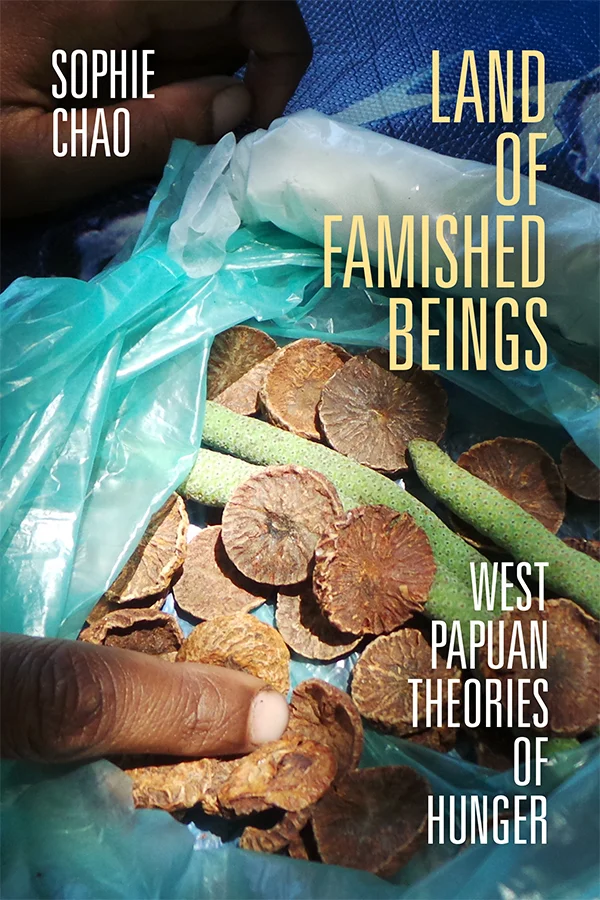
“In this book, Sophie Chao brilliantly metabolizes the entanglements of hunger, health, colonialism, and capitalism in West Papua. Land of Famished Beings is a must-read for students and scholars of environmental anthropology and multispecies ethnography. Moreover, it is essential reading for anyone passionate about justice in the Pacific, a region hungry for justice.” - Craig Santos Perez, author of Navigating CHamoru Poetry: Indigeneity, Aesthetics, and Decolonization
"Sophie Chao gained insight into Marind people's conceptualizations of hunger by living and working with them and by including them as cothinkers and cotheorists. Contending that hunger cannot be understood outside of rapacious capitalism, Chao shows how hungry people themselves make this argument, how they debate it, and how they work to counteract hunger. Evocatively written and expertly reasoned, Land of Famished Beings, exemplifies how to carry out and write about anthropological fieldwork in the twenty-first century." - Emily Yates-Doerr, author of Mal-Nutrition: Maternal Health Science and the Reproduction of Harm
"In poignant and poetic prose, Chao explores the transformation of nourishing, sentient forests into impoverished, extractive zones. . . . Poignant and disturbing, this book also explores the ethics and politics of contemporary ethnographic writing. Recommended. General readers through faculty; professionals." - Choice
"You, reader, are likely consuming palm oil that in turn consumes the land of the innocent Marind and the people themselves. We consume Chao's account with great intrigue for the Marind way of life, but we also digest it uneasily. There's genocide in Papua you may have never of, and you may be eating its fruits right now. It is an unsatiating realization, which makes Chao's project a solemn success." - Paige Welsh, Ethnic and Third World Literatures
"With Sophie’s deft, incisive pen, translating many months of fieldwork—and drawing on the wisdom and intelligence of Marind culture—this hunger is revealed as profound hunger that includes brute biological and nutritional wants, but stretches outwards to include the other forest species, also going hungry, and the deeper hungers unleashed by so-called development. . . . Land of Famished Beings helps us see and feel a hunger that stretches very deep and wide. It helps us feel for our neighbours to the north, who are bound to us by economic ties and market relations, but also by human ties." - Jamie Dunk, St. James Connection
"Through the many words for hunger used by the Marind people in different contexts, Chao enables us to understand the culture and struggles of a community who would not otherwise have a voice. . . . Chao brings unique insights to the spread of instant noodles in oil palm plantations, connecting the two ends of the capitalist system, the production of the ingredients and the consumption of the UPF itself." - Elna Tulus, Capitalism Nature Socialism Journal
"Land of Famished Beings would be a meaningful addition to courses on medical, food, and environmental anthropology as well as those on global political economy. . . .This book will hold special relevance for anyone working collaboratively with colonized and occupied communities and with those living under conditions of food apartheid." - Terese V. Gagnon, Food Anthropology
“This is a visceral, gut-wrenching ethnography and exemplary anthropology at its reflexive best.” - Margaret Jolly, The Australian Journal of Anthropology
“Land of Famished Beings . . . demonstrates what it might mean to write and read with people, rather than about them. It exemplifies through diligent and careful work how to remain accountable to people's relational worlds, to their voices, and to their silences.” - Shiori Shakuto, The Australian Journal of Anthropology
“Chao positions both women who speak and those who remain silent as sharing the same struggle. In a colonial and structurally violent context, both ‘telling’ and ‘not telling’ are political acts—the one demanding justice, the other safeguarding communal integrity.” - Hatib Kadir, The Australian Journal of Anthropology
“Land of Famished Beings does not offer simple answers or tidy lessons. It holds space for the tensions, imperfections, and ethical uncertainties that come with bringing different worlds into dialogue. To me, its greatest gift is that it shows how vital relations can still be forged across difference and how, even in an age of exhaustion and loss, we can learn from each other what it means to nourish and be nourished within our shared, more-than-human world.” - Hanna della Bosca, The Australian Journal of Anthropology
“Land of Famished Beings will be instrumental for those wishing to apply Fourth World Approaches to International Law (FWAIL) and Earth Jurisprudence in the context of West Papua. To my knowledge, few works articulate Indigenous understandings and more-than-human relationships with such clarity and depth." - Veronica Koman, The Australian Journal of Anthropology
“Chao inspires us all to see that ethnography is a tool for struggle and not just a research method, and that the voices of Marind Anum, who bear witness to the dispossessed world, remain steadfast in guarding the land and the hope of life through their wombs, stoves, and kamboti.” - Wensislaus Fatubun, The Australian Journal of Anthropology