
Lifelines
The Traffic of Trauma
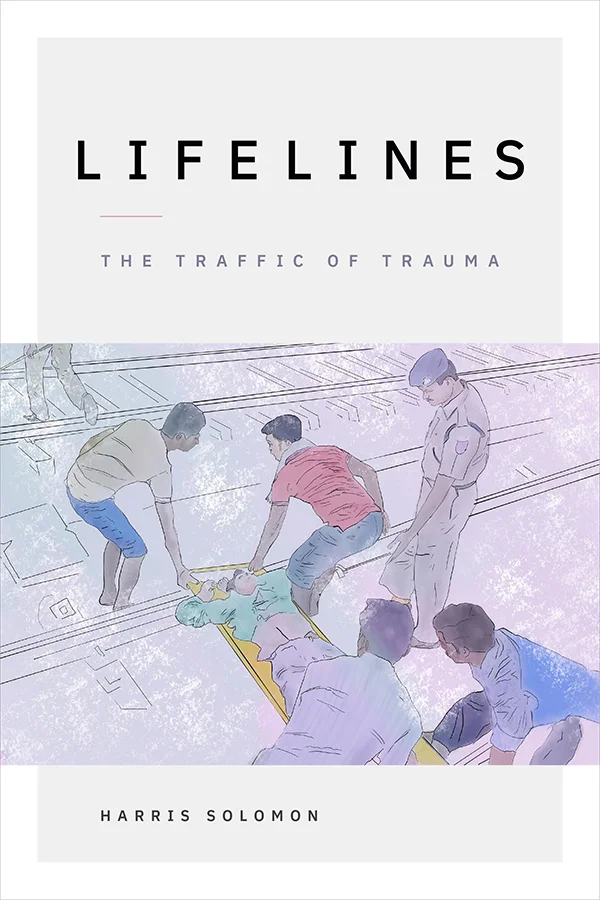
Book
Pages: 304
Illustrations: 11 illustrations
Published: September 2022
Author: Harris Solomon
Subjects
Anthropology > Medical Anthropology, Asian Studies > South Asia, Medicine and Health > Global Health
Anthropology > Medical Anthropology, Asian Studies > South Asia, Medicine and Health > Global Health
Praise
Buy
Availability: Loading...
Price: Loading...
This title will be released on September 23, 2022
Buy the e-book:
Open Access
Funding information for the OA format is found at the bottom of the page.
Information
Author/Editor Bios
Back to Top
Harris Solomon is Fred W. Shaffer Associate Professor of Cultural Anthropology and Global Health at Duke University and author of Metabolic Living: Food, Fat, and the Absorption of Illness in India, also published by Duke University Press.
Table Of Contents
Back to Top
Note on Illustrations ix
Acknowledgments xi
Introduction: The Traffic of Trauma 1
1. Carrying: The Lifelines of Transfer 27
2. Shifting: The Lifelines of Triage 53
3. Visiting: The Lifelines of Home 79
4. Tracing: The Lifelines of Identification 107
Seeing: The Lifelines of Surgery 135
5. Breathing: The Lifelines of Ventilation 147
6. Dissecting: The Lifelines of Forensics 174
7. Recovering: The Lifelines of Discharge 200
Epilogue: The Traffic of Medicine 229
Notes 237
References 253
Index 277
Acknowledgments xi
Introduction: The Traffic of Trauma 1
1. Carrying: The Lifelines of Transfer 27
2. Shifting: The Lifelines of Triage 53
3. Visiting: The Lifelines of Home 79
4. Tracing: The Lifelines of Identification 107
Seeing: The Lifelines of Surgery 135
5. Breathing: The Lifelines of Ventilation 147
6. Dissecting: The Lifelines of Forensics 174
7. Recovering: The Lifelines of Discharge 200
Epilogue: The Traffic of Medicine 229
Notes 237
References 253
Index 277
Rights
Back to TopSales/Territorial Rights: World
Rights and licensingAdditional Information
Back to Top
Related Links
Paper ISBN:
978-1-4780-1885-8 /
Hardcover ISBN:
978-1-4780-1621-2 /
eISBN:
978-1-4780-2348-7 /
DOI:
https://doi.org/10.1215/9781478023487
Publicity material
Funding Information
Back to Top
Publication of this open monograph was the result of Duke University’s participation in TOME (Toward an Open Monograph Ecosystem), a collaboration of the Association of American Universities, the Association of University Presses, and the Association of Research Libraries. TOME aims to expand the reach of long-form humanities and social science scholarship including digital scholarship. Additionally, the program looks to ensure the sustainability of university press monograph publishing by supporting the highest quality scholarship and promoting a new ecology of scholarly publishing in which authors' institutions bear the publication costs. Funding from Duke University Libraries made it possible to open this publication to the world.