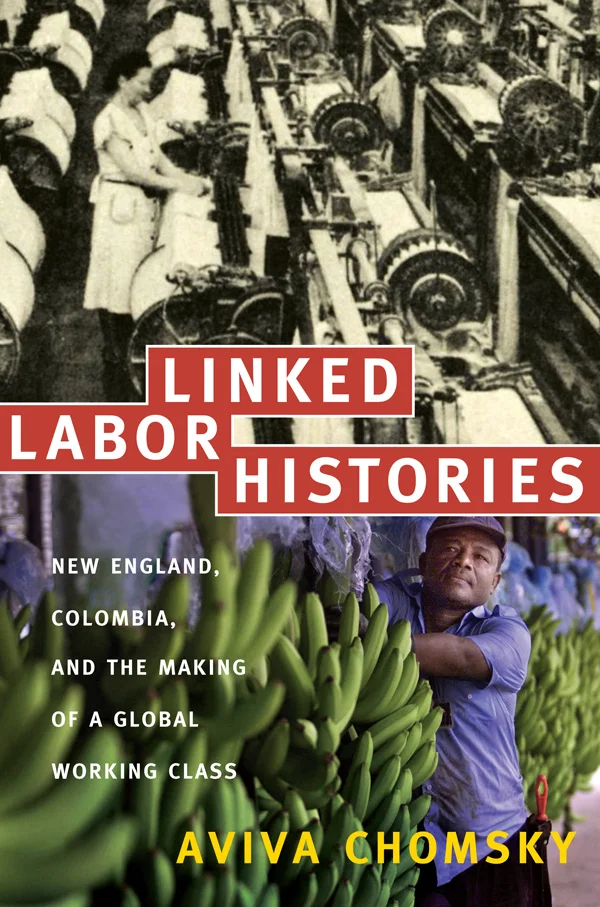
“Linked Labor Histories, which won the Best Book Award from the New England Council on Latin American Studies in 2009, deserves careful reading for the force of its arguments and the novelty of its approach.” - Seth Kershner, Historical Journal of Massachusetts
“[A] rousing call to consider globalization from the perspective of those who bear the brunt of its weight, and a stark reminder of the need to build farther-reaching coalitions with which to stand against its insidious influence.” - Sebastián Ramírez Hernandez, Journal of Latin American and Caribbean Anthropology
“[An} ambitious volume. . . . Aviva Chomsky makes a compelling case for studying immigration and capital flight as two sides of the same coin.” - Altha Cravey, Journal of American History
“[Chomsky] goes well beyond producing a merely comparative exercise. We are offered instead an in-depth analysis of the actual labour processes under consideration. . . . Overall, Linked Labor Histories is a fascinating text that will be of interest to people concerned about politics in the Americas and that will appeal to those concerned about labour history and processes of globalization from a labour-centric perspective.” - Robert O’Brien, Canadian Journal of Latin American and Caribbean Studies
“By looking at globalization from the perspective of labor history, and labor history through the lens of globalization, Aviva Chomsky transforms our understanding of both. The result is not only a wonderfully rich and detailed look at particular times and places, but a path-breaking study that forces us to rethink how we understand the Americas as a whole. Students, scholars, labor leaders, and activists should all read this compelling book.” - Steve Striffler, EIAL
“Chomsky’s book represents an important attempt both to understand the history of capital and labor in the United States and Latin America and to look at labor’s strategic responses to capital. Her book makes an important contribution to the literature on globalization and on labor union movements in the Americas. University and public libraries should make this book part of their collection, and labor activists and those concerned with issues of social justice will want to put this book on their reading lists.” - Dan La Botz, Dialectical Anthropology
“Chomsky’s study provides very interesting insights into the workings of American imperial expansion over the course of the twentieth century.” - Cary Fraser, Hispanic American Historical Review
“In Chomsky’s book, narrative takes second place to the fierce urgency, activist energy, and bracing anger with which she crafts hard-hitting vignettes that establish surprising connections between working people and capital in two very different countries.” - John D. French, Radical History Review
“The ambitious linkage of Colombia’s and New England’s labor histories is sustained by her understanding of the nature of capitalism. [Chomsky’s] approach is thought-provoking and reminiscent of the work of Charles W. Bergquist, though with much greater attention to the struggles of local activists. This book merits a close reading and, one hopes, will inspire others to undertake similar studies.” - David Sowell, American Historical Review
“By looking at globalization from the perspective of labor history, and labor history through the lens of globalization, Aviva Chomsky transforms our understanding of both. In Chomsky’s hands, global labor history becomes a compelling tool for understanding and challenging the social inequalities that capitalism creates and depends on. The result is not only a wonderfully rich and detailed look at particular places and times, but a pathbreaking study that forces us to rethink how we understand the Americas as a whole. Students, scholars, labor leaders, and activists should all read this magnificent book.” - Steve Striffler, author of In the Shadows of State and Capital
“The early-twentieth-century export of Draper looms from Hopedale, Massachusetts, to Medellin’s domestic textile industry sets the stage for a remarkably creative transnational study, documenting the eerie connection between the fates of both American and Colombian working people. Aviva Chomsky jumps skillfully across time and space to link capital flight and the early globalization of the New England textile industry to patterns of low-wage international immigration, even as she dissects the role of the United States (at times aided by American trade unions) in the suppression of Colombian labor radicalism.” - Leon Fink, author of The Maya of Morganton: Work and Community in the Nuevo New South
“Linked Labor Histories clearly establishes Chomsky as one of the foremost innovative labour historians of América—North and South.” - David C. Carlson, Canadian Journal of History
“Linked Labor Histories is a book with a story that scholars can certainly learn from, but it has an even more important message to concerned citizens and labour activists about the necessity of building a movement that confronts globalisation with global strategies.” - James P. Brennan, Journal of Latin American Studies
“Linked Labor Histories is an informative, thought-provoking explanation of how workers’ struggles within the imperialist centers are linked to those in countries dominated by imperialism.” - Ted Zuur, Socialism and Democracy